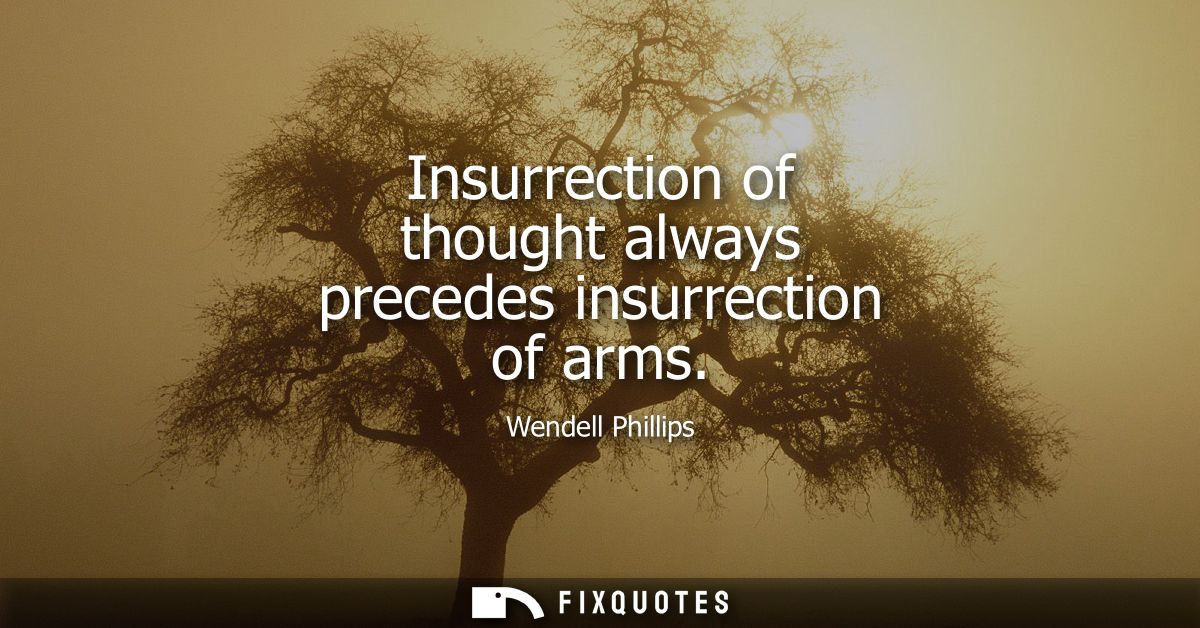
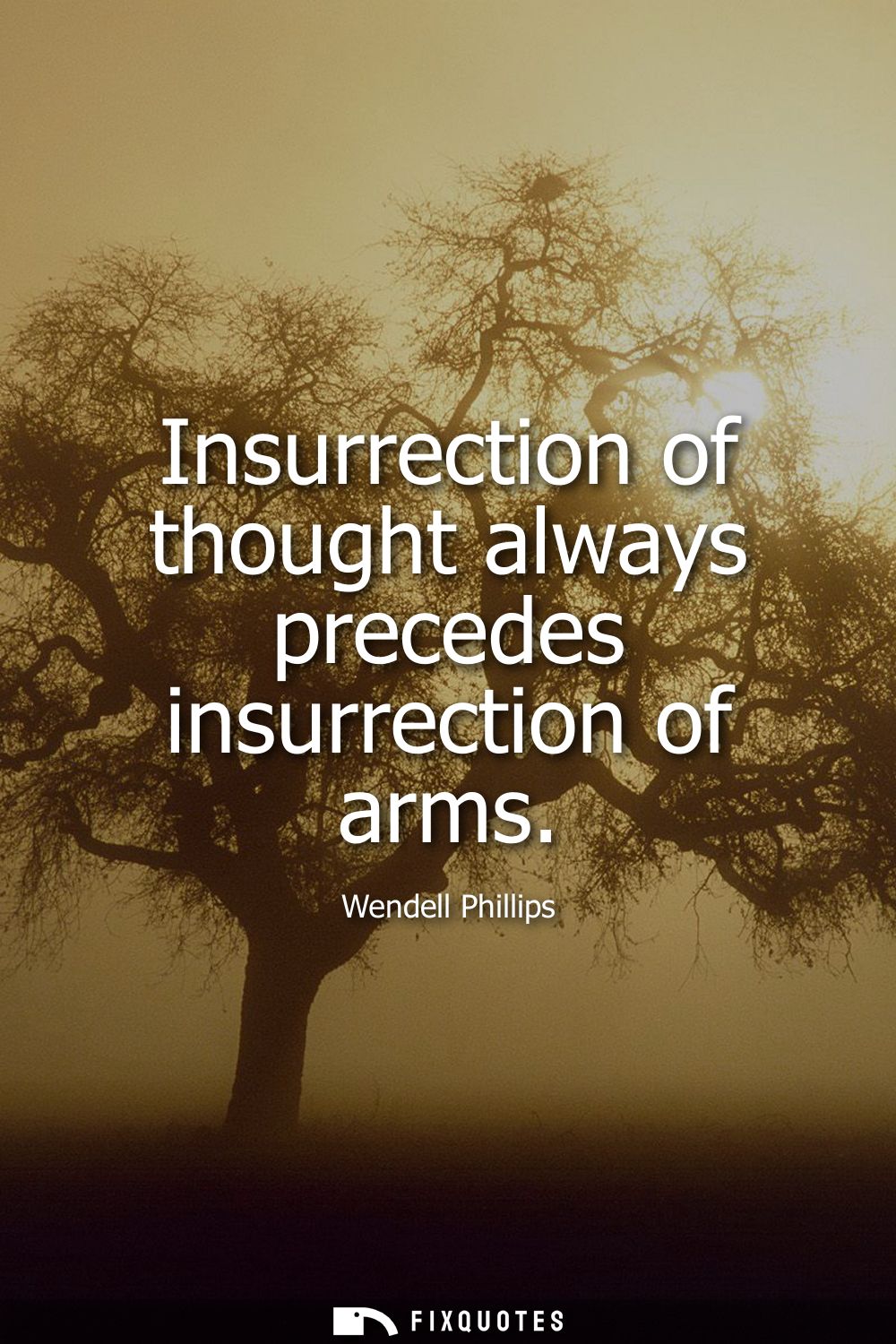
"Insurrection of thought always precedes insurrection of arms"
About this Quote
Phillips is smuggling a radical idea into a clean, almost procedural sentence: revolutions don’t begin with gunfire; they begin with permission. “Always” is doing the heavy lifting, insisting that violence is not the origin story but the late-stage symptom. By framing rebellion as an “insurrection of thought,” he recasts dissent as something organized, collective, and contagious - not mere private opinion, but a mass shift in what people consider tolerable.
The subtext is a defense strategy and a provocation at once. In Phillips’s America, where abolitionists were branded as fanatics and sometimes met with mobs, he’s arguing that the real threat to the status quo is speech, persuasion, and moral reframing. If authorities fear pamphlets and sermons, it’s because those tools rewire legitimacy. Once the public mind changes, the state’s monopoly on “order” starts to look like coercion, and coercion invites resistance.
Context sharpens the edge. Phillips was a fierce abolitionist during the decades when slavery was legally protected and violently enforced. The Civil War did not erupt out of nowhere; it followed years of ideological agitation: newspapers, lecture circuits, church schisms, party realignments, and the slow delegitimizing of slavery in the North. Phillips’s line is also a warning to power: suppressing debate won’t prevent upheaval; it simply delays it until only blunt instruments remain. The sentence reads calm, but it’s a countdown.
The subtext is a defense strategy and a provocation at once. In Phillips’s America, where abolitionists were branded as fanatics and sometimes met with mobs, he’s arguing that the real threat to the status quo is speech, persuasion, and moral reframing. If authorities fear pamphlets and sermons, it’s because those tools rewire legitimacy. Once the public mind changes, the state’s monopoly on “order” starts to look like coercion, and coercion invites resistance.
Context sharpens the edge. Phillips was a fierce abolitionist during the decades when slavery was legally protected and violently enforced. The Civil War did not erupt out of nowhere; it followed years of ideological agitation: newspapers, lecture circuits, church schisms, party realignments, and the slow delegitimizing of slavery in the North. Phillips’s line is also a warning to power: suppressing debate won’t prevent upheaval; it simply delays it until only blunt instruments remain. The sentence reads calm, but it’s a countdown.
Quote Details
| Topic | Freedom |
|---|---|
| Source | Help us find the source |
| Cite |
Citation Formats
APA Style (7th ed.)
Phillips, Wendell. (2026, January 15). Insurrection of thought always precedes insurrection of arms. FixQuotes. https://fixquotes.com/quotes/insurrection-of-thought-always-precedes-150200/
Chicago Style
Phillips, Wendell. "Insurrection of thought always precedes insurrection of arms." FixQuotes. January 15, 2026. https://fixquotes.com/quotes/insurrection-of-thought-always-precedes-150200/.
MLA Style (9th ed.)
"Insurrection of thought always precedes insurrection of arms." FixQuotes, 15 Jan. 2026, https://fixquotes.com/quotes/insurrection-of-thought-always-precedes-150200/. Accessed 25 Mar. 2026.
More Quotes by Wendell
Add to List