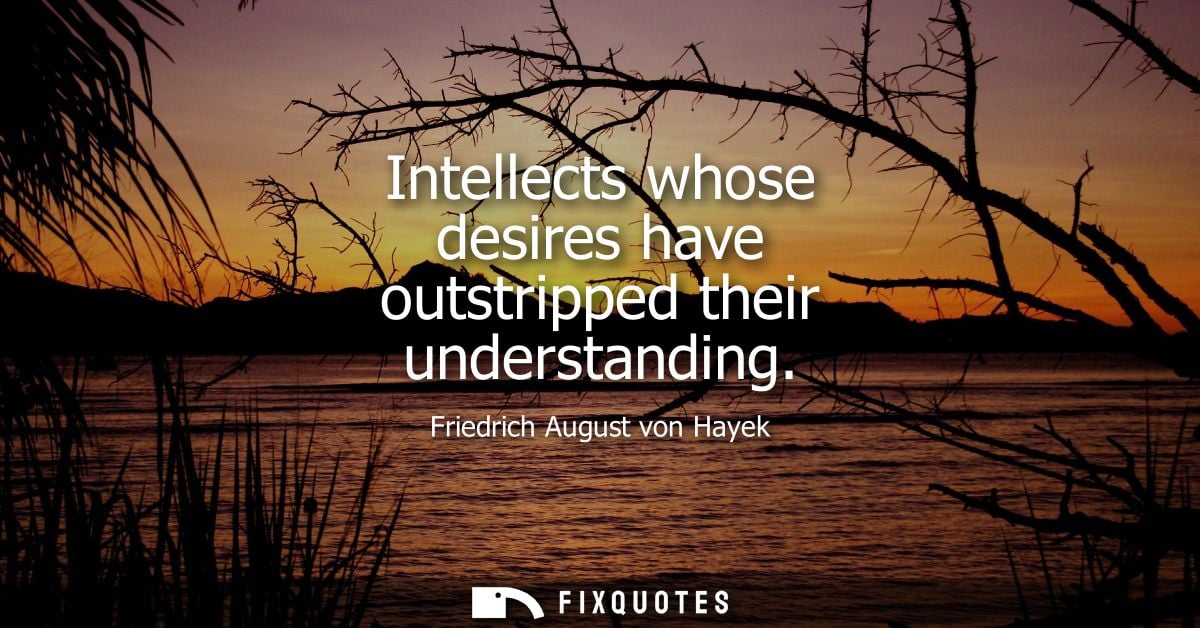
"Intellects whose desires have outstripped their understanding"
About this Quote
Hayek’s phrase is a scalpel aimed at a certain kind of modern confidence: the reformer or planner whose appetite for sweeping outcomes runs ahead of what they can actually know. “Desires” isn’t just wanting nice things; it’s the political and moral urge to fix society, smooth inequality, eliminate chaos. “Understanding” is the hard constraint: dispersed information, unintended consequences, feedback loops no committee can fully map. The line works because it doesn’t accuse these people of evil. It accuses them of a mismatch - a psychological imbalance between ambition and epistemic humility.
The subtext is Hayek’s broader suspicion of what he elsewhere framed as the “pretense of knowledge.” In market societies, knowledge is fragmented across millions of actors, embedded in prices, habits, local conditions. Central direction isn’t merely inefficient; it’s structurally blind. So the “outstripped” verb lands like a warning label: desire accelerates; understanding lags; policy becomes a high-speed vehicle driven by a partial map.
Context matters: Hayek is writing in the shadow of 20th-century planning - wartime economies, socialist projects, technocratic managerialism - moments when state capacity looked newly powerful and moral certainty felt like a substitute for information. The sting is that he’s also diagnosing intellectual culture: smart people seduced by elegant models and the romance of control.
It’s a line that flatters nobody. It implies that the danger isn’t ignorance in the street, but overconfidence in the seminar room - when brilliance becomes a permission slip to redesign what it hasn’t fully bothered to understand.
The subtext is Hayek’s broader suspicion of what he elsewhere framed as the “pretense of knowledge.” In market societies, knowledge is fragmented across millions of actors, embedded in prices, habits, local conditions. Central direction isn’t merely inefficient; it’s structurally blind. So the “outstripped” verb lands like a warning label: desire accelerates; understanding lags; policy becomes a high-speed vehicle driven by a partial map.
Context matters: Hayek is writing in the shadow of 20th-century planning - wartime economies, socialist projects, technocratic managerialism - moments when state capacity looked newly powerful and moral certainty felt like a substitute for information. The sting is that he’s also diagnosing intellectual culture: smart people seduced by elegant models and the romance of control.
It’s a line that flatters nobody. It implies that the danger isn’t ignorance in the street, but overconfidence in the seminar room - when brilliance becomes a permission slip to redesign what it hasn’t fully bothered to understand.
Quote Details
| Topic | Wisdom |
|---|---|
| Source | Help us find the source |
| Cite |
Citation Formats
APA Style (7th ed.)
Hayek, Friedrich August von. (2026, January 18). Intellects whose desires have outstripped their understanding. FixQuotes. https://fixquotes.com/quotes/intellects-whose-desires-have-outstripped-their-22669/
Chicago Style
Hayek, Friedrich August von. "Intellects whose desires have outstripped their understanding." FixQuotes. January 18, 2026. https://fixquotes.com/quotes/intellects-whose-desires-have-outstripped-their-22669/.
MLA Style (9th ed.)
"Intellects whose desires have outstripped their understanding." FixQuotes, 18 Jan. 2026, https://fixquotes.com/quotes/intellects-whose-desires-have-outstripped-their-22669/. Accessed 5 Mar. 2026.
More Quotes by Friedrich
Add to List