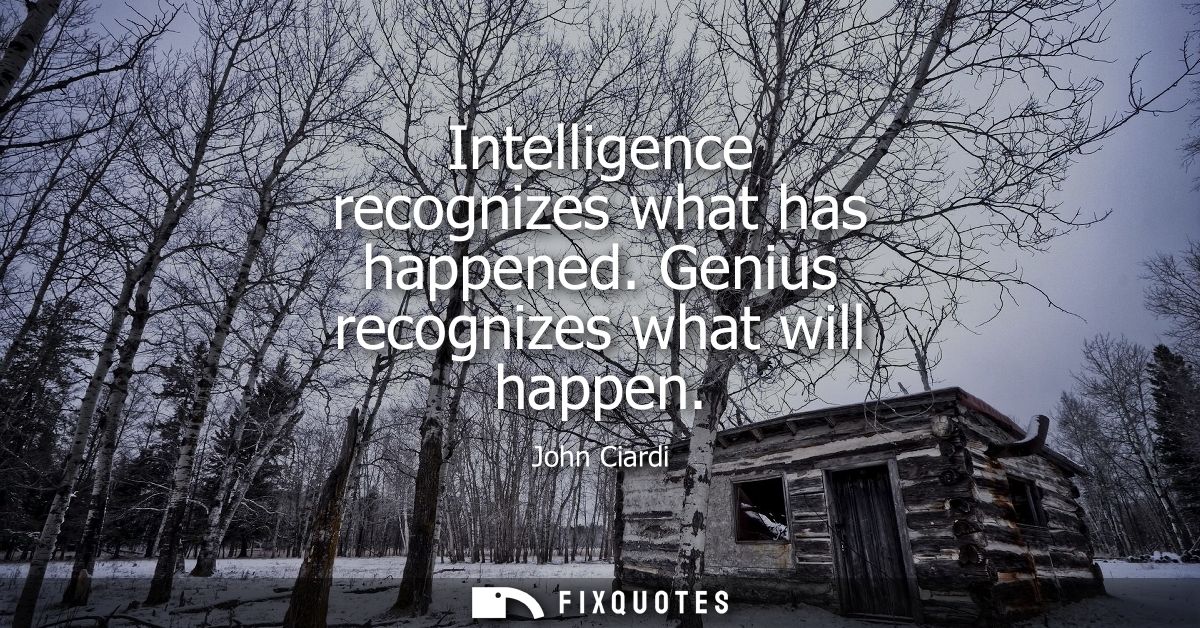
"Intelligence recognizes what has happened. Genius recognizes what will happen"
About this Quote
The subtext is also a critique of credentialed competence. "Recognizes what has happened" conjures the expert who explains yesterday with perfect clarity, armed with data and hindsight. Useful, but bloodless. "Recognizes what will happen" implies not prophecy so much as pattern literacy: the ability to feel the trajectory of a situation before it becomes obvious, to anticipate consequences, to read human behavior as if it were dialogue heading toward a reveal. It’s the difference between being a skilled critic and being an artist who can design the twist.
Context matters because the line echoes a mid-century American fixation on innovation and futurity, when "genius" was increasingly romanticized as the engine of progress, not just a high IQ. Ciardi’s formulation sells that romance while dodging mysticism: genius is framed as recognition, not magic. The sting is that it raises the bar from being right to being early, from understanding the world to steering it.
Quote Details
| Topic | Wisdom |
|---|---|
| Source | Help us find the source |
| Cite |
Citation Formats
APA Style (7th ed.)
Ciardi, John. (2026, January 17). Intelligence recognizes what has happened. Genius recognizes what will happen. FixQuotes. https://fixquotes.com/quotes/intelligence-recognizes-what-has-happened-genius-27697/
Chicago Style
Ciardi, John. "Intelligence recognizes what has happened. Genius recognizes what will happen." FixQuotes. January 17, 2026. https://fixquotes.com/quotes/intelligence-recognizes-what-has-happened-genius-27697/.
MLA Style (9th ed.)
"Intelligence recognizes what has happened. Genius recognizes what will happen." FixQuotes, 17 Jan. 2026, https://fixquotes.com/quotes/intelligence-recognizes-what-has-happened-genius-27697/. Accessed 6 Mar. 2026.