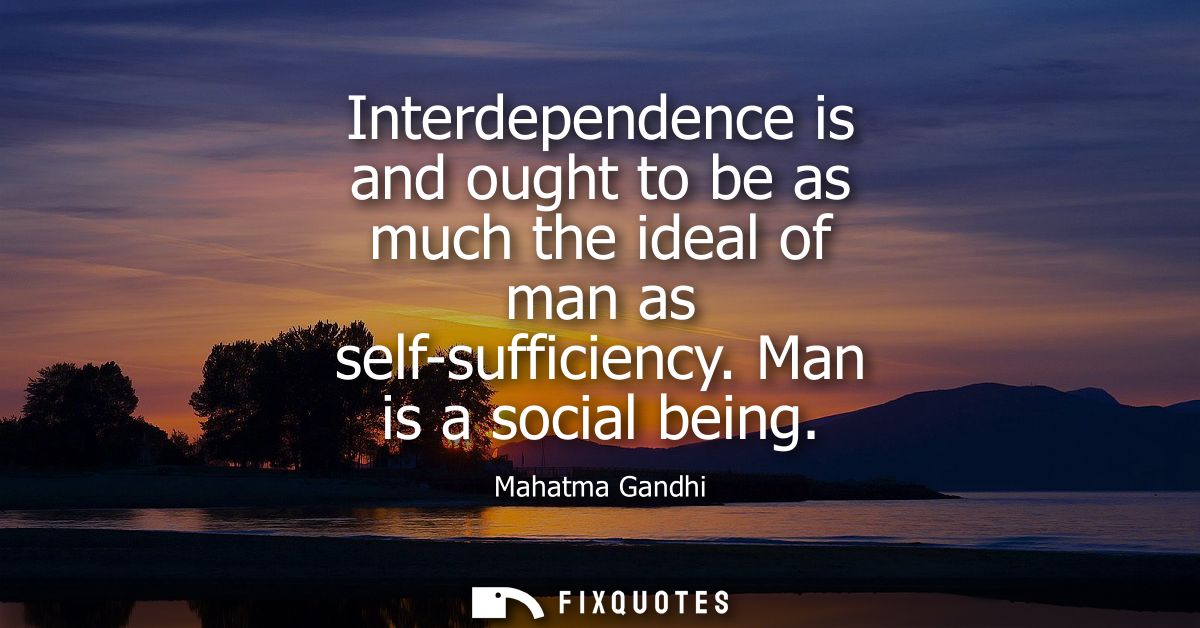
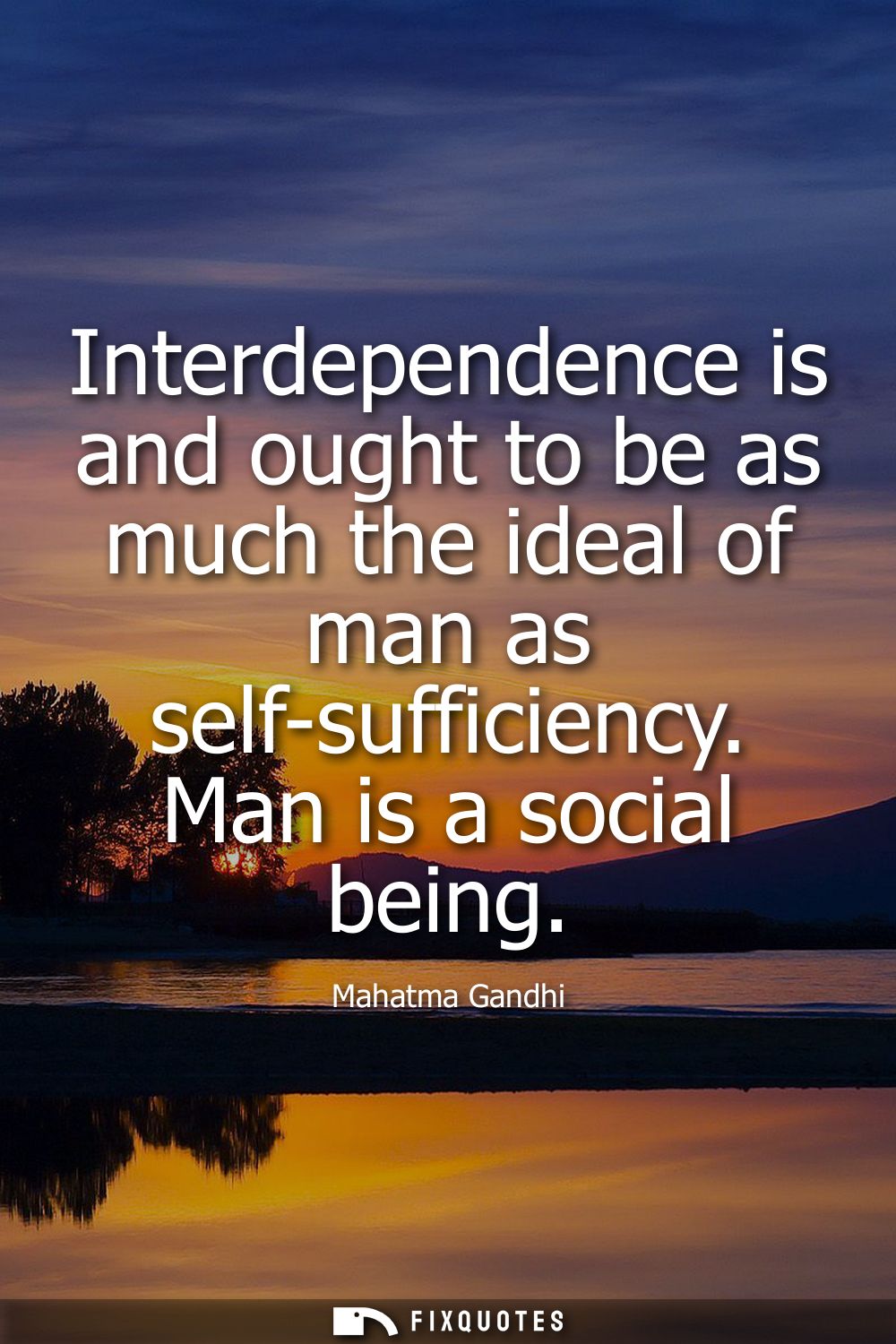
"Interdependence is and ought to be as much the ideal of man as self-sufficiency. Man is a social being"
About this Quote
Gandhi is quietly detonating a prized modern fantasy: that the highest form of freedom is needing no one. By pairing “is” with “ought to be,” he makes interdependence both a description of human life and a moral demand. It’s not sentimental. It’s strategic. The line insists that dependence isn’t a personal failure to overcome; it’s the raw material of ethical and political life.
The rhetorical move is in the symmetry. “Self-sufficiency” gets its due as an “ideal,” but Gandhi refuses to let it stand alone, as if virtue were a solo sport. Interdependence is elevated to equal status, which subtly reframes strength: the strong are those who can give, receive, and remain accountable inside a web of mutual obligations. That’s a direct rebuke to imperial logic, which celebrates autonomy for the colonizer while enforcing dependency on the colonized. It also pokes at industrial modernity’s promise that markets and machines can replace community.
Context matters: Gandhi’s politics were built on mass participation, disciplined nonviolence, and local economic practices (think swadeshi) that relied on collective restraint and shared risk. “Man is a social being” is less a textbook observation than a warning label. If you pretend you’re self-made, you’ll design societies that reward extraction, punish vulnerability, and call it progress. If you admit interdependence, you’re forced into a harder question: what do we owe one another, and what kinds of independence are actually compatible with human dignity?
The rhetorical move is in the symmetry. “Self-sufficiency” gets its due as an “ideal,” but Gandhi refuses to let it stand alone, as if virtue were a solo sport. Interdependence is elevated to equal status, which subtly reframes strength: the strong are those who can give, receive, and remain accountable inside a web of mutual obligations. That’s a direct rebuke to imperial logic, which celebrates autonomy for the colonizer while enforcing dependency on the colonized. It also pokes at industrial modernity’s promise that markets and machines can replace community.
Context matters: Gandhi’s politics were built on mass participation, disciplined nonviolence, and local economic practices (think swadeshi) that relied on collective restraint and shared risk. “Man is a social being” is less a textbook observation than a warning label. If you pretend you’re self-made, you’ll design societies that reward extraction, punish vulnerability, and call it progress. If you admit interdependence, you’re forced into a harder question: what do we owe one another, and what kinds of independence are actually compatible with human dignity?
Quote Details
| Topic | Ethics & Morality |
|---|
More Quotes by Mahatma
Add to List