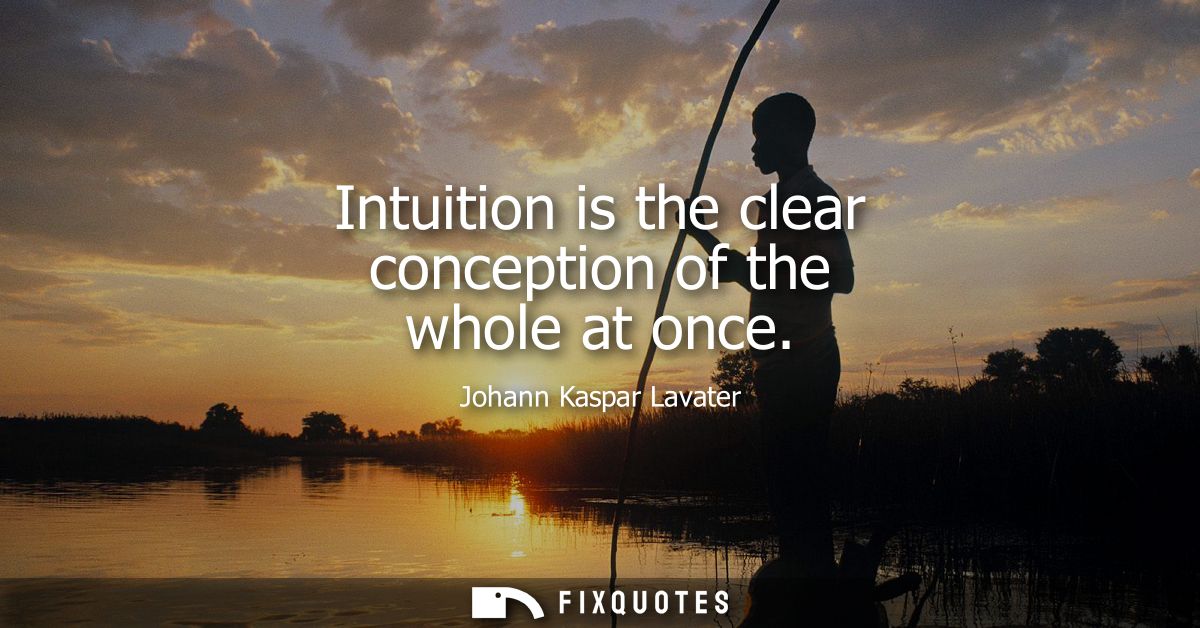
"Intuition is the clear conception of the whole at once"
About this Quote
Lavater’s line sells intuition as a kind of spiritual optics: not a hunch, not a lucky guess, but “the clear conception of the whole at once.” The phrasing is doing quiet polemical work. “Clear” borrows the authority of rational clarity, while “at once” denies the step-by-step method that Enlightenment thinkers increasingly treated as the gold standard for truth. He’s threading a needle between reason and revelation, claiming intuition can feel as crisp as logic yet arrive without logic’s visible scaffolding.
As an 18th-century Swiss theologian best known for physiognomy and religious writing, Lavater lived in a culture obsessed with reading hidden interiors from outward signs, and with defending the soul’s immediacy against the era’s mechanical explanations of human nature. “The whole” matters here: intuition isn’t just about spotting a detail; it’s about apprehending a total pattern, the way a believer might grasp providence in a life story or a moral character in a face. That’s the subtext: the world is coherent enough to be taken in as a unity, and humans have a faculty tuned to that coherence.
The intent is also disciplinary. By defining intuition as “conception” rather than “feeling,” Lavater legitimizes it for educated readers who distrust mysticism. He smuggles a theological anthropology into a seemingly neutral definition: there is, in us, a capacity for instantaneous wholeness that mirrors a world authored, not random. Intuition becomes a credentialed form of knowing, not a guilty pleasure.
As an 18th-century Swiss theologian best known for physiognomy and religious writing, Lavater lived in a culture obsessed with reading hidden interiors from outward signs, and with defending the soul’s immediacy against the era’s mechanical explanations of human nature. “The whole” matters here: intuition isn’t just about spotting a detail; it’s about apprehending a total pattern, the way a believer might grasp providence in a life story or a moral character in a face. That’s the subtext: the world is coherent enough to be taken in as a unity, and humans have a faculty tuned to that coherence.
The intent is also disciplinary. By defining intuition as “conception” rather than “feeling,” Lavater legitimizes it for educated readers who distrust mysticism. He smuggles a theological anthropology into a seemingly neutral definition: there is, in us, a capacity for instantaneous wholeness that mirrors a world authored, not random. Intuition becomes a credentialed form of knowing, not a guilty pleasure.
Quote Details
| Topic | Wisdom |
|---|---|
| Source | Help us find the source |
| Cite |
Citation Formats
APA Style (7th ed.)
Lavater, Johann Kaspar. (2026, January 14). Intuition is the clear conception of the whole at once. FixQuotes. https://fixquotes.com/quotes/intuition-is-the-clear-conception-of-the-whole-at-22692/
Chicago Style
Lavater, Johann Kaspar. "Intuition is the clear conception of the whole at once." FixQuotes. January 14, 2026. https://fixquotes.com/quotes/intuition-is-the-clear-conception-of-the-whole-at-22692/.
MLA Style (9th ed.)
"Intuition is the clear conception of the whole at once." FixQuotes, 14 Jan. 2026, https://fixquotes.com/quotes/intuition-is-the-clear-conception-of-the-whole-at-22692/. Accessed 7 Feb. 2026.
More Quotes by Johann
Add to List