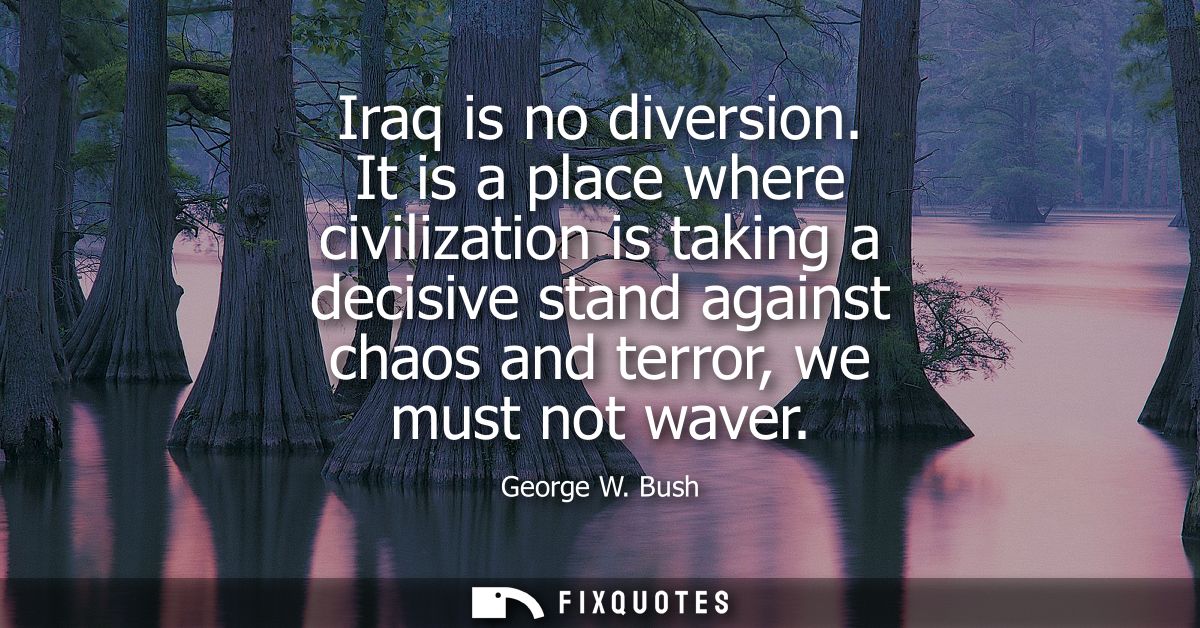
"Iraq is no diversion. It is a place where civilization is taking a decisive stand against chaos and terror, We must not waver"
About this Quote
The phrase “decisive stand” does heavy rhetorical lifting. It promises clarity where events on the ground were messy: insurgency, sectarian violence, shifting rationales. Bush compresses all that ambiguity into an old, reliable binary: order versus “chaos and terror.” That pairing isn’t descriptive so much as moralizing. “Chaos” turns Iraqi political reality into an elemental threat; “terror” ties the war to the post-9/11 emotional register. Together, they make disagreement feel like appeasement.
The subtext is as much domestic as foreign. “We must not waver” isn’t directed at Saddam’s remnants or militias; it’s aimed at Americans watching casualty counts rise and patience fall. It converts skepticism into weakness and persistence into virtue, a classic wartime move that polices the boundaries of acceptable debate.
Context matters: by casting Iraq as the front line of “civilization,” Bush tries to retrofit a coherent purpose onto a conflict whose justifications had shifted. The sentence is less a map of Iraq than a map of political necessity: hold the coalition together, stiffen public resolve, and keep the war inside the moral frame that 9/11 made available.
Quote Details
| Topic | War |
|---|---|
| Source | Help us find the source |
| Cite |
Citation Formats
APA Style (7th ed.)
Bush, George W. (2026, February 20). Iraq is no diversion. It is a place where civilization is taking a decisive stand against chaos and terror, We must not waver. FixQuotes. https://fixquotes.com/quotes/iraq-is-no-diversion-it-is-a-place-where-7279/
Chicago Style
Bush, George W. "Iraq is no diversion. It is a place where civilization is taking a decisive stand against chaos and terror, We must not waver." FixQuotes. February 20, 2026. https://fixquotes.com/quotes/iraq-is-no-diversion-it-is-a-place-where-7279/.
MLA Style (9th ed.)
"Iraq is no diversion. It is a place where civilization is taking a decisive stand against chaos and terror, We must not waver." FixQuotes, 20 Feb. 2026, https://fixquotes.com/quotes/iraq-is-no-diversion-it-is-a-place-where-7279/. Accessed 15 Mar. 2026.