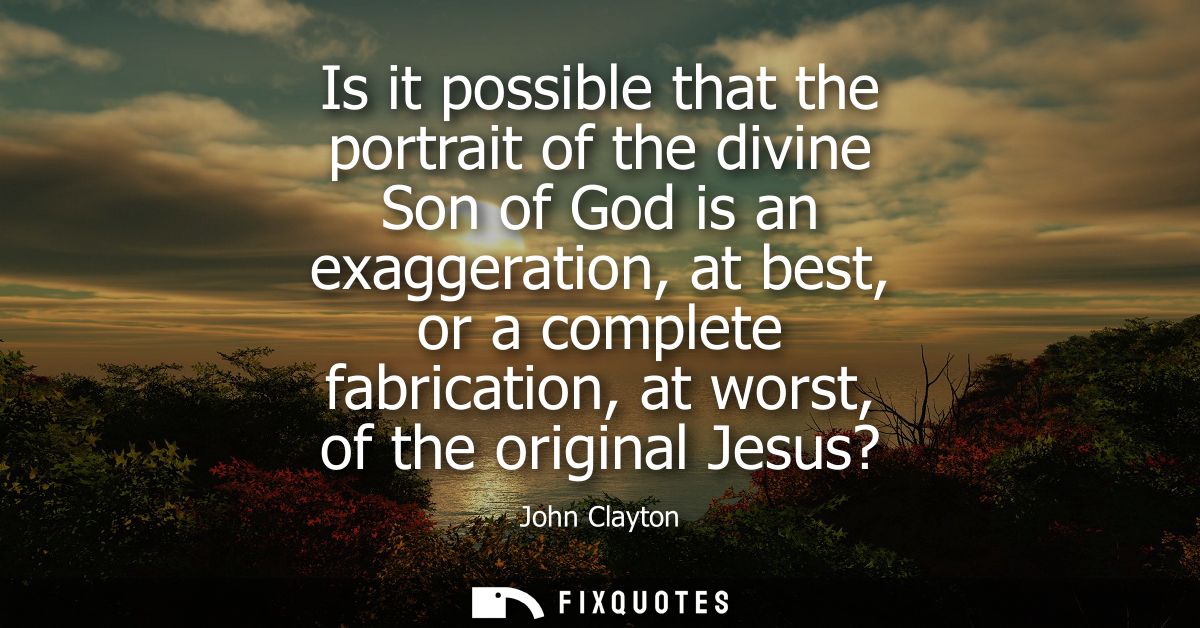
"Is it possible that the portrait of the divine Son of God is an exaggeration, at best, or a complete fabrication, at worst, of the original Jesus?"
About this Quote
The sentence is built as a trapdoor. “Is it possible” performs a kind of rhetorical politeness, but the range he offers (“exaggeration” to “complete fabrication”) quietly narrows the acceptable outcomes. Even the mild option concedes inflation; the harsh option implies a deliberate myth-making project. Either way, the divine claim becomes a story problem, not a faith claim.
Subtextually, Clayton is inviting the modern reader to treat early Christianity like any other institution with branding needs. The “original Jesus” is cast as a recoverable figure buried under layers: gospel narration, Pauline interpretation, church politics, translation choices, centuries of devotional art. That’s not accidental; it mirrors how contemporary audiences are trained to read media - behind the image, find the incentives.
Context matters because this is the classic historical-Jesus pressure point: the gap between a first-century Jewish teacher and the cosmic Christ of creeds. Clayton’s intent isn’t merely to shock believers; it’s to legitimize doubt as a rational posture. The question is less about answering and more about granting permission to reopen a case many traditions declare closed.
Quote Details
| Topic | God |
|---|---|
| Source | Help us find the source |
| Cite |
Citation Formats
APA Style (7th ed.)
Clayton, John. (2026, January 16). Is it possible that the portrait of the divine Son of God is an exaggeration, at best, or a complete fabrication, at worst, of the original Jesus? FixQuotes. https://fixquotes.com/quotes/is-it-possible-that-the-portrait-of-the-divine-86600/
Chicago Style
Clayton, John. "Is it possible that the portrait of the divine Son of God is an exaggeration, at best, or a complete fabrication, at worst, of the original Jesus?" FixQuotes. January 16, 2026. https://fixquotes.com/quotes/is-it-possible-that-the-portrait-of-the-divine-86600/.
MLA Style (9th ed.)
"Is it possible that the portrait of the divine Son of God is an exaggeration, at best, or a complete fabrication, at worst, of the original Jesus?" FixQuotes, 16 Jan. 2026, https://fixquotes.com/quotes/is-it-possible-that-the-portrait-of-the-divine-86600/. Accessed 30 Mar. 2026.