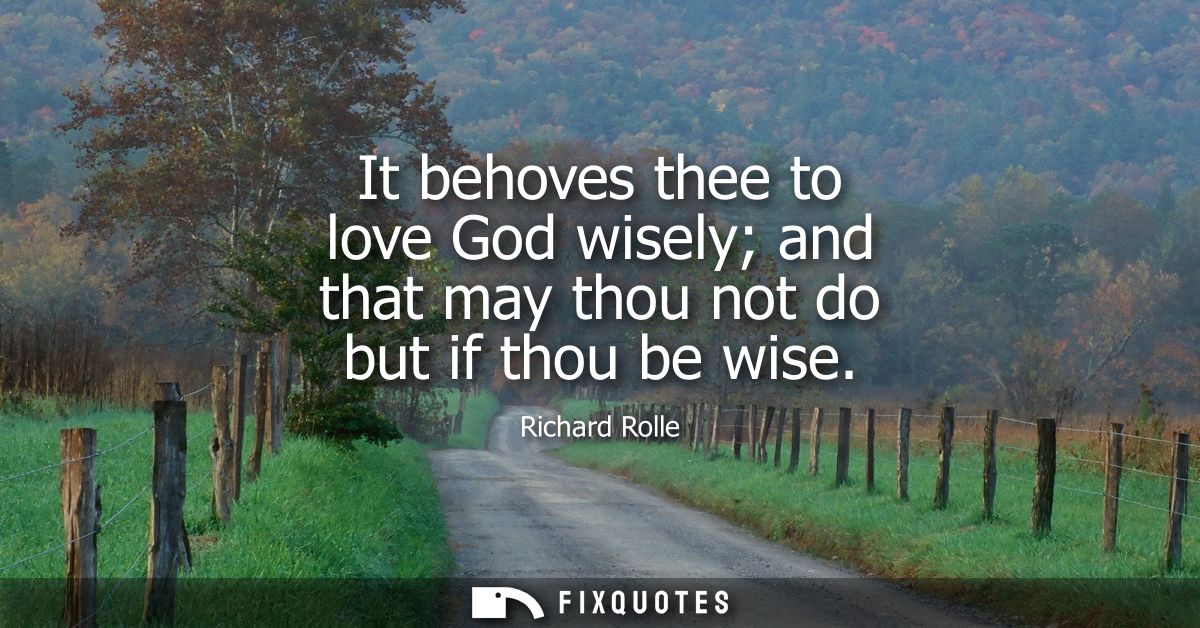
"It behoves thee to love God wisely; and that may thou not do, but if thou be wise"
About this Quote
The phrasing also exposes a medieval psychology in which love is not merely emotion but a moral and intellectual act. To love "wisely" is to love in right order: with discernment, humility, and a trained attention that doesn’t collapse into superstition or self-indulgent ecstasy. Rolle, a 14th-century English mystic, wrote for a culture saturated with devotion but also riddled with anxiety about spiritual error. Heresy trials, vernacular religion, and competing claims to revelation made "wisdom" a safeguard. The sentence quietly asserts authority: authentic love of God requires formation, not just enthusiasm.
Subtextually, Rolle is staking out a middle path between cold scholasticism and reckless zeal. He wants a love that is intelligent enough to resist fantasy, and wise enough to avoid turning God into a mirror for your own desires. In a single line, he makes devotion accountable.
Quote Details
| Topic | God |
|---|---|
| Source | Help us find the source |
| Cite |
Citation Formats
APA Style (7th ed.)
Rolle, Richard. (2026, February 18). It behoves thee to love God wisely; and that may thou not do, but if thou be wise. FixQuotes. https://fixquotes.com/quotes/it-behoves-thee-to-love-god-wisely-and-that-may-89884/
Chicago Style
Rolle, Richard. "It behoves thee to love God wisely; and that may thou not do, but if thou be wise." FixQuotes. February 18, 2026. https://fixquotes.com/quotes/it-behoves-thee-to-love-god-wisely-and-that-may-89884/.
MLA Style (9th ed.)
"It behoves thee to love God wisely; and that may thou not do, but if thou be wise." FixQuotes, 18 Feb. 2026, https://fixquotes.com/quotes/it-behoves-thee-to-love-god-wisely-and-that-may-89884/. Accessed 5 Mar. 2026.