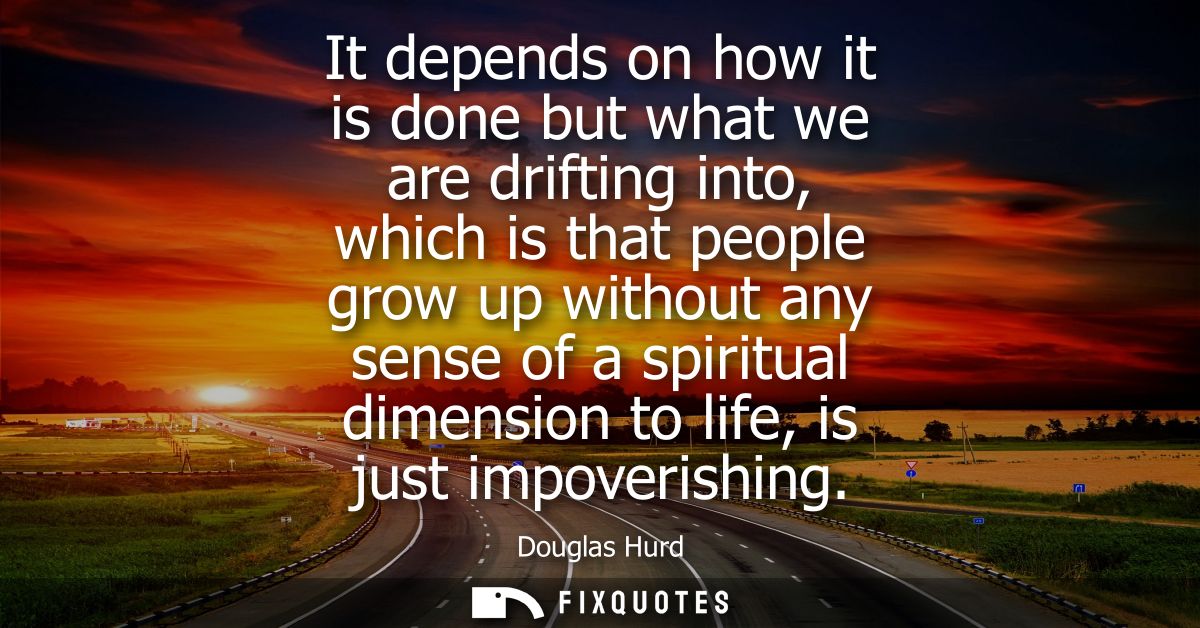
"It depends on how it is done, but what we are drifting into, which is that people grow up without any sense of a spiritual dimension to life, is just impoverishing"
About this Quote
The deeper move is how he describes the change: “drifting.” That verb denies villainy and design. No conspirators, no militant secularists storming the gates - just a slow, frictionless slide into thinness. Drift suggests institutional neglect: schools that teach skills but not meaning, public life that prizes productivity over purpose, a consumer culture that gives constant stimulation while starving the inner life. The subtext is generational: “people grow up” implies the loss is baked in early, before anyone can choose otherwise.
As a late-20th-century British Conservative with a patrician, establishment sensibility, Hurd is speaking from a world where churches once doubled as community infrastructure and moral language was shared even by the not-especially-devout. His worry isn’t damnation; it’s deprivation - fewer rituals to mark grief and joy, less vocabulary for duty and transcendence, more loneliness disguised as freedom. The line works because it recasts spirituality as public ecology: remove it, and life still functions, but the air gets noticeably thinner.
Quote Details
| Topic | Faith |
|---|---|
| Source | Help us find the source |
| Cite |
Citation Formats
APA Style (7th ed.)
Hurd, Douglas. (2026, February 19). It depends on how it is done, but what we are drifting into, which is that people grow up without any sense of a spiritual dimension to life, is just impoverishing. FixQuotes. https://fixquotes.com/quotes/it-depends-on-how-it-is-done-but-what-we-are-51497/
Chicago Style
Hurd, Douglas. "It depends on how it is done, but what we are drifting into, which is that people grow up without any sense of a spiritual dimension to life, is just impoverishing." FixQuotes. February 19, 2026. https://fixquotes.com/quotes/it-depends-on-how-it-is-done-but-what-we-are-51497/.
MLA Style (9th ed.)
"It depends on how it is done, but what we are drifting into, which is that people grow up without any sense of a spiritual dimension to life, is just impoverishing." FixQuotes, 19 Feb. 2026, https://fixquotes.com/quotes/it-depends-on-how-it-is-done-but-what-we-are-51497/. Accessed 30 Mar. 2026.