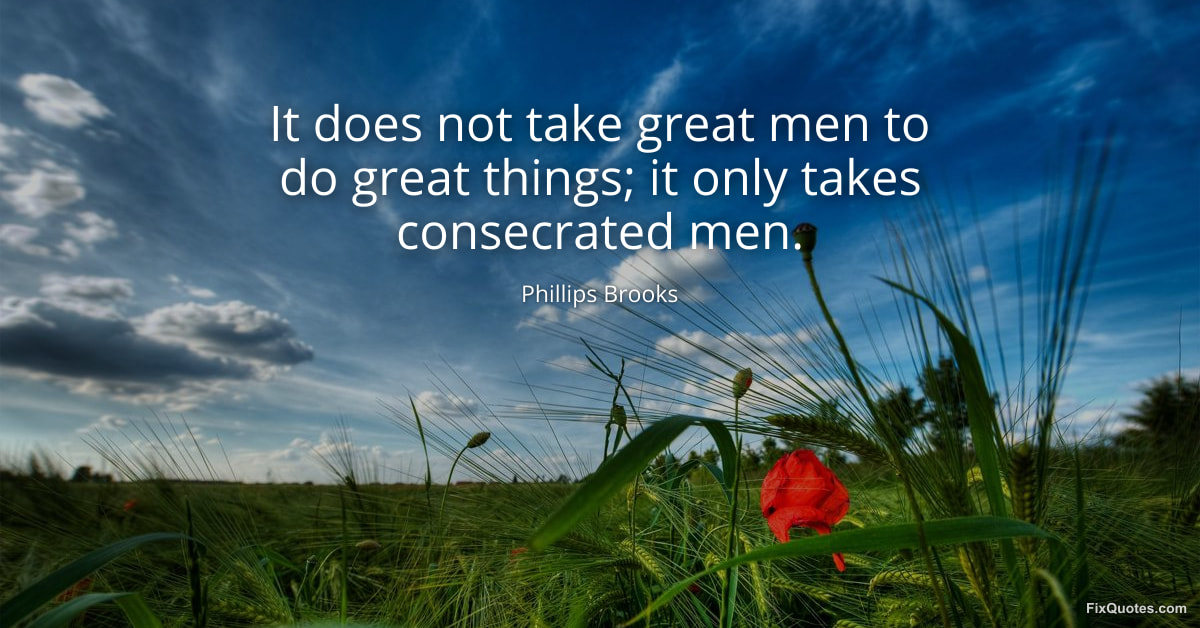
"It does not take great men to do great things; it only takes consecrated men"
About this Quote
As a 19th-century American clergyman preaching amid industrial expansion, widening inequality, and rising confidence in “self-made” masculinity, Brooks is also pushing against the era’s secular success mythology. His claim is countercultural: the engine of change is not brilliance but devotion, not exceptional personality but disciplined alignment. That’s why the sentence is structured like a sermon in miniature - first stripping away an excuse (“I’m not great”), then replacing it with a demanding alternative (“be consecrated”). It flatters no one. Consecration is harder than talent because it requires consistency, restraint, and a willingness to be used rather than celebrated.
The line also protects communities from the volatility of celebrity leadership. Great things, Brooks implies, should be reproducible - the product of committed people, not miraculous individuals.
Quote Details
| Topic | Faith |
|---|---|
| Source | Help us find the source |
| Cite |
Citation Formats
APA Style (7th ed.)
Brooks, Phillips. (2026, January 15). It does not take great men to do great things; it only takes consecrated men. FixQuotes. https://fixquotes.com/quotes/it-does-not-take-great-men-to-do-great-things-it-90530/
Chicago Style
Brooks, Phillips. "It does not take great men to do great things; it only takes consecrated men." FixQuotes. January 15, 2026. https://fixquotes.com/quotes/it-does-not-take-great-men-to-do-great-things-it-90530/.
MLA Style (9th ed.)
"It does not take great men to do great things; it only takes consecrated men." FixQuotes, 15 Jan. 2026, https://fixquotes.com/quotes/it-does-not-take-great-men-to-do-great-things-it-90530/. Accessed 12 Feb. 2026.