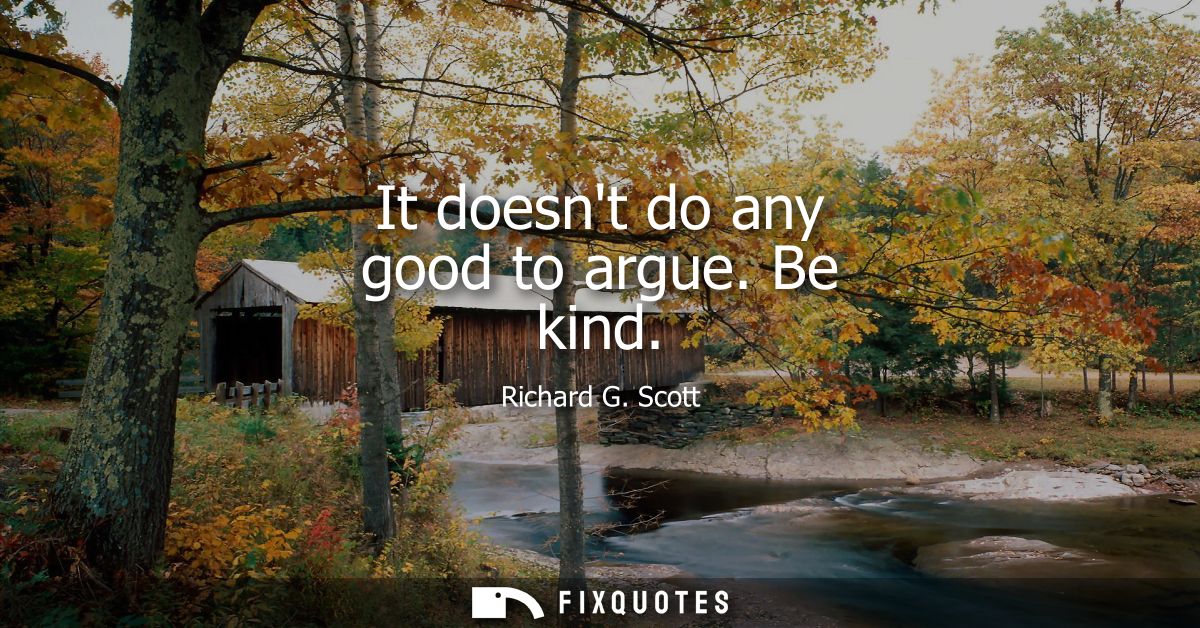
"It doesn't do any good to argue. Be kind"
About this Quote
There is a quiet power move in telling people that arguing “doesn’t do any good.” Richard G. Scott, speaking as a clergyman, isn’t merely offering conflict-avoidance advice; he’s sketching a moral hierarchy. “Argue” is framed as fruitless, ego-driven noise. “Be kind” becomes the higher, spiritually mature alternative - not a tactic, but a posture.
The phrasing matters. “Doesn’t do any good” is deliberately plain, almost domestic, like something said in a kitchen mid-disagreement. That simplicity smuggles in a claim about what counts as “good”: not winning, not being right, not performing cleverness, but protecting relationships and softening hearts. It’s pastoral rhetoric at its most effective: deflation rather than confrontation. By refusing to romanticize debate, Scott shifts the battleground from intellect to character.
The subtext is also institutional. Clergy often speak to communities where unity is a spiritual value and discord is seen as spiritually corrosive. In that context, “don’t argue” is less about silencing thought than about steering behavior away from pride, resentment, and the kind of grievance that metastasizes. It’s an ethic of de-escalation: if the goal is peace and mutual dignity, argument is a bad tool, even when your facts are correct.
Still, the line carries a tension modern readers will feel. Kindness can be a balm, but it can also be deployed as a leash, especially when “arguing” is how marginalized people name harm. The quote works because it’s both a comfort and a challenge: a call to choose the relational cost you’re willing to pay for being right.
The phrasing matters. “Doesn’t do any good” is deliberately plain, almost domestic, like something said in a kitchen mid-disagreement. That simplicity smuggles in a claim about what counts as “good”: not winning, not being right, not performing cleverness, but protecting relationships and softening hearts. It’s pastoral rhetoric at its most effective: deflation rather than confrontation. By refusing to romanticize debate, Scott shifts the battleground from intellect to character.
The subtext is also institutional. Clergy often speak to communities where unity is a spiritual value and discord is seen as spiritually corrosive. In that context, “don’t argue” is less about silencing thought than about steering behavior away from pride, resentment, and the kind of grievance that metastasizes. It’s an ethic of de-escalation: if the goal is peace and mutual dignity, argument is a bad tool, even when your facts are correct.
Still, the line carries a tension modern readers will feel. Kindness can be a balm, but it can also be deployed as a leash, especially when “arguing” is how marginalized people name harm. The quote works because it’s both a comfort and a challenge: a call to choose the relational cost you’re willing to pay for being right.
Quote Details
| Topic | Kindness |
|---|---|
| Source | Help us find the source |
| Cite |
Citation Formats
APA Style (7th ed.)
Scott, Richard G. (2026, January 16). It doesn't do any good to argue. Be kind. FixQuotes. https://fixquotes.com/quotes/it-doesnt-do-any-good-to-argue-be-kind-116035/
Chicago Style
Scott, Richard G. "It doesn't do any good to argue. Be kind." FixQuotes. January 16, 2026. https://fixquotes.com/quotes/it-doesnt-do-any-good-to-argue-be-kind-116035/.
MLA Style (9th ed.)
"It doesn't do any good to argue. Be kind." FixQuotes, 16 Jan. 2026, https://fixquotes.com/quotes/it-doesnt-do-any-good-to-argue-be-kind-116035/. Accessed 12 Feb. 2026.
More Quotes by Richard
Add to List