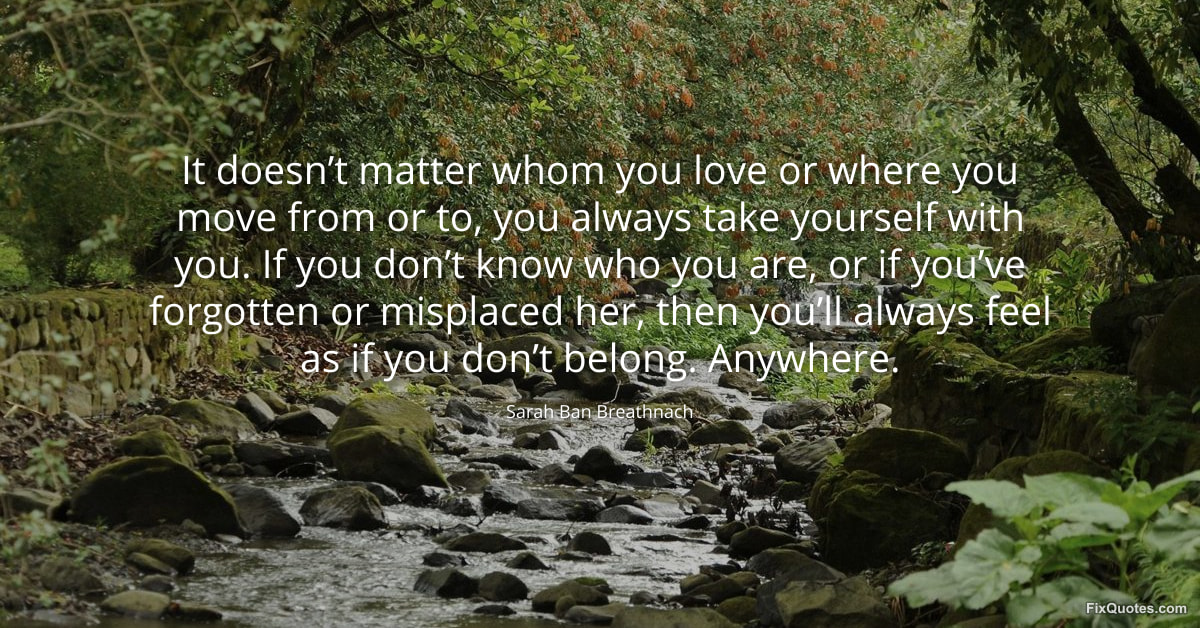
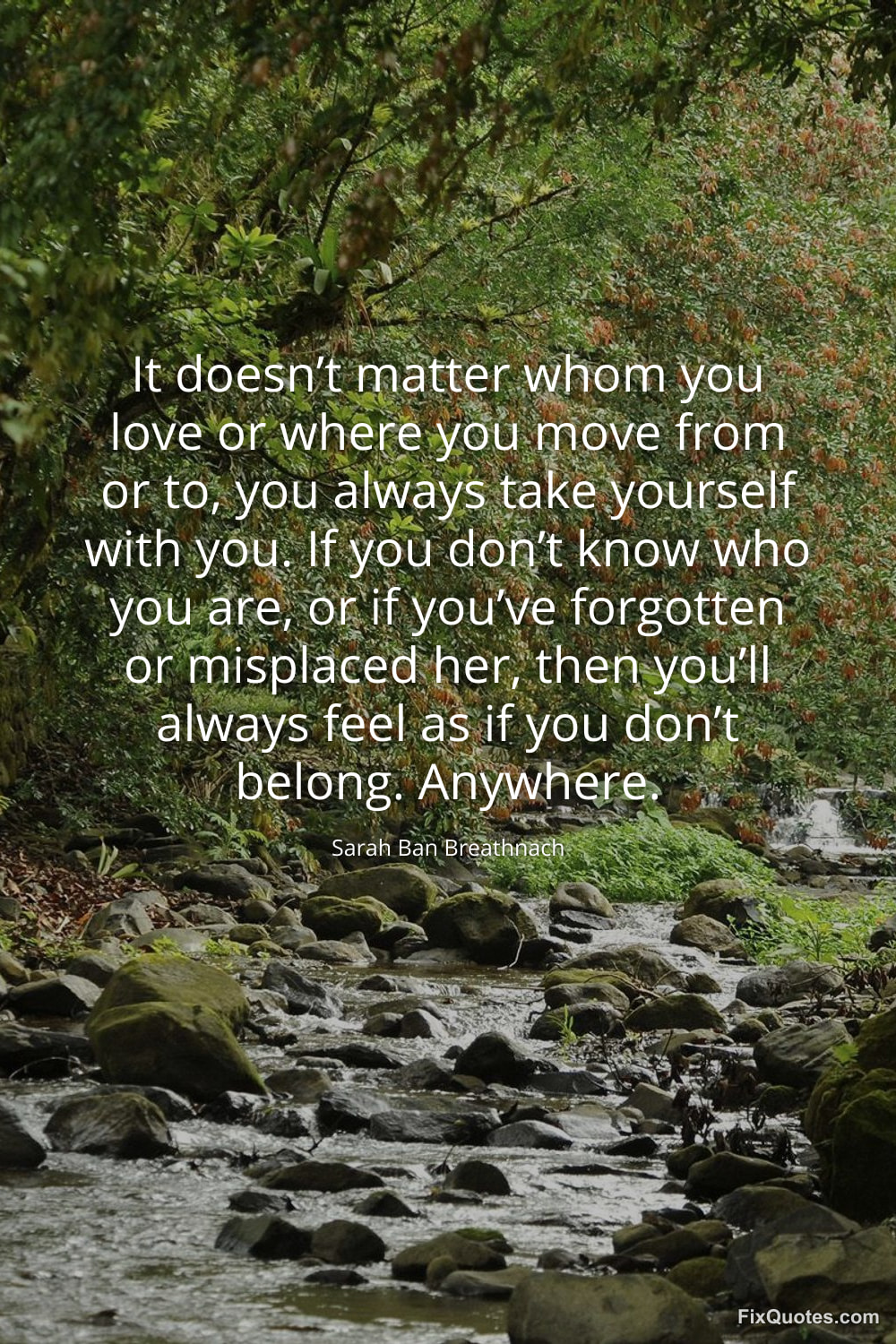
"It doesn't matter whom you love or where you move from or to, you always take yourself with you. If you don't know who you are, or if you've forgotten or misplaced her, then you'll always feel as if you don't belong anywhere"
About this Quote
Her most pointed move is grammatical. “Whom you love” and “where you move” are the usual suspects we blame for our restlessness, but the sentence swerves to “yourself,” then sharpens into a missing-person report: “forgotten or misplaced her.” That pronoun matters. By feminizing the self, Breathnach cues a specifically gendered history of self-erasure - the way women are trained to be legible to everyone but themselves, to outsource identity to romance, caretaking, or location. It’s intimate without being confessional, a hallmark of her self-help-adjacent voice: you’re being called out, but with a hand on your shoulder.
The final “Anywhere” is doing heavy rhetorical work. It’s the drop at the end of a song, the extra beat that turns observation into diagnosis. Belonging isn’t framed as a community failing or a city’s coldness; it’s portrayed as a symptom of internal amnesia. The subtext isn’t that place and love don’t matter - it’s that they can’t do the job of self-recognition. Until you’re reacquainted with the person you’re dragging through every new beginning, every new beginning will feel like a temporary rental.
Quote Details
| Topic | Self-Improvement |
|---|---|
| Source | Help us find the source |
| Cite |
Citation Formats
APA Style (7th ed.)
Breathnach, Sarah Ban. (2026, February 16). It doesn't matter whom you love or where you move from or to, you always take yourself with you. If you don't know who you are, or if you've forgotten or misplaced her, then you'll always feel as if you don't belong anywhere. FixQuotes. https://fixquotes.com/quotes/it-doesnt-matter-whom-you-love-or-where-you-move-183953/
Chicago Style
Breathnach, Sarah Ban. "It doesn't matter whom you love or where you move from or to, you always take yourself with you. If you don't know who you are, or if you've forgotten or misplaced her, then you'll always feel as if you don't belong anywhere." FixQuotes. February 16, 2026. https://fixquotes.com/quotes/it-doesnt-matter-whom-you-love-or-where-you-move-183953/.
MLA Style (9th ed.)
"It doesn't matter whom you love or where you move from or to, you always take yourself with you. If you don't know who you are, or if you've forgotten or misplaced her, then you'll always feel as if you don't belong anywhere." FixQuotes, 16 Feb. 2026, https://fixquotes.com/quotes/it-doesnt-matter-whom-you-love-or-where-you-move-183953/. Accessed 31 Mar. 2026.