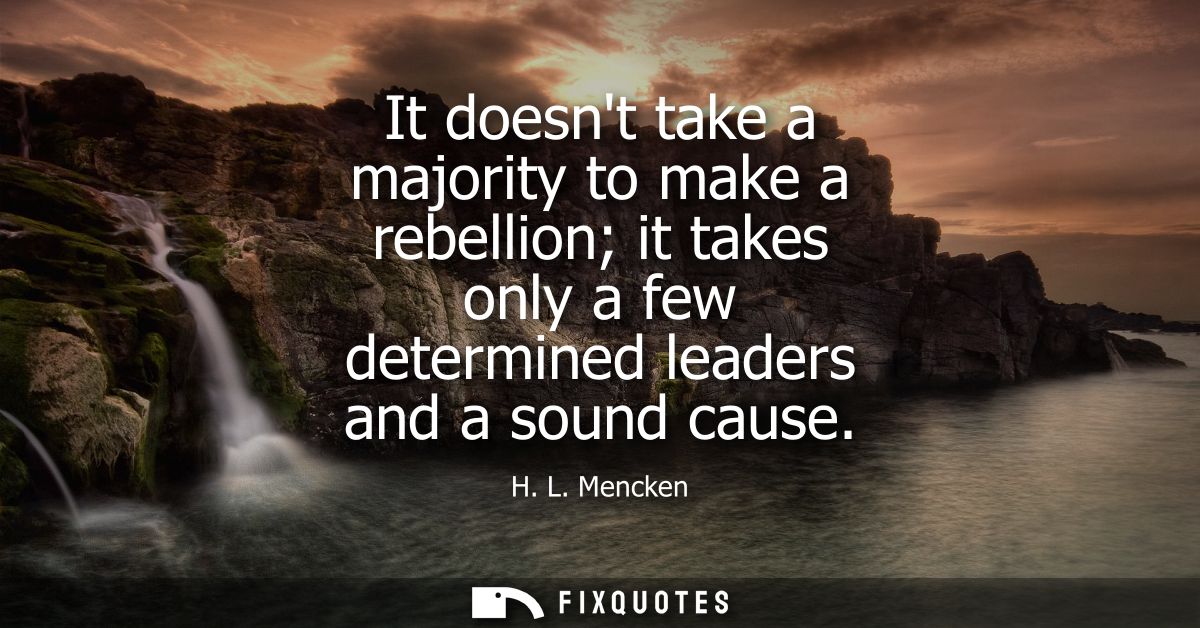
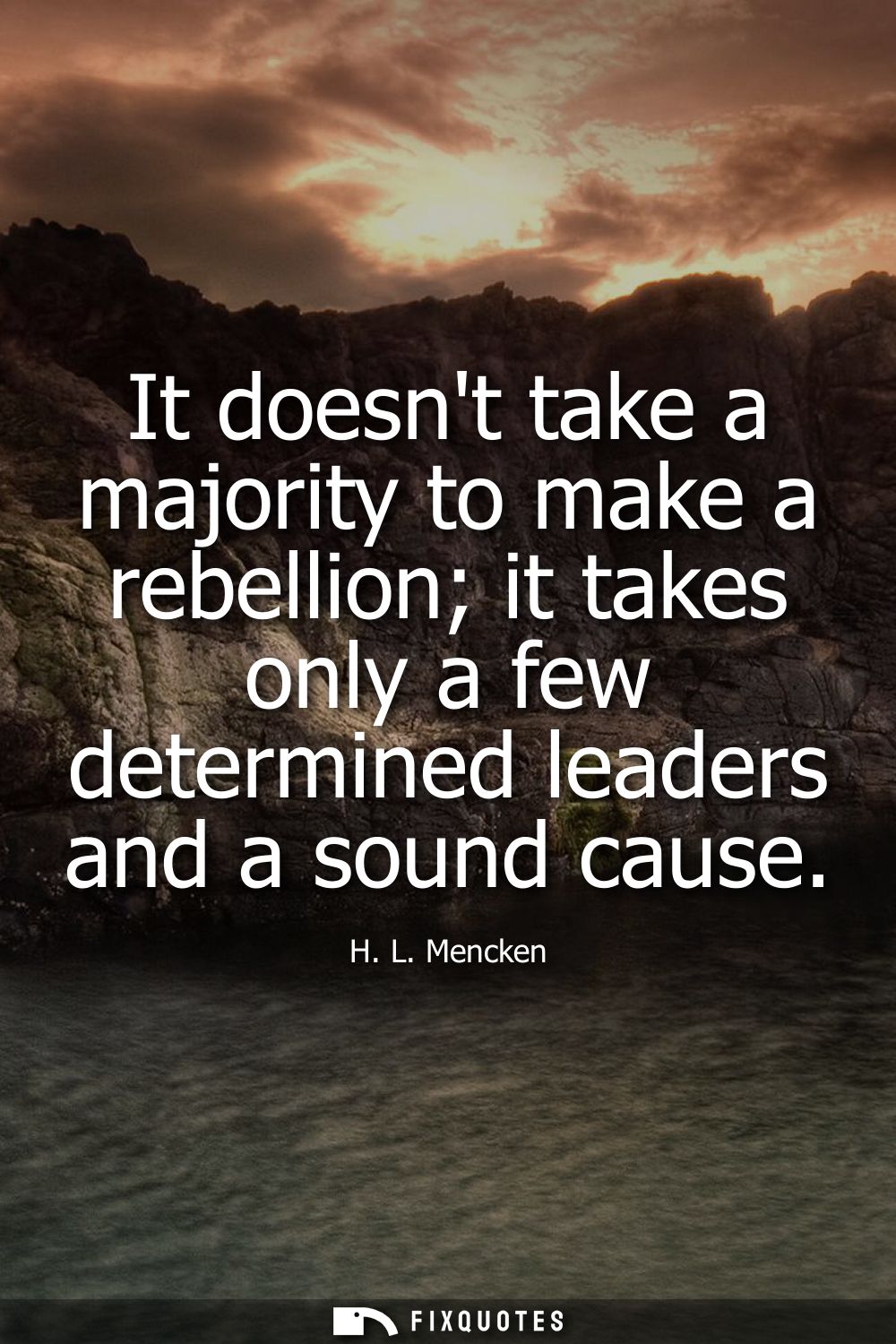
"It doesn't take a majority to make a rebellion; it takes only a few determined leaders and a sound cause"
About this Quote
The subtext is more Mencken than Hallmark. “Majority” is less a number than a stand-in for complacency: the crowd as a blunt instrument, easily managed, slow to notice its own interests. In Mencken’s skeptical worldview, mass opinion isn’t sacred; it’s suspect, a fog that power brokers and moralists can exploit. By celebrating “a few determined leaders,” he’s not necessarily endorsing purity or virtue. He’s pointing to the mechanics of change: organization beats consensus, narrative beats headcount, and courage (or audacity) beats process.
“Sound cause” is the sly qualifier. It signals moral legitimacy while also exposing how flexible legitimacy can be. Every rebellion claims a cause; the winners get to retroactively label it sound. Mencken, chronicler of American boosterism and political cant, knows how easily righteousness becomes branding. The line’s intent, then, is double: a bracing reminder that minorities can move history, and a cynical warning about how little democratic comfort that should provide. The same principle powers liberation movements and coups; the difference lies not in the math, but in who gets to write the afterward.
Quote Details
| Topic | Leadership |
|---|---|
| Source | Help us find the source |
| Cite |
Citation Formats
APA Style (7th ed.)
Mencken, H. L. (2026, January 15). It doesn't take a majority to make a rebellion; it takes only a few determined leaders and a sound cause. FixQuotes. https://fixquotes.com/quotes/it-doesnt-take-a-majority-to-make-a-rebellion-it-19516/
Chicago Style
Mencken, H. L. "It doesn't take a majority to make a rebellion; it takes only a few determined leaders and a sound cause." FixQuotes. January 15, 2026. https://fixquotes.com/quotes/it-doesnt-take-a-majority-to-make-a-rebellion-it-19516/.
MLA Style (9th ed.)
"It doesn't take a majority to make a rebellion; it takes only a few determined leaders and a sound cause." FixQuotes, 15 Jan. 2026, https://fixquotes.com/quotes/it-doesnt-take-a-majority-to-make-a-rebellion-it-19516/. Accessed 27 Mar. 2026.