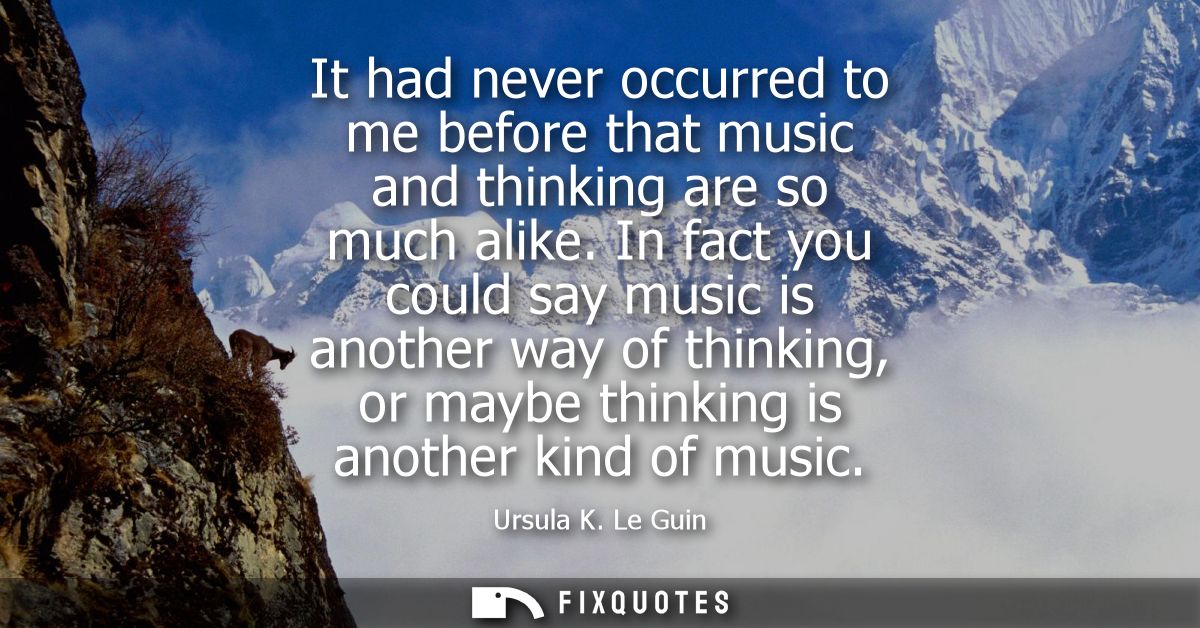
"It had never occurred to me before that music and thinking are so much alike. In fact you could say music is another way of thinking, or maybe thinking is another kind of music"
About this Quote
The phrasing matters. “It had never occurred to me before” stages discovery, not doctrine, a signature Le Guin tactic: she invites you into an experiment instead of handing down a thesis. Then she pivots on “another way” and “another kind,” language that rejects binaries. Music isn’t an escape from thought; it’s thought with different tools: rhythm, repetition, tension and release, theme and variation. Likewise, thinking at its best has musical qualities - pacing, cadence, an ear for resonance, a sense of where to place silence.
Subtext: she’s also smuggling in a critique of Western logocentrism, the old bias that treats language-based reasoning as the only legitimate mind. Le Guin, steeped in anthropology and Taoist-inflected sensibilities, often writes toward forms of knowing that don’t dominate or dissect. Music becomes a model for non-coercive intelligence: collaborative, temporal, embodied, impossible to pin down to a single “meaning” yet undeniably structured.
Contextually, it’s an author of speculative worlds making a claim about our own: that consciousness is not a courtroom brief. It’s a composition.
Quote Details
| Topic | Music |
|---|---|
| Source | Help us find the source |
| Cite |
Citation Formats
APA Style (7th ed.)
Guin, Ursula K. Le. (2026, January 15). It had never occurred to me before that music and thinking are so much alike. In fact you could say music is another way of thinking, or maybe thinking is another kind of music. FixQuotes. https://fixquotes.com/quotes/it-had-never-occurred-to-me-before-that-music-and-74369/
Chicago Style
Guin, Ursula K. Le. "It had never occurred to me before that music and thinking are so much alike. In fact you could say music is another way of thinking, or maybe thinking is another kind of music." FixQuotes. January 15, 2026. https://fixquotes.com/quotes/it-had-never-occurred-to-me-before-that-music-and-74369/.
MLA Style (9th ed.)
"It had never occurred to me before that music and thinking are so much alike. In fact you could say music is another way of thinking, or maybe thinking is another kind of music." FixQuotes, 15 Jan. 2026, https://fixquotes.com/quotes/it-had-never-occurred-to-me-before-that-music-and-74369/. Accessed 12 Feb. 2026.