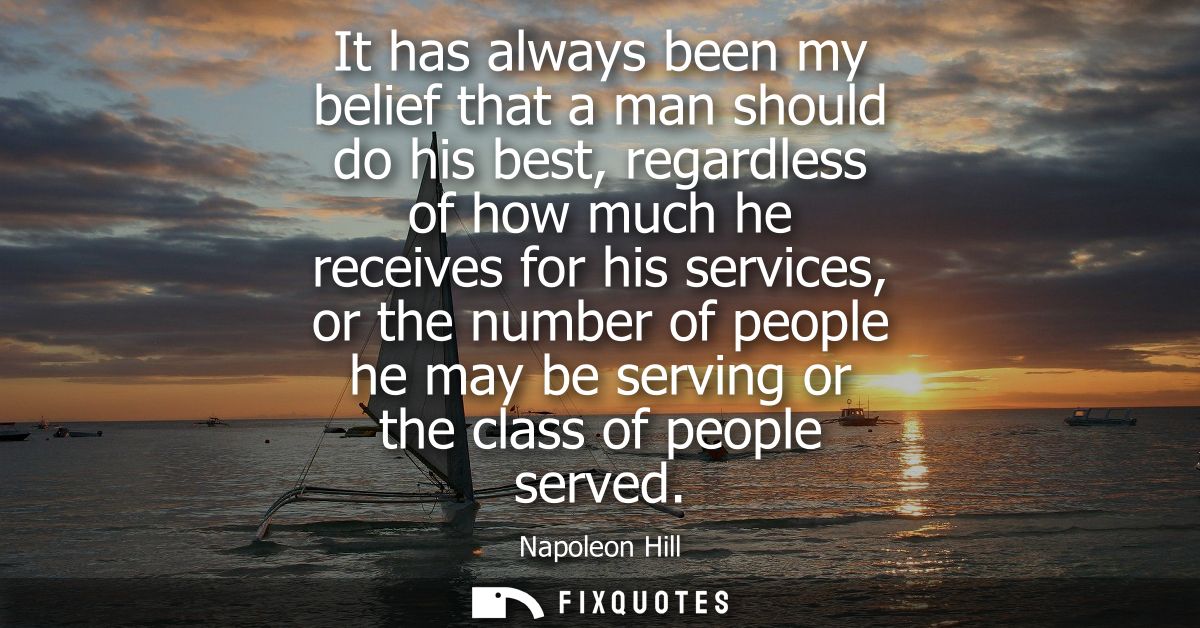
"It has always been my belief that a man should do his best, regardless of how much he receives for his services, or the number of people he may be serving or the class of people served"
About this Quote
The intent is motivational, but the subtext is more complicated. Hill isn’t just praising craftsmanship; he’s policing resentment. If you’re underpaid or overlooked, the quote asks you to keep producing at the same standard, converting frustration into virtue. That’s admirable as personal discipline, and also socially useful: it encourages stability in systems where compensation and recognition often lag behind labor. In other words, it offers dignity, but it can also normalize exploitation by making under-reward a test of character rather than a problem to be solved.
Context matters. Hill’s career sits inside early-20th-century American self-help, an era obsessed with “character,” upward mobility, and the idea that attitude can outmuscle structure. Read that way, this is classic Hill: build a self-image of professionalism so consistent it becomes a magnet for future opportunity. He’s selling a portable ethic for a volatile marketplace - one that flatters the reader with agency while quietly shifting attention away from the inequities of who gets paid, praised, or served in the first place.
Quote Details
| Topic | Work Ethic |
|---|---|
| Source | Help us find the source |
| Cite |
Citation Formats
APA Style (7th ed.)
Hill, Napoleon. (2026, January 18). It has always been my belief that a man should do his best, regardless of how much he receives for his services, or the number of people he may be serving or the class of people served. FixQuotes. https://fixquotes.com/quotes/it-has-always-been-my-belief-that-a-man-should-do-20602/
Chicago Style
Hill, Napoleon. "It has always been my belief that a man should do his best, regardless of how much he receives for his services, or the number of people he may be serving or the class of people served." FixQuotes. January 18, 2026. https://fixquotes.com/quotes/it-has-always-been-my-belief-that-a-man-should-do-20602/.
MLA Style (9th ed.)
"It has always been my belief that a man should do his best, regardless of how much he receives for his services, or the number of people he may be serving or the class of people served." FixQuotes, 18 Jan. 2026, https://fixquotes.com/quotes/it-has-always-been-my-belief-that-a-man-should-do-20602/. Accessed 2 Apr. 2026.