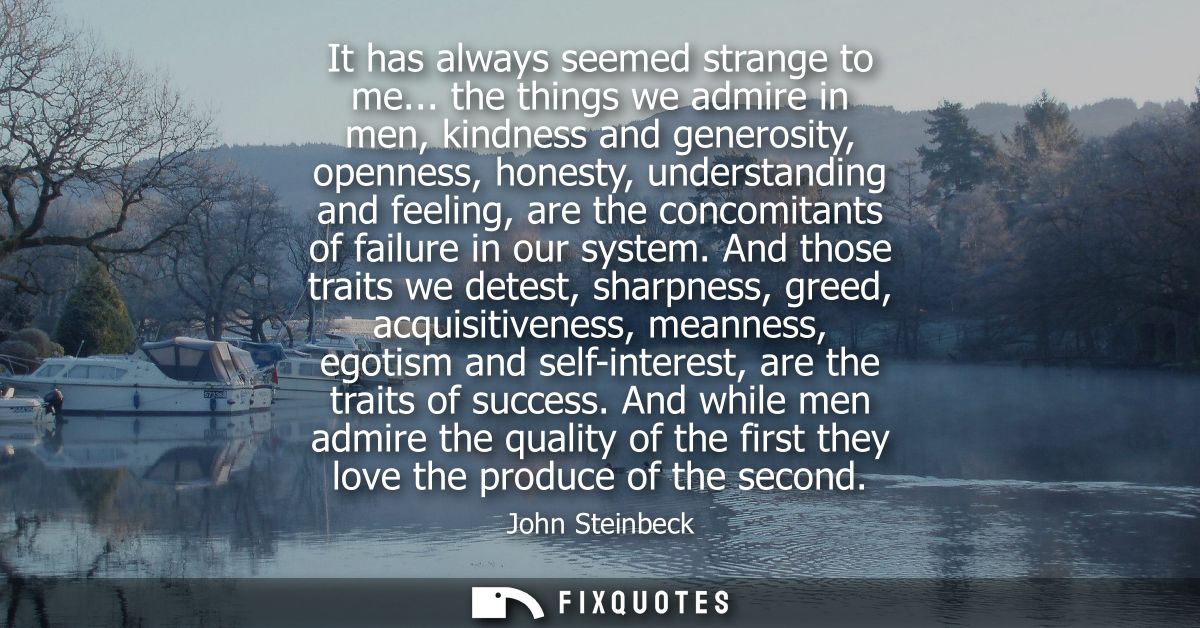
"It has always seemed strange to me... the things we admire in men, kindness and generosity, openness, honesty, understanding and feeling, are the concomitants of failure in our system. And those traits we detest, sharpness, greed, acquisitiveness, meanness, egotism and self-interest, are the traits of success. And while men admire the quality of the first they love the produce of the second"
About this Quote
Steinbeck is doing that rare trick: indicting an economic order without letting anyone off the hook. The sentence begins as a personal puzzlement ("strange to me") but quickly reveals itself as an accusation dressed in plain clothes. He sets up a moral ledger - kindness, generosity, openness - then tells you those virtues are not merely unrewarded but structurally penalized: "concomitants of failure". That word choice matters. He isn't describing bad luck or individual weakness; he's naming a system that reliably converts decency into losing.
The second half turns the knife. The traits "we detest" are not accidental blemishes on success; they're its operating equipment. "Sharpness" and "acquisitiveness" are a sanitized vocabulary for predation, the kind a culture can celebrate as "drive". Steinbeck's list-making is deliberate and exhausting, a rhetorical piling-on that mirrors the cumulative grind of capitalism's incentives. You feel the weight of it because it's meant to feel inevitable.
Then comes the real subtext: our complicity is consumer-facing. We admire the saint but "love the produce" of the scoundrel. It's an early diagnosis of what we'd now call ethical dissonance: we want humane people, but we buy outcomes made by inhumane behavior, and we pretend those desires can coexist without cost. Written from a novelist steeped in Depression-era labor politics, the line reads less like a lament than a warning: if a society makes goodness uncompetitive, it will eventually treat goodness as a hobby, not a standard.
The second half turns the knife. The traits "we detest" are not accidental blemishes on success; they're its operating equipment. "Sharpness" and "acquisitiveness" are a sanitized vocabulary for predation, the kind a culture can celebrate as "drive". Steinbeck's list-making is deliberate and exhausting, a rhetorical piling-on that mirrors the cumulative grind of capitalism's incentives. You feel the weight of it because it's meant to feel inevitable.
Then comes the real subtext: our complicity is consumer-facing. We admire the saint but "love the produce" of the scoundrel. It's an early diagnosis of what we'd now call ethical dissonance: we want humane people, but we buy outcomes made by inhumane behavior, and we pretend those desires can coexist without cost. Written from a novelist steeped in Depression-era labor politics, the line reads less like a lament than a warning: if a society makes goodness uncompetitive, it will eventually treat goodness as a hobby, not a standard.
Quote Details
| Topic | Ethics & Morality |
|---|
More Quotes by John
Add to List