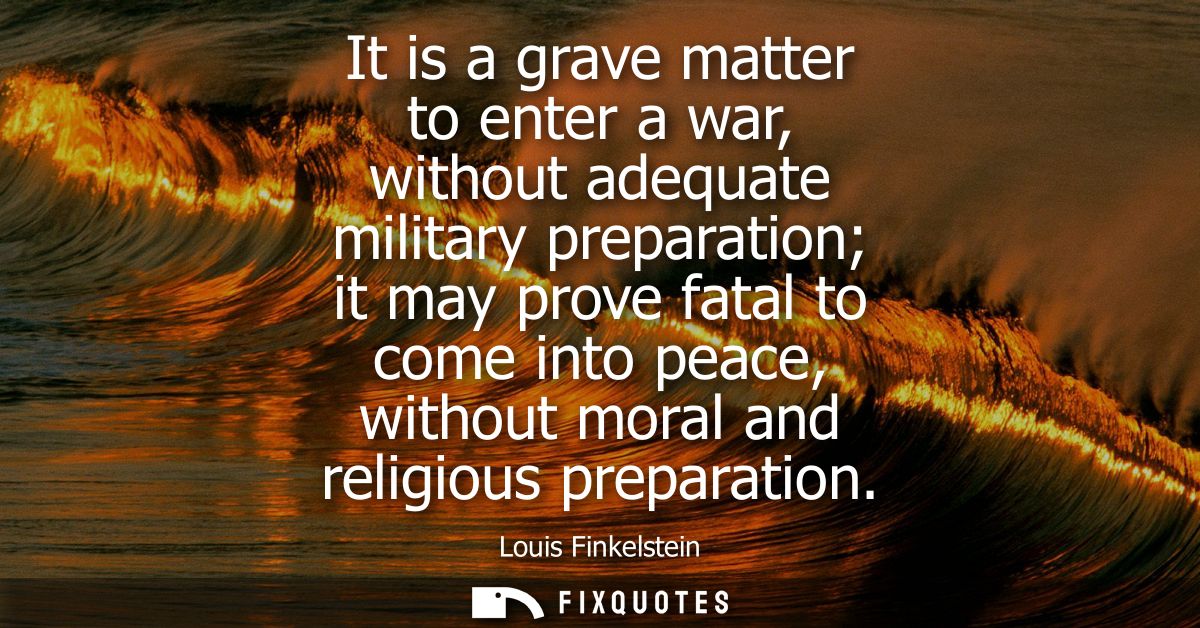
"It is a grave matter to enter a war, without adequate military preparation; it may prove fatal to come into peace, without moral and religious preparation"
About this Quote
The subtext is a critique of modern confidence: we can engineer victory, rebuild cities, draft treaties, and still fail at the harder work of being decent when the adrenaline drains away. War forces discipline through external threat; peace demands self-government without the excuse of emergency. That’s where “moral and religious preparation” lands, not as sectarian chest-thumping but as a claim that institutions, habits, and shared meanings must be cultivated before the crisis ends, not after. Otherwise peace becomes a vacuum filled by cynicism, vengeance, consumerism, or the next nationalist fever.
Context matters. Finkelstein’s career straddled the world wars and the Cold War, eras when “winning” could be defined militarily while the moral wreckage lingered for generations. The sentence reads like a postwar warning: treaties can stop shooting; they can’t automatically restore restraint, empathy, or purpose. Peace, he implies, is not the absence of conflict but the presence of moral readiness - and without it, the aftermath can still be “fatal,” just slower and more self-inflicted.
Quote Details
| Topic | War |
|---|---|
| Source | Help us find the source |
| Cite |
Citation Formats
APA Style (7th ed.)
Finkelstein, Louis. (2026, January 15). It is a grave matter to enter a war, without adequate military preparation; it may prove fatal to come into peace, without moral and religious preparation. FixQuotes. https://fixquotes.com/quotes/it-is-a-grave-matter-to-enter-a-war-without-152755/
Chicago Style
Finkelstein, Louis. "It is a grave matter to enter a war, without adequate military preparation; it may prove fatal to come into peace, without moral and religious preparation." FixQuotes. January 15, 2026. https://fixquotes.com/quotes/it-is-a-grave-matter-to-enter-a-war-without-152755/.
MLA Style (9th ed.)
"It is a grave matter to enter a war, without adequate military preparation; it may prove fatal to come into peace, without moral and religious preparation." FixQuotes, 15 Jan. 2026, https://fixquotes.com/quotes/it-is-a-grave-matter-to-enter-a-war-without-152755/. Accessed 12 Feb. 2026.