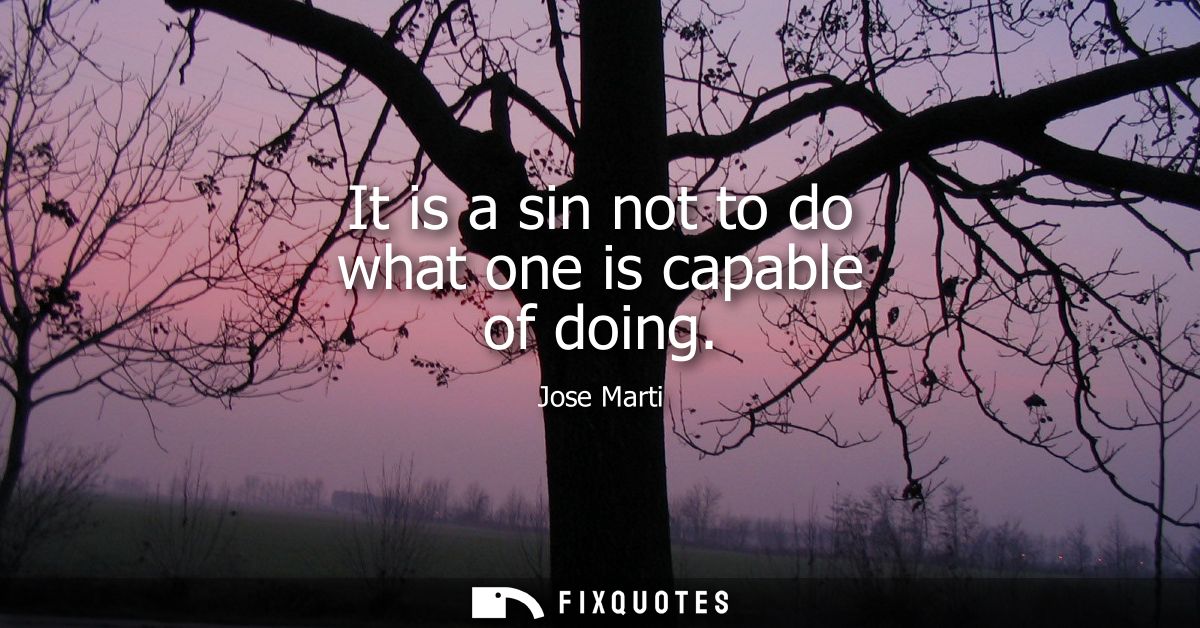
"It is a sin not to do what one is capable of doing"
About this Quote
Marti frames wasted ability as moral failure, not a personal quirk. Calling it "a sin" yanks talent out of the self-help aisle and drops it into the realm of duty, where excuses don’t just disappoint - they implicate. For an activist living under colonial power, that move matters: capability isn’t a private asset to be curated for comfort, it’s leverage in a world built to keep people powerless.
The line’s pressure comes from its verb choice. "Capable" is deceptively practical, almost bureaucratic. Marti isn’t romanticizing genius; he’s talking about whatever competence you actually have - your capacity to write, organize, teach, speak, build, persist. By making the standard individual ("what one is capable of"), he avoids easy martyr narratives. The demand isn’t "do everything" but "do your part at full stretch". That specificity turns the quote into a quiet indictment of spectatorship.
Subtextually, it’s also a rebuke to the colonial mindset Marti fought: the trained habit of shrinking, of playing small because the system punishes ambition. If oppression banks on your self-limitation, then withholding your gifts becomes collaboration-by-default. Marti’s ethic insists that freedom is not only won through grand gestures but through the daily refusal to underperform your conscience.
Context sharpens the stakes. Marti helped shape Cuban independence thinking while organizing exile communities and writing relentlessly. For him, ability wasn’t ornamental; it was the toolset of liberation. The quote functions like a moral draft notice: if you can act, you must.
The line’s pressure comes from its verb choice. "Capable" is deceptively practical, almost bureaucratic. Marti isn’t romanticizing genius; he’s talking about whatever competence you actually have - your capacity to write, organize, teach, speak, build, persist. By making the standard individual ("what one is capable of"), he avoids easy martyr narratives. The demand isn’t "do everything" but "do your part at full stretch". That specificity turns the quote into a quiet indictment of spectatorship.
Subtextually, it’s also a rebuke to the colonial mindset Marti fought: the trained habit of shrinking, of playing small because the system punishes ambition. If oppression banks on your self-limitation, then withholding your gifts becomes collaboration-by-default. Marti’s ethic insists that freedom is not only won through grand gestures but through the daily refusal to underperform your conscience.
Context sharpens the stakes. Marti helped shape Cuban independence thinking while organizing exile communities and writing relentlessly. For him, ability wasn’t ornamental; it was the toolset of liberation. The quote functions like a moral draft notice: if you can act, you must.
Quote Details
| Topic | Ethics & Morality |
|---|---|
| Source | Help us find the source |
| Cite |
Citation Formats
APA Style (7th ed.)
Marti, Jose. (2026, January 17). It is a sin not to do what one is capable of doing. FixQuotes. https://fixquotes.com/quotes/it-is-a-sin-not-to-do-what-one-is-capable-of-doing-80566/
Chicago Style
Marti, Jose. "It is a sin not to do what one is capable of doing." FixQuotes. January 17, 2026. https://fixquotes.com/quotes/it-is-a-sin-not-to-do-what-one-is-capable-of-doing-80566/.
MLA Style (9th ed.)
"It is a sin not to do what one is capable of doing." FixQuotes, 17 Jan. 2026, https://fixquotes.com/quotes/it-is-a-sin-not-to-do-what-one-is-capable-of-doing-80566/. Accessed 15 Feb. 2026.
More Quotes by Jose
Add to List