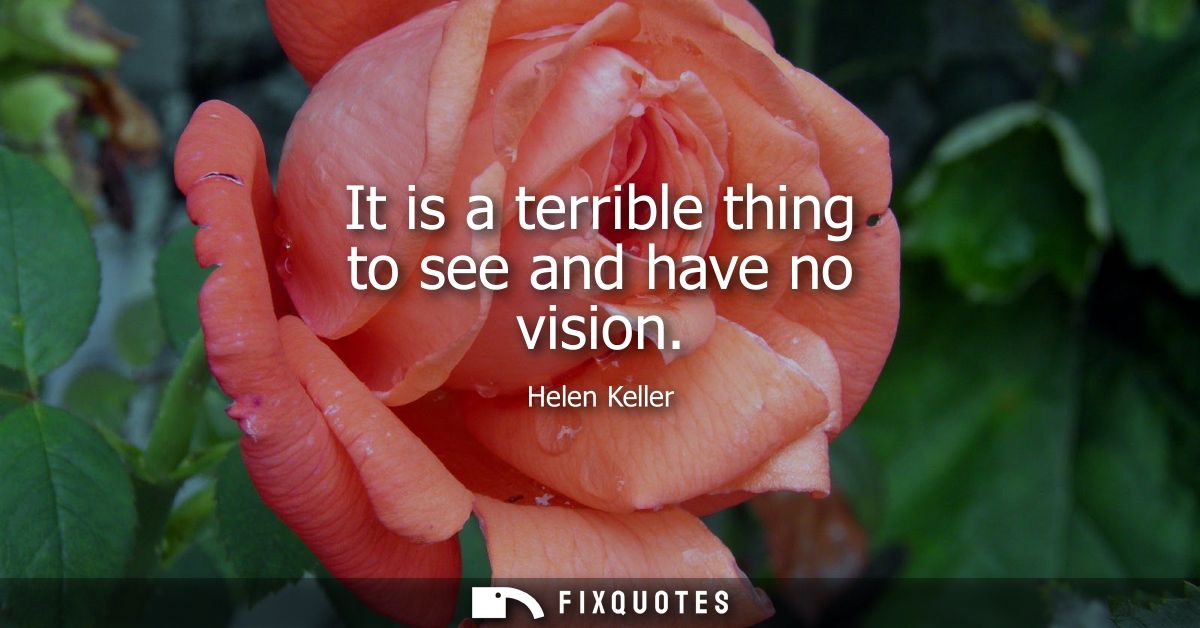
"It is a terrible thing to see and have no vision"
About this Quote
The line lands like a quiet indictment: the real tragedy isn’t darkness, it’s drift. Keller, so often flattened into a symbol of “overcoming,” flips the expected script. She’s not auditioning for pity or delivering a motivational poster. She’s warning that perception without purpose is its own kind of disability - and one we choose.
Keller knew exactly how the world wanted to read her: blind and deaf, therefore “limited.” Her genius was to weaponize that assumption against the sighted majority. “To see” here is literal, but it’s also civic and moral: the ability to witness injustice, to recognize another person’s humanity, to imagine alternatives to the status quo. Having “no vision” names a more damning deficit: not the lack of sensory input, but the refusal to interpret what you’re given, the failure to project a future worth building.
The subtext is sharpened by Keller’s historical moment. Living through industrial capitalism’s brutal inequalities, World War I, and the rise of mass propaganda, she became an outspoken socialist and activist. In that context, “vision” isn’t airy optimism; it’s political imagination and ethical clarity. A society can have newspapers, photographs, and front-row seats to suffering - and still lack the will to change. That’s the terrible thing she’s pointing at: not ignorance, but the comfortable, well-lit vacancy where conviction should be.
The sentence is spare, almost aphoristic, because it’s designed to travel. It doesn’t beg for agreement; it dares you to ask whether your eyesight is doing any real work.
Keller knew exactly how the world wanted to read her: blind and deaf, therefore “limited.” Her genius was to weaponize that assumption against the sighted majority. “To see” here is literal, but it’s also civic and moral: the ability to witness injustice, to recognize another person’s humanity, to imagine alternatives to the status quo. Having “no vision” names a more damning deficit: not the lack of sensory input, but the refusal to interpret what you’re given, the failure to project a future worth building.
The subtext is sharpened by Keller’s historical moment. Living through industrial capitalism’s brutal inequalities, World War I, and the rise of mass propaganda, she became an outspoken socialist and activist. In that context, “vision” isn’t airy optimism; it’s political imagination and ethical clarity. A society can have newspapers, photographs, and front-row seats to suffering - and still lack the will to change. That’s the terrible thing she’s pointing at: not ignorance, but the comfortable, well-lit vacancy where conviction should be.
The sentence is spare, almost aphoristic, because it’s designed to travel. It doesn’t beg for agreement; it dares you to ask whether your eyesight is doing any real work.
Quote Details
| Topic | Vision & Strategy |
|---|---|
| Source | Help us find the source |
| Cite |
Citation Formats
APA Style (7th ed.)
Keller, Helen. (2026, January 17). It is a terrible thing to see and have no vision. FixQuotes. https://fixquotes.com/quotes/it-is-a-terrible-thing-to-see-and-have-no-vision-26472/
Chicago Style
Keller, Helen. "It is a terrible thing to see and have no vision." FixQuotes. January 17, 2026. https://fixquotes.com/quotes/it-is-a-terrible-thing-to-see-and-have-no-vision-26472/.
MLA Style (9th ed.)
"It is a terrible thing to see and have no vision." FixQuotes, 17 Jan. 2026, https://fixquotes.com/quotes/it-is-a-terrible-thing-to-see-and-have-no-vision-26472/. Accessed 22 Mar. 2026.
More Quotes by Helen
Add to List