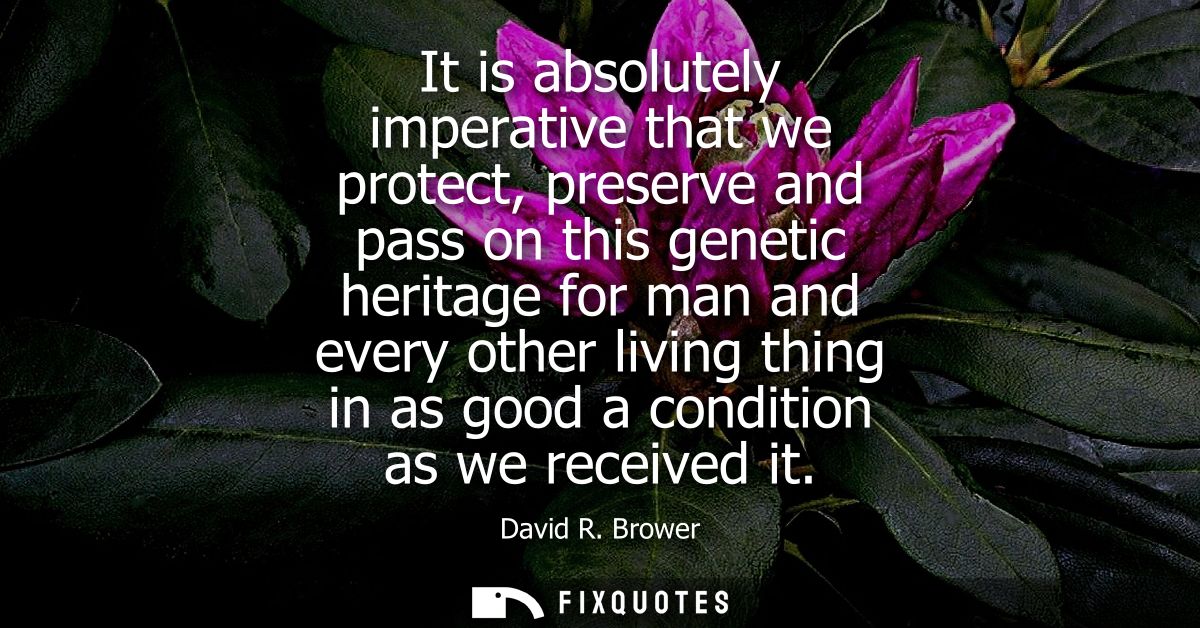
"It is absolutely imperative that we protect, preserve and pass on this genetic heritage for man and every other living thing in as good a condition as we received it"
About this Quote
The phrase “genetic heritage” is the masterstroke. Brower sidesteps the postcard aesthetics of wilderness and instead frames biodiversity as inheritance: a bank account, a library, a hard-won archive written over evolutionary time. He’s also quietly modernizing environmentalism, pulling it away from scenic preservation toward systems-thinking. Protecting a species isn’t charity; it’s safeguarding the underlying code that makes ecosystems resilient and adaptable. In the late 20th century, as industrial agriculture, pesticides, and habitat loss accelerated extinctions, “genetic” reads like a pointed rebuttal to the era’s techno-optimism: you can’t replace what you’ve edited out of existence.
His inclusion of “man and every other living thing” does double work. It starts from an anthropocentric “we,” then immediately decentering it, insisting humans are participants in the same biological continuum. The kicker is the closing standard: “as good a condition as we received it.” That’s intergenerational ethics with teeth. It rejects the idea that progress is permission to degrade; it sets a baseline of stewardship, implicitly accusing the present of running a deficit against the future. Brower’s intent is clear: make conservation feel less like a hobby and more like fiduciary duty.
Quote Details
| Topic | Nature |
|---|---|
| Source | Help us find the source |
| Cite |
Citation Formats
APA Style (7th ed.)
Brower, David R. (2026, January 18). It is absolutely imperative that we protect, preserve and pass on this genetic heritage for man and every other living thing in as good a condition as we received it. FixQuotes. https://fixquotes.com/quotes/it-is-absolutely-imperative-that-we-protect-15740/
Chicago Style
Brower, David R. "It is absolutely imperative that we protect, preserve and pass on this genetic heritage for man and every other living thing in as good a condition as we received it." FixQuotes. January 18, 2026. https://fixquotes.com/quotes/it-is-absolutely-imperative-that-we-protect-15740/.
MLA Style (9th ed.)
"It is absolutely imperative that we protect, preserve and pass on this genetic heritage for man and every other living thing in as good a condition as we received it." FixQuotes, 18 Jan. 2026, https://fixquotes.com/quotes/it-is-absolutely-imperative-that-we-protect-15740/. Accessed 4 Apr. 2026.