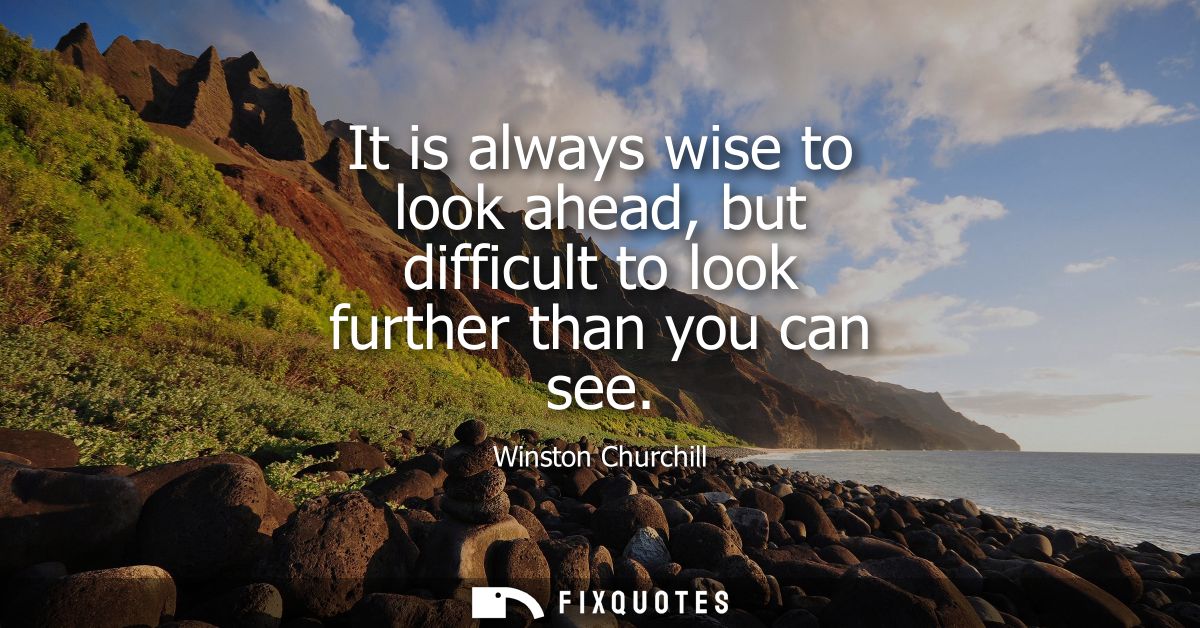
"It is always wise to look ahead, but difficult to look further than you can see"
About this Quote
Churchill’s line flatters the planner while quietly mocking the fantasy of omniscience. “Always wise” signals the statesman’s moral universe: prudence is a virtue, not a personality trait. But the sentence pivots on that comma into a chastening limit. Yes, look ahead; no, don’t pretend you can see around every bend. It’s counsel with a built-in corrective, the kind a wartime leader offers to audiences hungry for certainty.
The subtext is political as much as philosophical. Churchill made a career of urging foresight - warning about German rearmament, pushing preparedness, insisting that history has patterns you ignore at your peril. Yet he also governed amid fog: incomplete intelligence, shifting alliances, public morale, battlefield volatility. “Difficult to look further than you can see” isn’t an excuse for shortsightedness; it’s an argument against the theatrical certainty that politicians often perform. He’s validating sober strategy while inoculating listeners against the seduction of long-range prophecies dressed up as policy.
Rhetorically, it works because it reconciles two impulses in democratic leadership: the demand for a plan and the reality of contingency. The phrase “than you can see” keeps the metaphor bodily and immediate, not abstract. It’s an image of headlights on a dark road: you still drive, but you don’t claim daylight. In Churchill’s mouth, humility becomes a tool of authority - a way to promise direction without promising miracles.
The subtext is political as much as philosophical. Churchill made a career of urging foresight - warning about German rearmament, pushing preparedness, insisting that history has patterns you ignore at your peril. Yet he also governed amid fog: incomplete intelligence, shifting alliances, public morale, battlefield volatility. “Difficult to look further than you can see” isn’t an excuse for shortsightedness; it’s an argument against the theatrical certainty that politicians often perform. He’s validating sober strategy while inoculating listeners against the seduction of long-range prophecies dressed up as policy.
Rhetorically, it works because it reconciles two impulses in democratic leadership: the demand for a plan and the reality of contingency. The phrase “than you can see” keeps the metaphor bodily and immediate, not abstract. It’s an image of headlights on a dark road: you still drive, but you don’t claim daylight. In Churchill’s mouth, humility becomes a tool of authority - a way to promise direction without promising miracles.
Quote Details
| Topic | Wisdom |
|---|---|
| Source | Attributed to Winston Churchill; listed on Wikiquote (Winston Churchill) as a quoted aphorism. |
More Quotes by Winston
Add to List