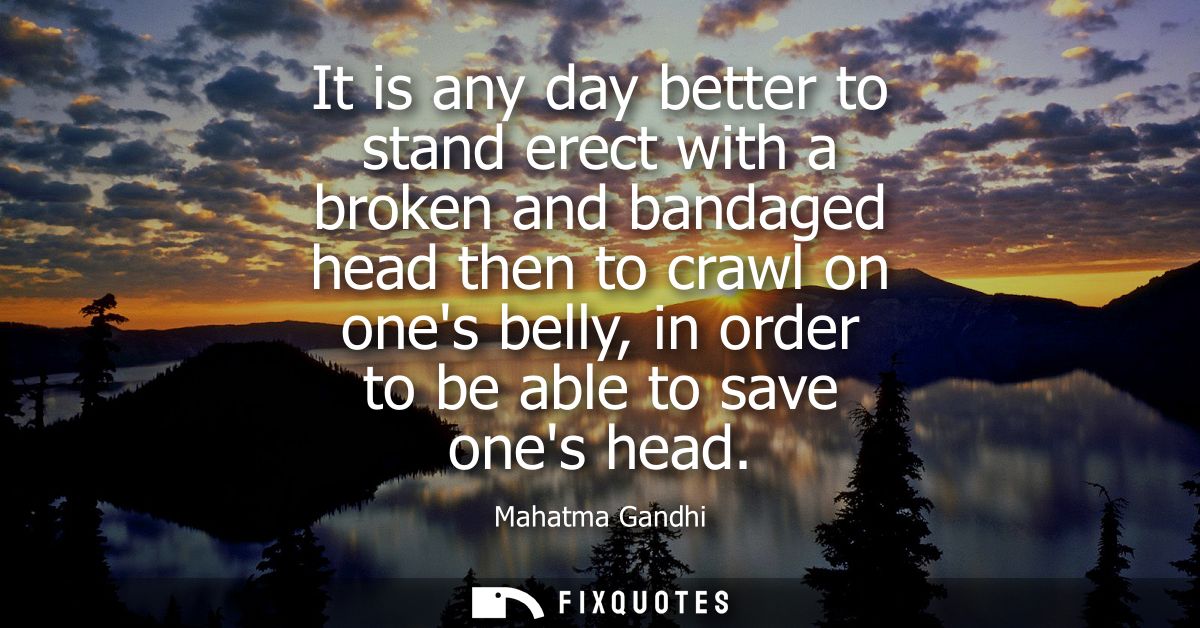
"It is any day better to stand erect, with a broken and bandaged head, then to crawl on one's belly, in order to be able to save one's head"
About this Quote
The subtext is strategic as much as moral. Gandhi’s politics of nonviolence depended on people refusing the everyday bargains colonial power offered: comply, keep your job, avoid the baton, protect your family’s fragile stability. He reframes that “safety” as cowardice dressed up as prudence. The head you “save” by crawling is, in his formulation, already lost: you keep the skull, surrender the mind.
Contextually, this sits inside a broader campaign to convert private fear into public leverage. British rule thrived not only on force but on habituation: the quiet agreement that resistance is too costly. Gandhi rejects that calculus. He’s not promising victory; he’s prescribing a way to be defeated without being conquered.
Quote Details
| Topic | Honesty & Integrity |
|---|---|
| Source | Help us find the source |
| Cite |
Citation Formats
APA Style (7th ed.)
Gandhi, Mahatma. (2026, February 19). It is any day better to stand erect, with a broken and bandaged head, then to crawl on one's belly, in order to be able to save one's head. FixQuotes. https://fixquotes.com/quotes/it-is-any-day-better-to-stand-erect-with-a-broken-26079/
Chicago Style
Gandhi, Mahatma. "It is any day better to stand erect, with a broken and bandaged head, then to crawl on one's belly, in order to be able to save one's head." FixQuotes. February 19, 2026. https://fixquotes.com/quotes/it-is-any-day-better-to-stand-erect-with-a-broken-26079/.
MLA Style (9th ed.)
"It is any day better to stand erect, with a broken and bandaged head, then to crawl on one's belly, in order to be able to save one's head." FixQuotes, 19 Feb. 2026, https://fixquotes.com/quotes/it-is-any-day-better-to-stand-erect-with-a-broken-26079/. Accessed 31 Mar. 2026.