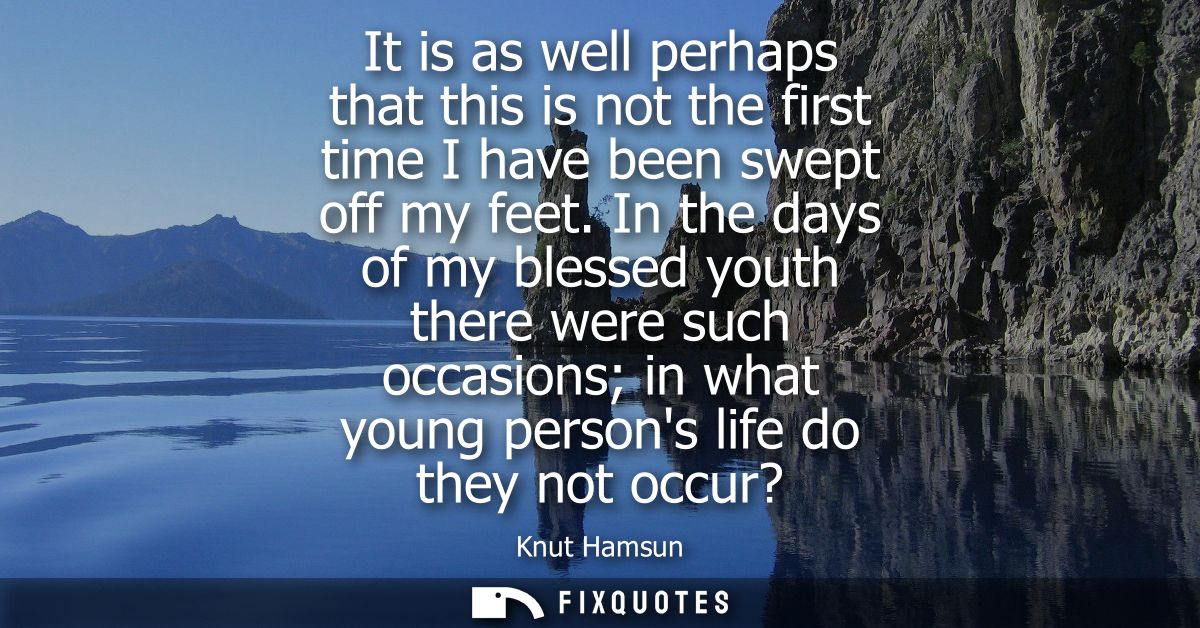
"It is as well perhaps that this is not the first time I have been swept off my feet. In the days of my blessed youth there were such occasions; in what young person's life do they not occur?"
About this Quote
Hamsun’s phrasing is doing double work. “Blessed youth” romanticizes the past while quietly putting it at a safe distance, as if ardor belongs to an earlier, forgiven version of the self. Then comes the sly universalizing: “in what young person’s life do they not occur?” It’s a question that pretends to be generous but actually pressures the reader into agreement. If you resist, you’re either dishonest or inhuman. The move is classic Hamsun: psychology framed as inevitability, personal impulse presented as common weather.
Context matters because Hamsun’s fiction often treats feeling not as a moral compass but as a destabilizing force - a gust that reorganizes status, self-respect, and rational plans. The subtext here is not simply nostalgia; it’s self-justification. The speaker wants permission to be undone again, while maintaining the dignity of someone who has seen this movie before. The charm is in that tension: desire rebranded as experience, weakness recast as proof of having lived.
Quote Details
| Topic | Romantic |
|---|---|
| Source | Help us find the source |
| Cite |
Citation Formats
APA Style (7th ed.)
Hamsun, Knut. (2026, January 17). It is as well perhaps that this is not the first time I have been swept off my feet. In the days of my blessed youth there were such occasions; in what young person's life do they not occur? FixQuotes. https://fixquotes.com/quotes/it-is-as-well-perhaps-that-this-is-not-the-first-32829/
Chicago Style
Hamsun, Knut. "It is as well perhaps that this is not the first time I have been swept off my feet. In the days of my blessed youth there were such occasions; in what young person's life do they not occur?" FixQuotes. January 17, 2026. https://fixquotes.com/quotes/it-is-as-well-perhaps-that-this-is-not-the-first-32829/.
MLA Style (9th ed.)
"It is as well perhaps that this is not the first time I have been swept off my feet. In the days of my blessed youth there were such occasions; in what young person's life do they not occur?" FixQuotes, 17 Jan. 2026, https://fixquotes.com/quotes/it-is-as-well-perhaps-that-this-is-not-the-first-32829/. Accessed 10 Mar. 2026.