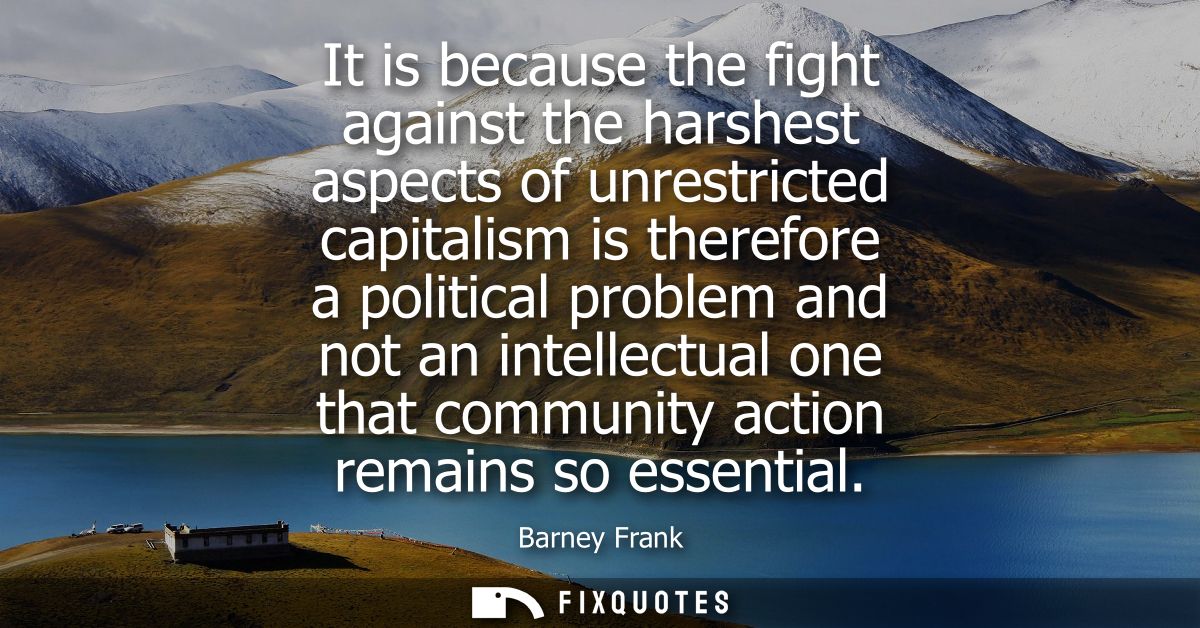
"It is because the fight against the harshest aspects of unrestricted capitalism is therefore a political problem and not an intellectual one that community action remains so essential"
About this Quote
The key move is his demotion of the “intellectual” as the primary agent of change. He’s not anti-intellectual; he’s suspicious of intellectualism as a substitute for organization. In the American tradition, policy often gets framed as a seminar: data versus data, theory versus theory. Frank punctures that by saying the harshness persists not because we haven’t diagnosed it, but because the people who benefit from it have political leverage. If the problem is political, then persuasion alone is inadequate; you need coalition-building, turnout, pressure, and the slow grind of local mobilization.
“Community action remains so essential” reads like a reminder from someone who has seen reform fail when it stays elite. It’s also a rebuke to complacent liberalism: you can’t outsource justice to experts. The subtext is urgency and realism, likely shaped by moments like deregulation’s long arc and the fallout of financial crises, when public pain was obvious yet structural change still required organized, sustained force. Frank is arguing for democracy as a muscle, not a mood.
Quote Details
| Topic | Equality |
|---|---|
| Source | Help us find the source |
| Cite |
Citation Formats
APA Style (7th ed.)
Frank, Barney. (2026, January 17). It is because the fight against the harshest aspects of unrestricted capitalism is therefore a political problem and not an intellectual one that community action remains so essential. FixQuotes. https://fixquotes.com/quotes/it-is-because-the-fight-against-the-harshest-42132/
Chicago Style
Frank, Barney. "It is because the fight against the harshest aspects of unrestricted capitalism is therefore a political problem and not an intellectual one that community action remains so essential." FixQuotes. January 17, 2026. https://fixquotes.com/quotes/it-is-because-the-fight-against-the-harshest-42132/.
MLA Style (9th ed.)
"It is because the fight against the harshest aspects of unrestricted capitalism is therefore a political problem and not an intellectual one that community action remains so essential." FixQuotes, 17 Jan. 2026, https://fixquotes.com/quotes/it-is-because-the-fight-against-the-harshest-42132/. Accessed 15 Mar. 2026.