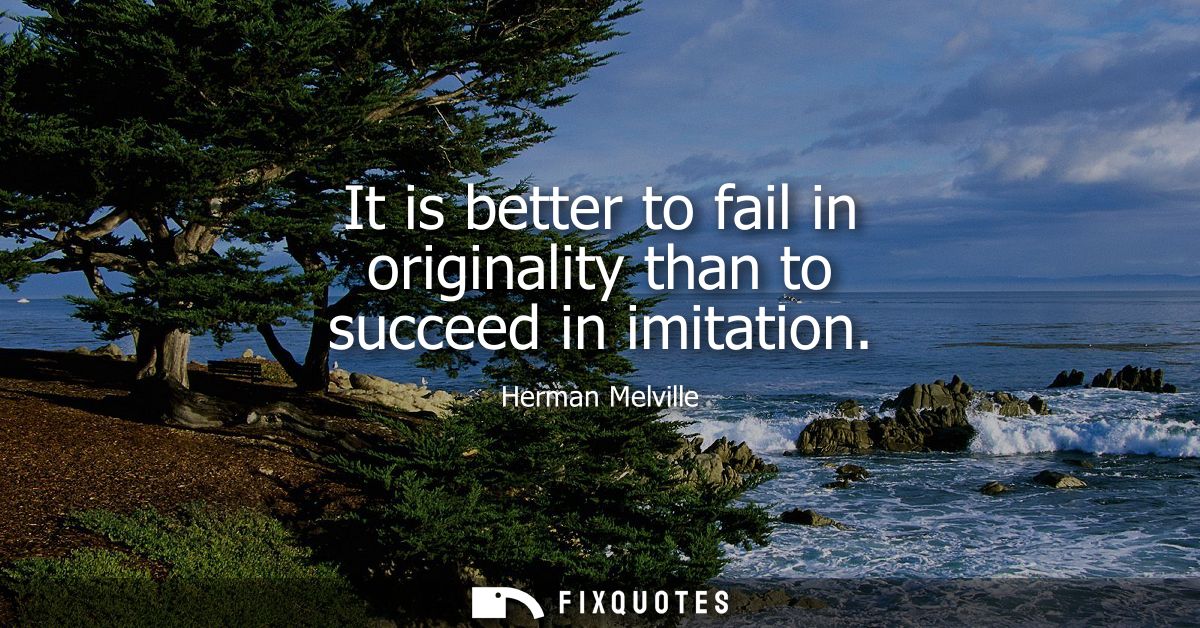
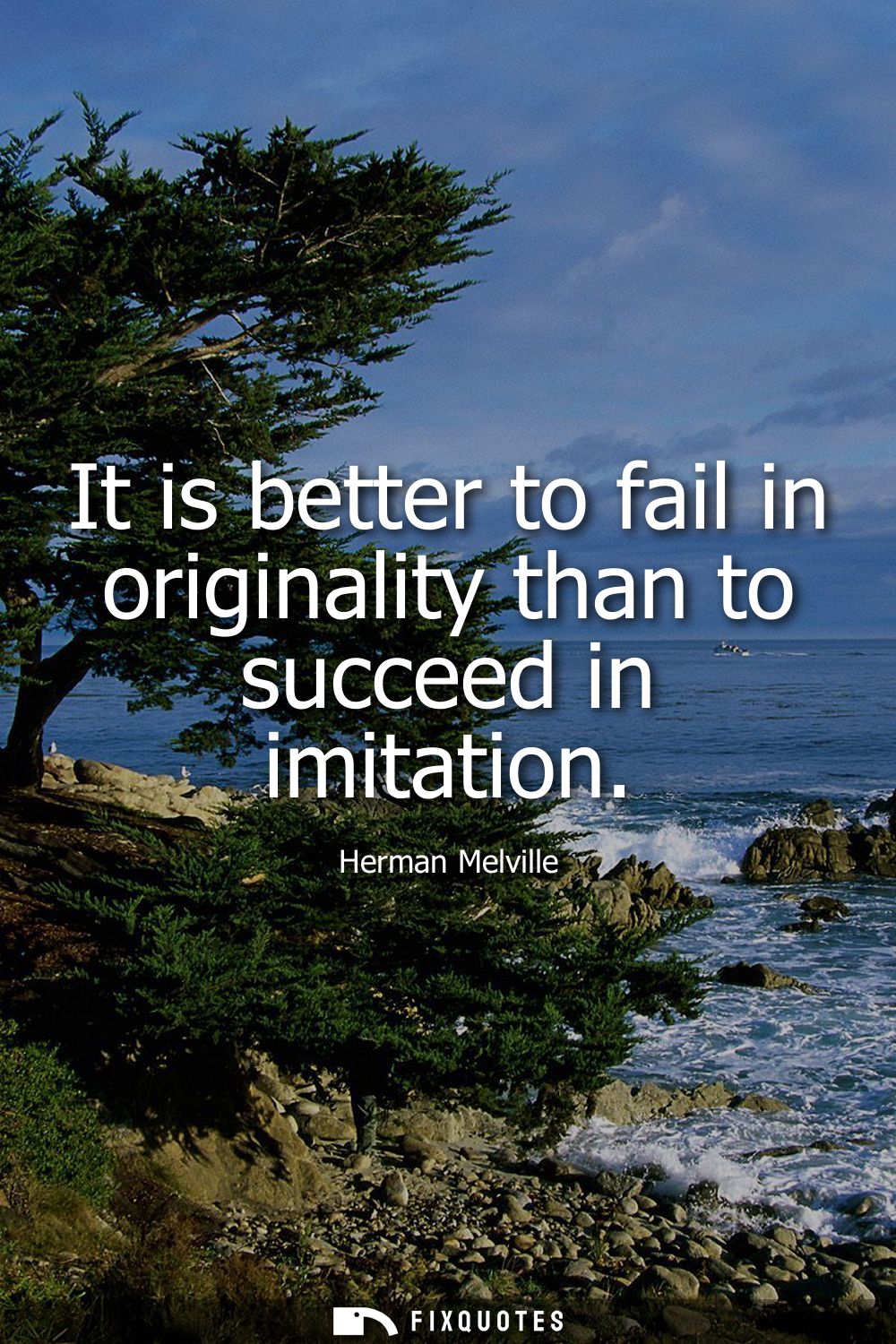
"It is better to fail in originality than to succeed in imitation"
About this Quote
Melville isn’t offering a motivational poster; he’s issuing a survival tip for artists who can feel the market tightening around their throats. “Fail in originality” turns failure into a badge of honest risk, while “succeed in imitation” exposes a more corrosive defeat: getting rewarded for being replaceable. The line works because it flips the usual bargain. Most people will accept a little self-betrayal in exchange for applause. Melville suggests that bargain is rigged. The applause is rented, not earned, and it comes with the fine print of erasure.
The subtext is personal. Melville knew what it was to be celebrated (Typee) and then to watch his most ambitious work (Moby-Dick) meet confusion and commercial indifference. He’s not romanticizing obscurity so much as diagnosing the long arc of reputation: imitation can buy you a season, originality buys you a chance at posterity, even if it first buys you rejection. There’s a quiet contempt here for “success” as a metric when it’s detached from vision.
Context matters, too: mid-19th-century American letters were still negotiating their independence from European models, while publishers wanted the familiar, the exportable, the safe. Melville’s sentence is a refusal to write the book that goes down easy. It’s also a warning that copying isn’t neutral; it trains you to anticipate taste instead of discovering it. Better to miss while aiming at something only you can see than to hit the target someone else drew.
The subtext is personal. Melville knew what it was to be celebrated (Typee) and then to watch his most ambitious work (Moby-Dick) meet confusion and commercial indifference. He’s not romanticizing obscurity so much as diagnosing the long arc of reputation: imitation can buy you a season, originality buys you a chance at posterity, even if it first buys you rejection. There’s a quiet contempt here for “success” as a metric when it’s detached from vision.
Context matters, too: mid-19th-century American letters were still negotiating their independence from European models, while publishers wanted the familiar, the exportable, the safe. Melville’s sentence is a refusal to write the book that goes down easy. It’s also a warning that copying isn’t neutral; it trains you to anticipate taste instead of discovering it. Better to miss while aiming at something only you can see than to hit the target someone else drew.
Quote Details
| Topic | Wisdom |
|---|---|
| Source | Help us find the source |
| Cite |
Citation Formats
APA Style (7th ed.)
Melville, Herman. (2026, January 18). It is better to fail in originality than to succeed in imitation. FixQuotes. https://fixquotes.com/quotes/it-is-better-to-fail-in-originality-than-to-23150/
Chicago Style
Melville, Herman. "It is better to fail in originality than to succeed in imitation." FixQuotes. January 18, 2026. https://fixquotes.com/quotes/it-is-better-to-fail-in-originality-than-to-23150/.
MLA Style (9th ed.)
"It is better to fail in originality than to succeed in imitation." FixQuotes, 18 Jan. 2026, https://fixquotes.com/quotes/it-is-better-to-fail-in-originality-than-to-23150/. Accessed 4 Feb. 2026.
More Quotes by Herman
Add to List