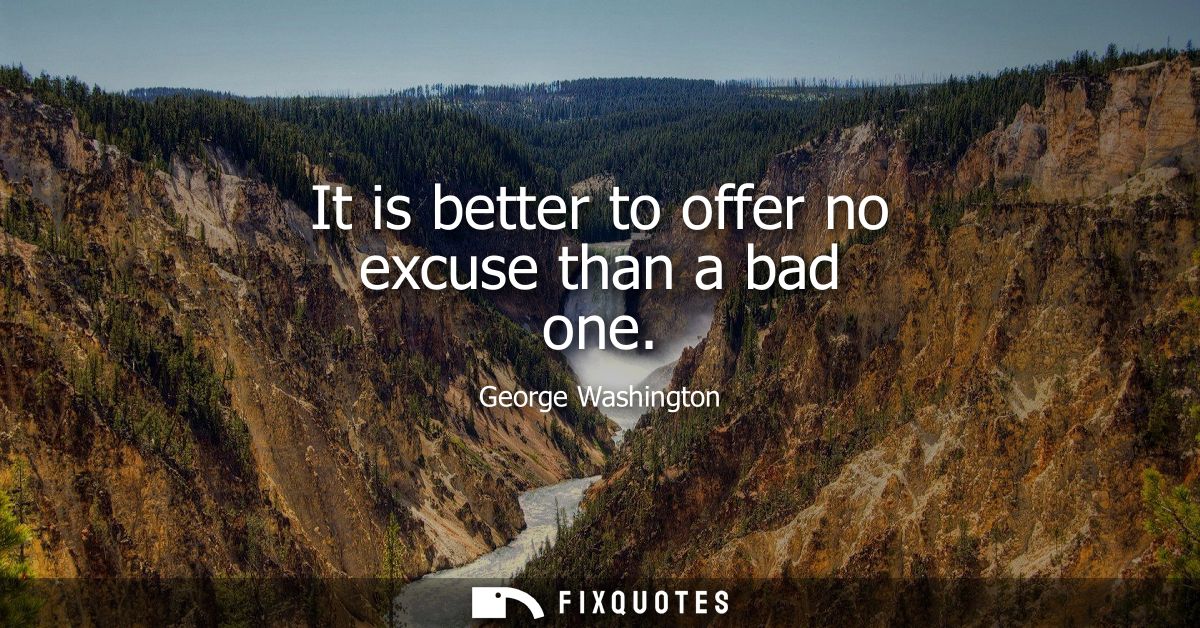
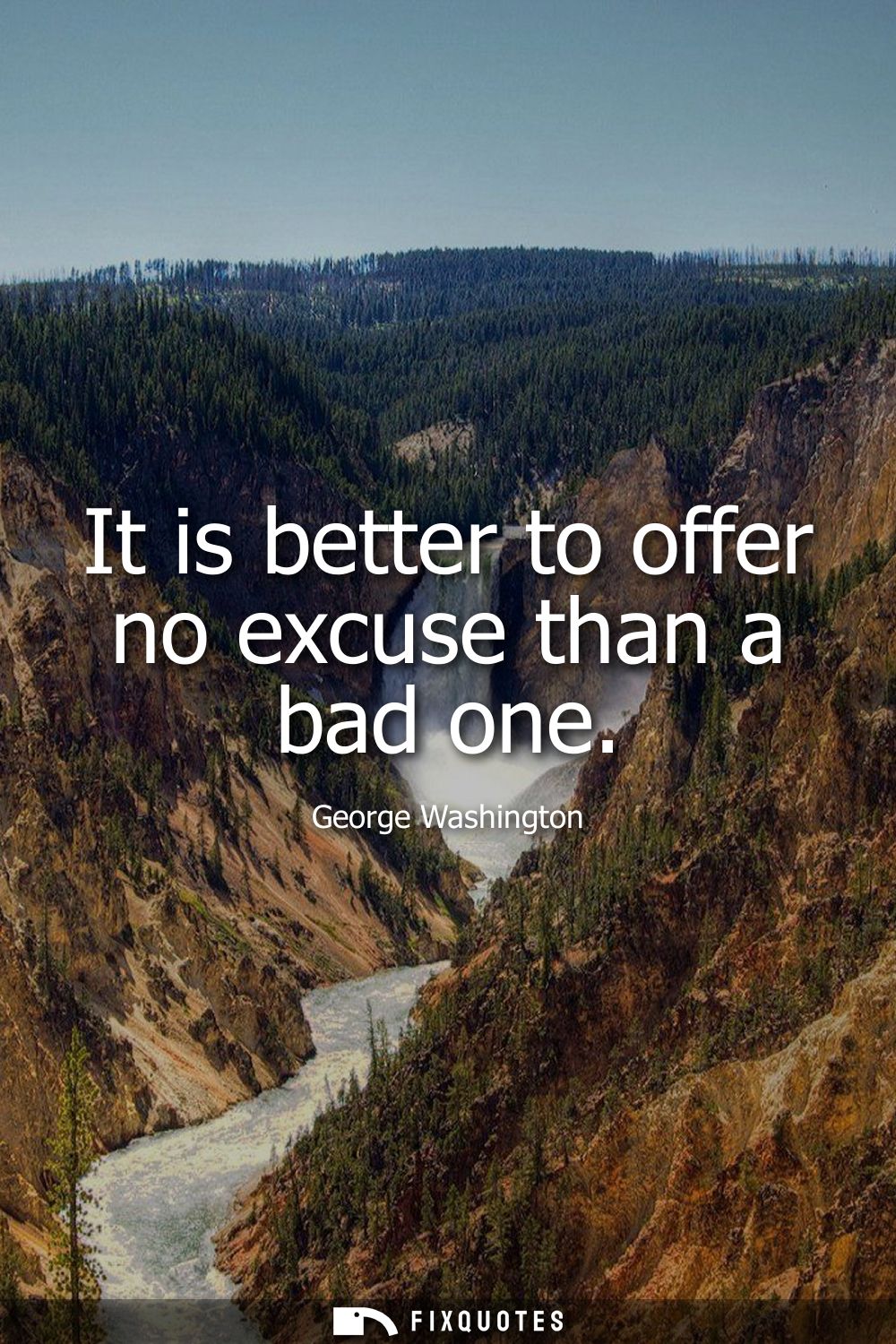
"It is better to offer no excuse than a bad one"
About this Quote
A bad excuse doesn’t just fail; it advertises weakness in judgment. Washington’s line is blunt, almost managerial, but it carries the moral gravity of a man trying to build a political culture from scratch. In a young republic allergic to monarchy and hungry for legitimacy, credibility was a form of currency. If leaders sounded slippery, the whole experiment looked flimsy. “Offer no excuse” isn’t an endorsement of silence so much as a demand for self-command: take the hit cleanly, don’t insult your audience with a story you don’t fully believe.
The subtext is about authority. Washington understood that power in a republic depends on restraint and public trust, not spectacle. A bad excuse signals panic, vanity, or evasiveness - the very traits the Revolution claimed to reject. Refusing to give one performs steadiness. It suggests you can absorb criticism without scrambling to protect your ego, and that you respect the listener enough not to hand them a flimsy pretext.
There’s also a strategic edge: a weak excuse gives your opponent the easiest possible target. Once disproved, it turns a single mistake into a pattern of dishonesty. Silence, by contrast, preserves optionality. You can apologize, you can correct, you can explain later with evidence - but you can’t un-lie a lie-shaped excuse.
Placed in Washington’s world of reputation, honor, and fragile institutions, the line reads as an early American rule of crisis communication: integrity isn’t only what you did, it’s how you account for it when everyone is watching.
The subtext is about authority. Washington understood that power in a republic depends on restraint and public trust, not spectacle. A bad excuse signals panic, vanity, or evasiveness - the very traits the Revolution claimed to reject. Refusing to give one performs steadiness. It suggests you can absorb criticism without scrambling to protect your ego, and that you respect the listener enough not to hand them a flimsy pretext.
There’s also a strategic edge: a weak excuse gives your opponent the easiest possible target. Once disproved, it turns a single mistake into a pattern of dishonesty. Silence, by contrast, preserves optionality. You can apologize, you can correct, you can explain later with evidence - but you can’t un-lie a lie-shaped excuse.
Placed in Washington’s world of reputation, honor, and fragile institutions, the line reads as an early American rule of crisis communication: integrity isn’t only what you did, it’s how you account for it when everyone is watching.
Quote Details
| Topic | Honesty & Integrity |
|---|---|
| Source | Verified source: George Washington to Harriot Washington, 30 October 1791 (George Washington, 1791)
Evidence: I make this remark for no other reason than to shew you it is better to offer no excuse than a bad one, if at any time you should happen to fall into an error. (Papers of George Washington, Presidential Series, vol. 9, pp. 130–131). This line appears in Washington’s letter written in Philadelphia on October 30, 1791, to his niece Harriot (Harriett) Washington. Founders Online (National Archives) provides a vetted transcription and identifies the print scholarly edition: The Papers of George Washington, Presidential Series, vol. 9, edited by Mark A. Mastromarino (University Press of Virginia, 2000), pp. 130–131. This is a primary-source occurrence (Washington’s own words) and is the best verifiable origin for the quote in this wording. Other candidates (1) The Writings of George Washington (George Washington, 1891) compilation95.0% George Washington. cousin was on the point of sending to the post - office . I make this remark for no other reason ,... |
| Cite |
Citation Formats
APA Style (7th ed.)
Washington, George. (2026, February 11). It is better to offer no excuse than a bad one. FixQuotes. https://fixquotes.com/quotes/it-is-better-to-offer-no-excuse-than-a-bad-one-27932/
Chicago Style
Washington, George. "It is better to offer no excuse than a bad one." FixQuotes. February 11, 2026. https://fixquotes.com/quotes/it-is-better-to-offer-no-excuse-than-a-bad-one-27932/.
MLA Style (9th ed.)
"It is better to offer no excuse than a bad one." FixQuotes, 11 Feb. 2026, https://fixquotes.com/quotes/it-is-better-to-offer-no-excuse-than-a-bad-one-27932/. Accessed 11 Mar. 2026.
More Quotes by George
Add to List