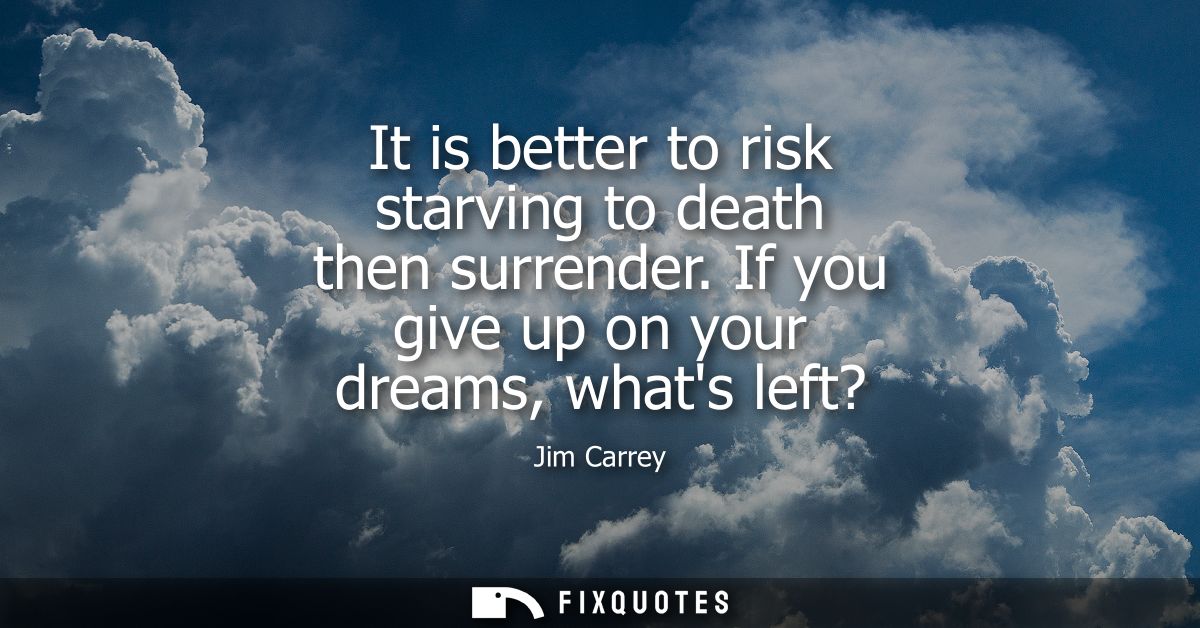
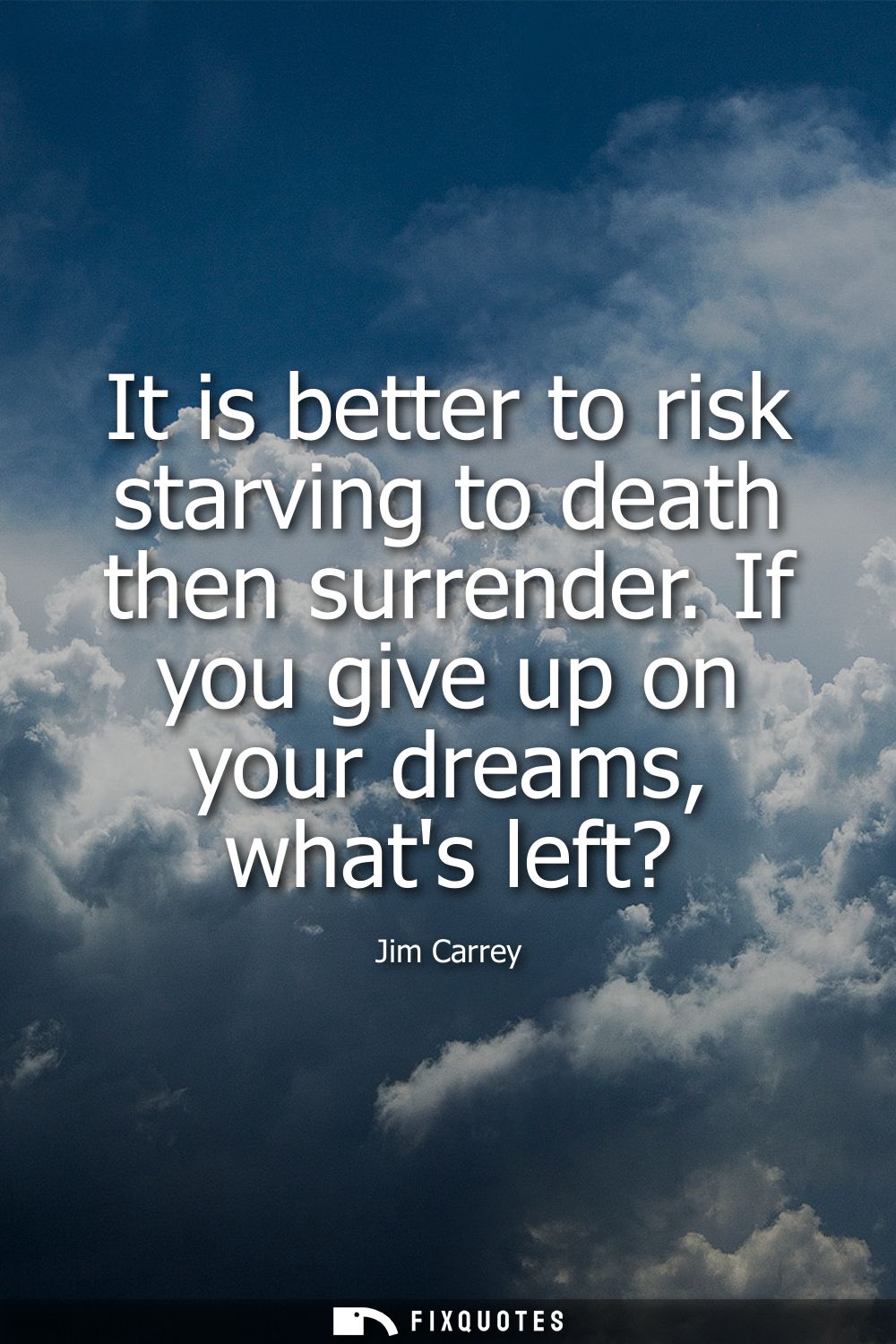
"It is better to risk starving to death then surrender. If you give up on your dreams, what's left?"
About this Quote
The subtext is shaped by Carrey’s particular mythology. He’s one of the era’s most visible rags-to-riches entertainers, someone who’s spoken publicly about visualization, rejection, and the weird faith required to keep auditioning when you’re broke and anonymous. Coming from him, “risk” isn’t abstract self-help language; it’s the memory of choosing instability on purpose and being mocked for it until it paid.
The second sentence lands the real punch: surrender doesn’t just cost you the dream; it hollows out the present. Carrey frames dreams as a structural necessity, not a luxury. The rhetorical move is clever: he turns quitting into an existential problem rather than a practical one, forcing the listener to consider identity. If you abandon the thing that animates you, what replaces it - distraction, comfort, status? His intent is motivational, but the edge is accusatory: don’t pretend you’re fine if you’ve negotiated yourself into numbness.
Quote Details
| Topic | Never Give Up |
|---|---|
| Source | Help us find the source |
| Cite |
Citation Formats
APA Style (7th ed.)
Carrey, Jim. (2026, January 15). It is better to risk starving to death then surrender. If you give up on your dreams, what's left? FixQuotes. https://fixquotes.com/quotes/it-is-better-to-risk-starving-to-death-then-7761/
Chicago Style
Carrey, Jim. "It is better to risk starving to death then surrender. If you give up on your dreams, what's left?" FixQuotes. January 15, 2026. https://fixquotes.com/quotes/it-is-better-to-risk-starving-to-death-then-7761/.
MLA Style (9th ed.)
"It is better to risk starving to death then surrender. If you give up on your dreams, what's left?" FixQuotes, 15 Jan. 2026, https://fixquotes.com/quotes/it-is-better-to-risk-starving-to-death-then-7761/. Accessed 6 Apr. 2026.