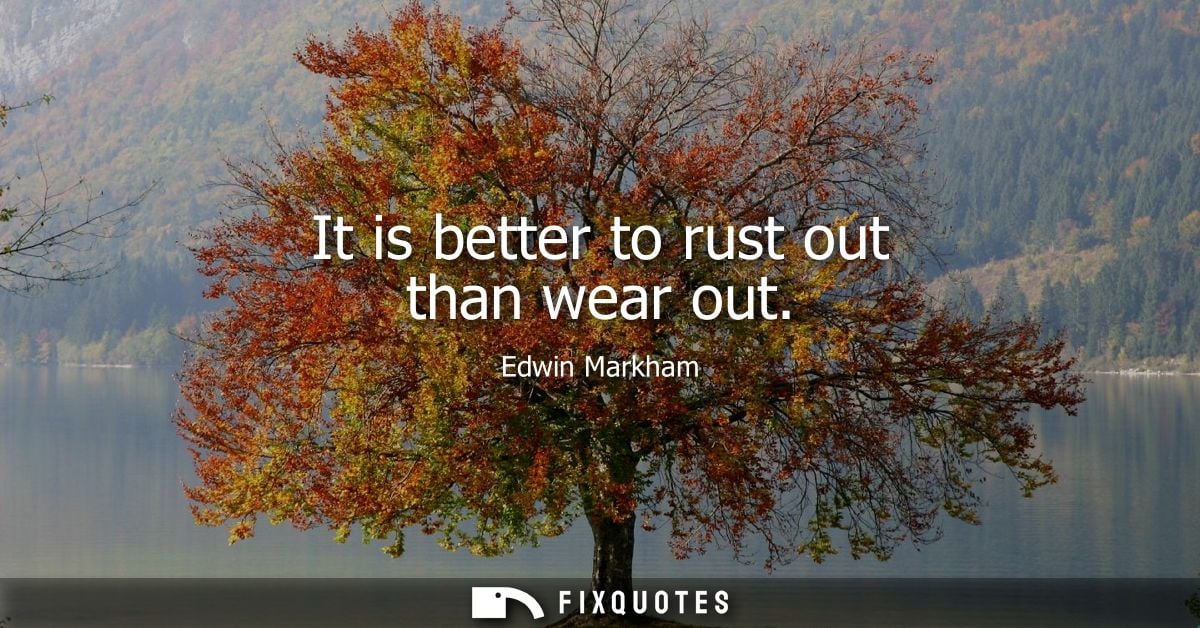
"It is better to rust out than wear out"
About this Quote
Rust is a quiet failure: it happens when something sits still long enough for the world to reclaim it. To “wear out,” by contrast, is the honorable damage of use. Markham’s line flips the usual moral geometry. Most cultures praise the tool that wears out in service; Markham praises the one that corrodes, because corrosion implies duration. You can only rust if you’ve lasted.
The intent feels less like laziness-as-virtue and more like a poet’s wager against the era’s growing worship of productivity. Markham lived through the industrial churn of the late 19th and early 20th centuries, when human beings were increasingly measured like machinery: output, efficiency, replaceability. “Wear out” is what the factory demands - burn bright, break, get swapped. “Rust out” is the refusal to be consumed on schedule. It’s a defense of the long arc: staying intact, staying yours, even if that means slower, less visibly “useful” years.
The subtext is also anxious. Rust isn’t just longevity; it’s neglect, obsolescence, the fear of being left behind. Markham turns that fear into a kind of stoic stance: if the price of not being used up by other people’s needs is a little corrosion at the edges, so be it. It’s a line that works because it argues with itself. It sounds like surrender, but it’s really a protest against a culture that calls self-erasure “work ethic.”
The intent feels less like laziness-as-virtue and more like a poet’s wager against the era’s growing worship of productivity. Markham lived through the industrial churn of the late 19th and early 20th centuries, when human beings were increasingly measured like machinery: output, efficiency, replaceability. “Wear out” is what the factory demands - burn bright, break, get swapped. “Rust out” is the refusal to be consumed on schedule. It’s a defense of the long arc: staying intact, staying yours, even if that means slower, less visibly “useful” years.
The subtext is also anxious. Rust isn’t just longevity; it’s neglect, obsolescence, the fear of being left behind. Markham turns that fear into a kind of stoic stance: if the price of not being used up by other people’s needs is a little corrosion at the edges, so be it. It’s a line that works because it argues with itself. It sounds like surrender, but it’s really a protest against a culture that calls self-erasure “work ethic.”
Quote Details
| Topic | Work-Life Balance |
|---|---|
| Source | Later attribution: Quotes: The Famous and Not so Famous (Terence M. Dorn Ph.D., 2021) modern compilationISBN: 9781662447952 · ID: ptZSEAAAQBAJ
Evidence: ... It is better to rust out than wear out . - Edwin Markham I will not die an unlived life . I will not live in fear of falling or catching fire . I choose to inhabit my days , to allow my living to open me , to make me less afraid , more ... Other candidates (1) Edwin Markham (Edwin Markham) compilation32.9% of this life run there to rhyme how eagerly then will the poor heart pardon all |
| Cite |
Citation Formats
APA Style (7th ed.)
Markham, Edwin. (2026, January 13). It is better to rust out than wear out. FixQuotes. https://fixquotes.com/quotes/it-is-better-to-rust-out-than-wear-out-67839/
Chicago Style
Markham, Edwin. "It is better to rust out than wear out." FixQuotes. January 13, 2026. https://fixquotes.com/quotes/it-is-better-to-rust-out-than-wear-out-67839/.
MLA Style (9th ed.)
"It is better to rust out than wear out." FixQuotes, 13 Jan. 2026, https://fixquotes.com/quotes/it-is-better-to-rust-out-than-wear-out-67839/. Accessed 4 Apr. 2026.
More Quotes by Edwin
Add to List