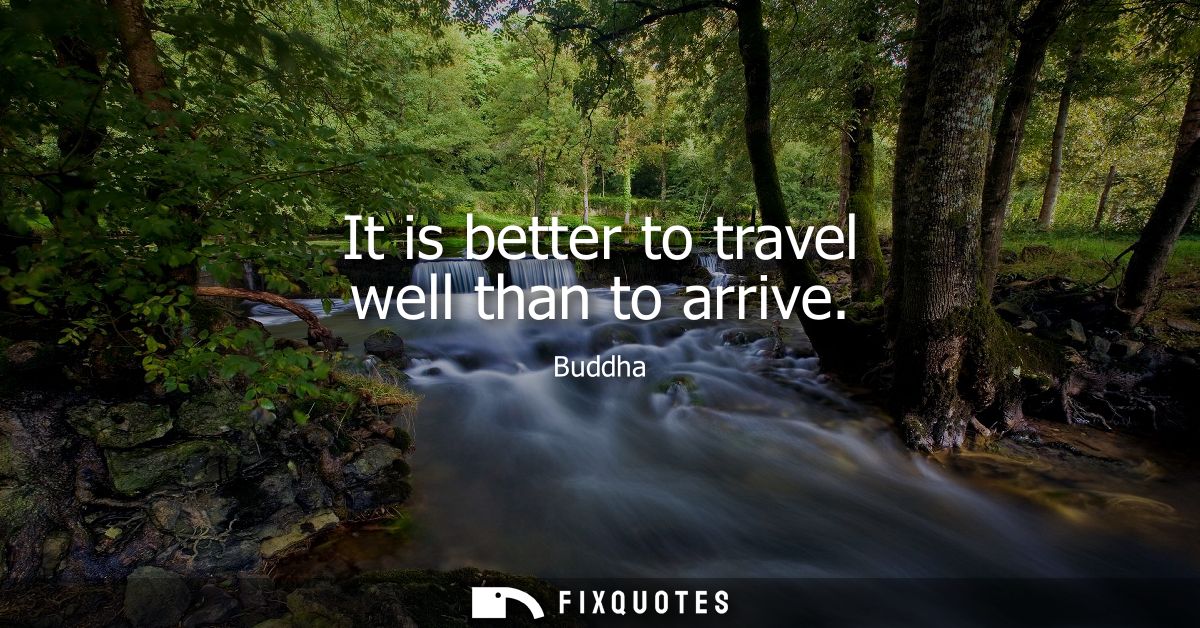
"It is better to travel well than to arrive"
About this Quote
“It is better to travel well than to arrive” weaponizes a deceptively gentle image against one of the oldest human addictions: treating life as a series of finish lines. Put in the mouth of the Buddha, it’s not a Hallmark slogan about enjoying the scenery. It’s a disciplined rebuke of goal-obsession and the quiet violence we do to ourselves when “arrival” becomes salvation.
The line works because it smuggles a spiritual argument into ordinary logistics. Travel is process: breath, attention, restraint, the daily choices that shape a mind. Arrival is the fantasy of closure, the moment we tell ourselves striving stops and satisfaction locks in. Buddhism’s central diagnosis is that this fantasy breeds dukkha: we cling to outcomes, then suffer when they shift, disappoint, or evaporate. Even if you “arrive,” the mind immediately drafts the next destination. The quote punctures that treadmill.
Its subtext also challenges status. In any culture, arrival implies proof: credentials, enlightenment badges, a story you can sell. “Travel well” refuses the performance. It centers conduct over conquest, ethics over applause, practice over proclamation. Read through the Eightfold Path, the phrase becomes almost technical: the “well” is right intention, right action, right livelihood enacted in motion, not displayed at the end.
Context matters. The Buddha taught in a world of competing ascetics and ritual guarantees, where liberation was often marketed as a dramatic endpoint. This line shifts authority away from priests and promises and back onto the practitioner’s moment-to-moment attention. Liberation isn’t a trophy; it’s how you walk.
The line works because it smuggles a spiritual argument into ordinary logistics. Travel is process: breath, attention, restraint, the daily choices that shape a mind. Arrival is the fantasy of closure, the moment we tell ourselves striving stops and satisfaction locks in. Buddhism’s central diagnosis is that this fantasy breeds dukkha: we cling to outcomes, then suffer when they shift, disappoint, or evaporate. Even if you “arrive,” the mind immediately drafts the next destination. The quote punctures that treadmill.
Its subtext also challenges status. In any culture, arrival implies proof: credentials, enlightenment badges, a story you can sell. “Travel well” refuses the performance. It centers conduct over conquest, ethics over applause, practice over proclamation. Read through the Eightfold Path, the phrase becomes almost technical: the “well” is right intention, right action, right livelihood enacted in motion, not displayed at the end.
Context matters. The Buddha taught in a world of competing ascetics and ritual guarantees, where liberation was often marketed as a dramatic endpoint. This line shifts authority away from priests and promises and back onto the practitioner’s moment-to-moment attention. Liberation isn’t a trophy; it’s how you walk.
Quote Details
| Topic | Journey |
|---|---|
| Source | Help us find the source |
| Cite |
Citation Formats
APA Style (7th ed.)
Buddha. (2026, January 15). It is better to travel well than to arrive. FixQuotes. https://fixquotes.com/quotes/it-is-better-to-travel-well-than-to-arrive-13648/
Chicago Style
Buddha. "It is better to travel well than to arrive." FixQuotes. January 15, 2026. https://fixquotes.com/quotes/it-is-better-to-travel-well-than-to-arrive-13648/.
MLA Style (9th ed.)
"It is better to travel well than to arrive." FixQuotes, 15 Jan. 2026, https://fixquotes.com/quotes/it-is-better-to-travel-well-than-to-arrive-13648/. Accessed 13 Mar. 2026.
More Quotes by Buddha
Add to List