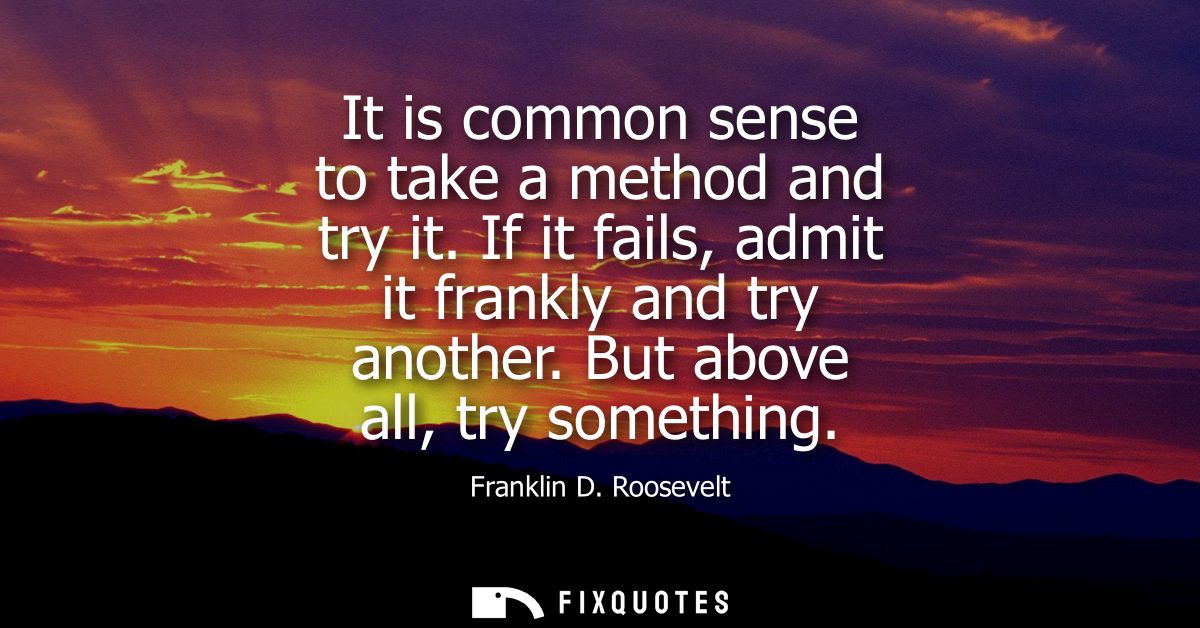
"It is common sense to take a method and try it. If it fails, admit it frankly and try another. But above all, try something"
About this Quote
The intent is strategic. “Take a method and try it” sounds humble, almost managerial, as if the presidency is a workshop instead of a throne. That modesty is disarming; it lowers the ideological temperature and invites buy-in from people who might distrust grand theories. Then comes the key clause: “If it fails, admit it frankly.” That’s accountability, but also inoculation. By pre-authorizing failure, Roosevelt makes policy risk acceptable in public life, where opponents treat any mistake as evidence of corruption or incompetence.
The subtext is sharper: doing nothing is the real failure, and it carries its own politics. “Above all, try something” is a jab at the conservative instinct to wait for perfect information - an instinct that can masquerade as prudence while unemployment climbs and banks collapse. It’s also a blueprint for the New Deal’s improvisational character: a series of programs, agencies, and reforms, some lasting, some scrapped, all premised on the idea that government can learn in real time.
Roosevelt’s rhetorical power comes from turning experimentation into patriotism. In a moment when the future felt closed, he pried it open by treating action as a civic duty.
Quote Details
| Topic | Motivational |
|---|---|
| Source | Help us find the source |
| Cite |
Citation Formats
APA Style (7th ed.)
Roosevelt, Franklin D. (2026, January 17). It is common sense to take a method and try it. If it fails, admit it frankly and try another. But above all, try something. FixQuotes. https://fixquotes.com/quotes/it-is-common-sense-to-take-a-method-and-try-it-if-35016/
Chicago Style
Roosevelt, Franklin D. "It is common sense to take a method and try it. If it fails, admit it frankly and try another. But above all, try something." FixQuotes. January 17, 2026. https://fixquotes.com/quotes/it-is-common-sense-to-take-a-method-and-try-it-if-35016/.
MLA Style (9th ed.)
"It is common sense to take a method and try it. If it fails, admit it frankly and try another. But above all, try something." FixQuotes, 17 Jan. 2026, https://fixquotes.com/quotes/it-is-common-sense-to-take-a-method-and-try-it-if-35016/. Accessed 5 Mar. 2026.