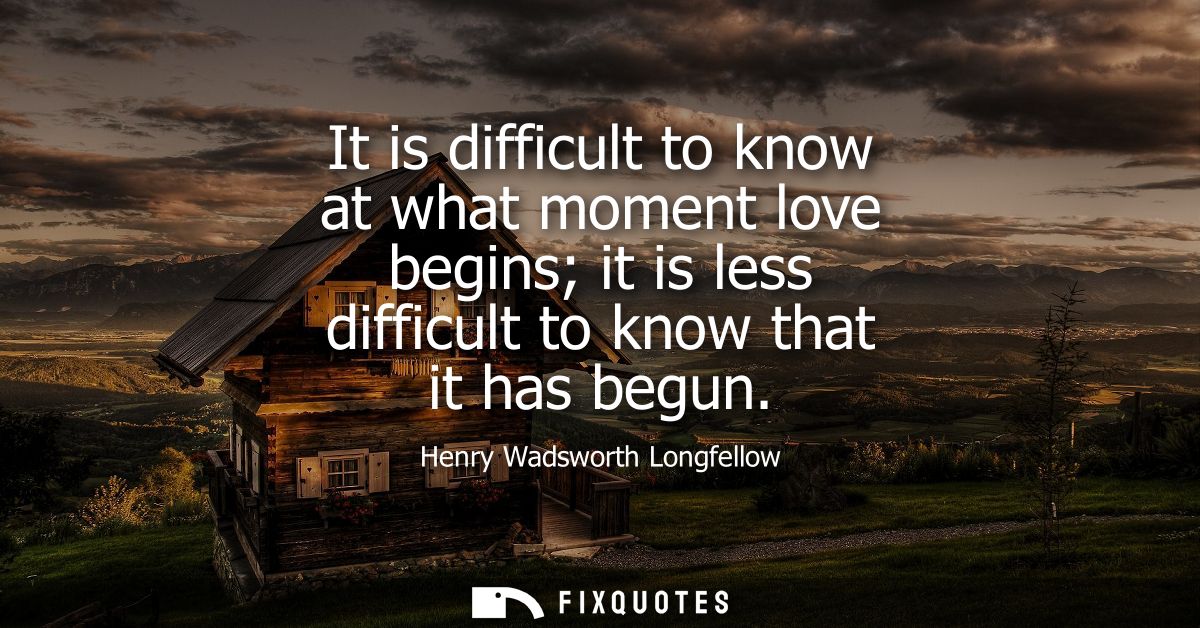
"It is difficult to know at what moment love begins; it is less difficult to know that it has begun"
About this Quote
Then the sentence pivots: “it is less difficult to know that it has begun.” Not easy, just easier. The subtext is almost diagnostic. You may not catch love entering, but you recognize the symptoms: the reshaping of attention, the way someone becomes a default reference point, the strange new seriousness of small things. Longfellow is naming the asymmetry between cause and effect. Origins are obscure; consequences are loud.
Context matters: Longfellow wrote in a 19th-century literary culture that prized sentiment but also moral clarity. This aphorism splits the difference. It gives romance its mystery while keeping it accountable to lived evidence. The line also flatters the reader’s emotional intelligence: you don’t need metaphysics to prove love; you need noticing. And in an era (including ours) that loves to litigate whether feelings are “real,” Longfellow offers a quietly modern standard: love begins not as a declaration, but as a change in perception you can’t unsee.
Quote Details
| Topic | Love |
|---|---|
| Source | Help us find the source |
| Cite |
Citation Formats
APA Style (7th ed.)
Longfellow, Henry Wadsworth. (2026, January 14). It is difficult to know at what moment love begins; it is less difficult to know that it has begun. FixQuotes. https://fixquotes.com/quotes/it-is-difficult-to-know-at-what-moment-love-19963/
Chicago Style
Longfellow, Henry Wadsworth. "It is difficult to know at what moment love begins; it is less difficult to know that it has begun." FixQuotes. January 14, 2026. https://fixquotes.com/quotes/it-is-difficult-to-know-at-what-moment-love-19963/.
MLA Style (9th ed.)
"It is difficult to know at what moment love begins; it is less difficult to know that it has begun." FixQuotes, 14 Jan. 2026, https://fixquotes.com/quotes/it-is-difficult-to-know-at-what-moment-love-19963/. Accessed 12 Feb. 2026.