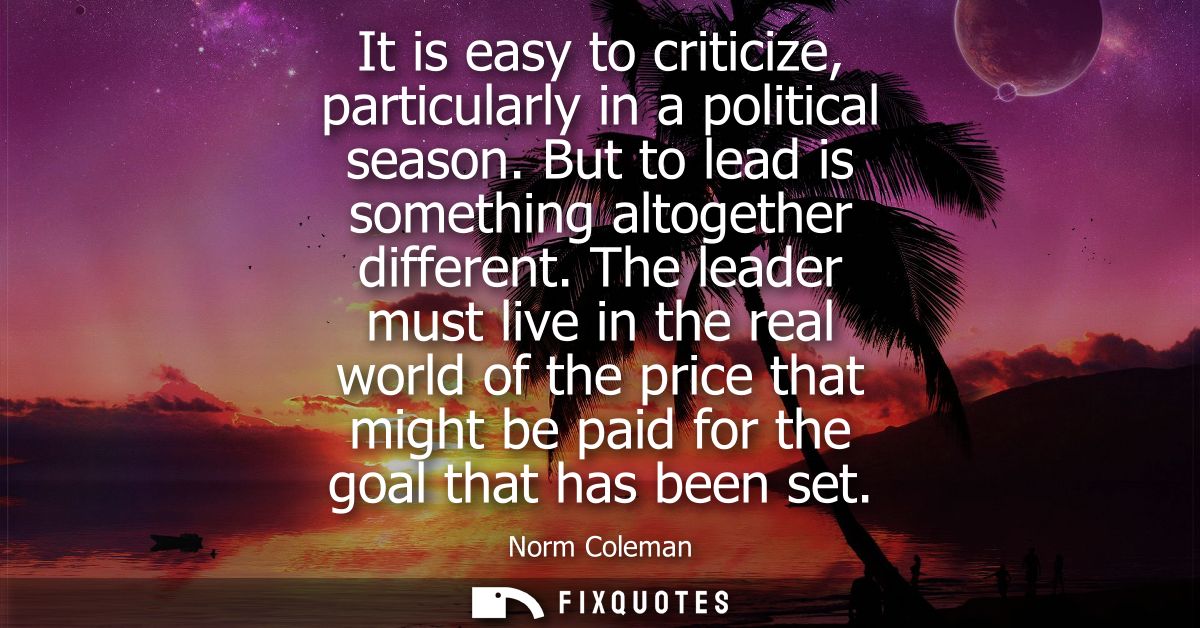
"It is easy to criticize, particularly in a political season. But to lead is something altogether different. The leader must live in the real world of the price that might be paid for the goal that has been set"
About this Quote
Coleman’s line draws a bright, self-serving border between the cheap sport of commentary and the costly business of governing. It’s a familiar move from an elected official: reframe criticism as frictionless virtue-signaling, then recast leadership as a grim calculus of tradeoffs, consequences, and “prices” the public rarely wants itemized. The rhetoric is plainspoken, almost managerial, and that’s the point. He’s not trying to inspire; he’s trying to claim authority.
The subtext is permission and insulation at once. Permission to compromise (“the real world”), to disappoint (“the price”), to make moves that look unprincipled in a soundbite but can be sold as necessary in the Situation Room of politics. Insulation, because it subtly delegitimizes opponents: if you’re criticizing, you must not understand what adults know about constraints, coalition math, and second-order effects. The phrase “particularly in a political season” also tips his hand. Campaigns reward maximalism; governing punishes it. Coleman is talking to voters fatigued by performative outrage and to donors and insiders who prize “electability” and “seriousness” over purity.
“Price” does the heavy lifting. It implies sacrifice without naming who pays it. That ambiguity is useful: it can mean political capital, fiscal cost, reputational damage, even human harm, depending on the issue, while keeping the speaker safely abstract. In an era when politicians are judged by slogans, Coleman stakes out a counter-identity: the pragmatist who wants credit not for being right, but for being responsible.
The subtext is permission and insulation at once. Permission to compromise (“the real world”), to disappoint (“the price”), to make moves that look unprincipled in a soundbite but can be sold as necessary in the Situation Room of politics. Insulation, because it subtly delegitimizes opponents: if you’re criticizing, you must not understand what adults know about constraints, coalition math, and second-order effects. The phrase “particularly in a political season” also tips his hand. Campaigns reward maximalism; governing punishes it. Coleman is talking to voters fatigued by performative outrage and to donors and insiders who prize “electability” and “seriousness” over purity.
“Price” does the heavy lifting. It implies sacrifice without naming who pays it. That ambiguity is useful: it can mean political capital, fiscal cost, reputational damage, even human harm, depending on the issue, while keeping the speaker safely abstract. In an era when politicians are judged by slogans, Coleman stakes out a counter-identity: the pragmatist who wants credit not for being right, but for being responsible.
Quote Details
| Topic | Leadership |
|---|
More Quotes by Norm
Add to List