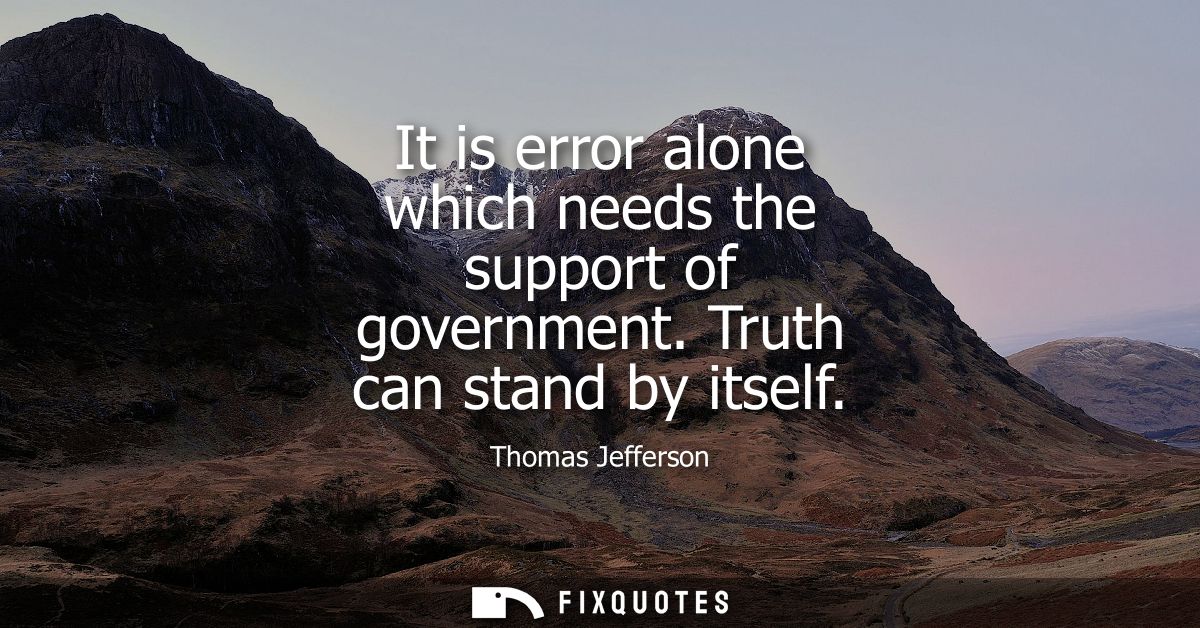
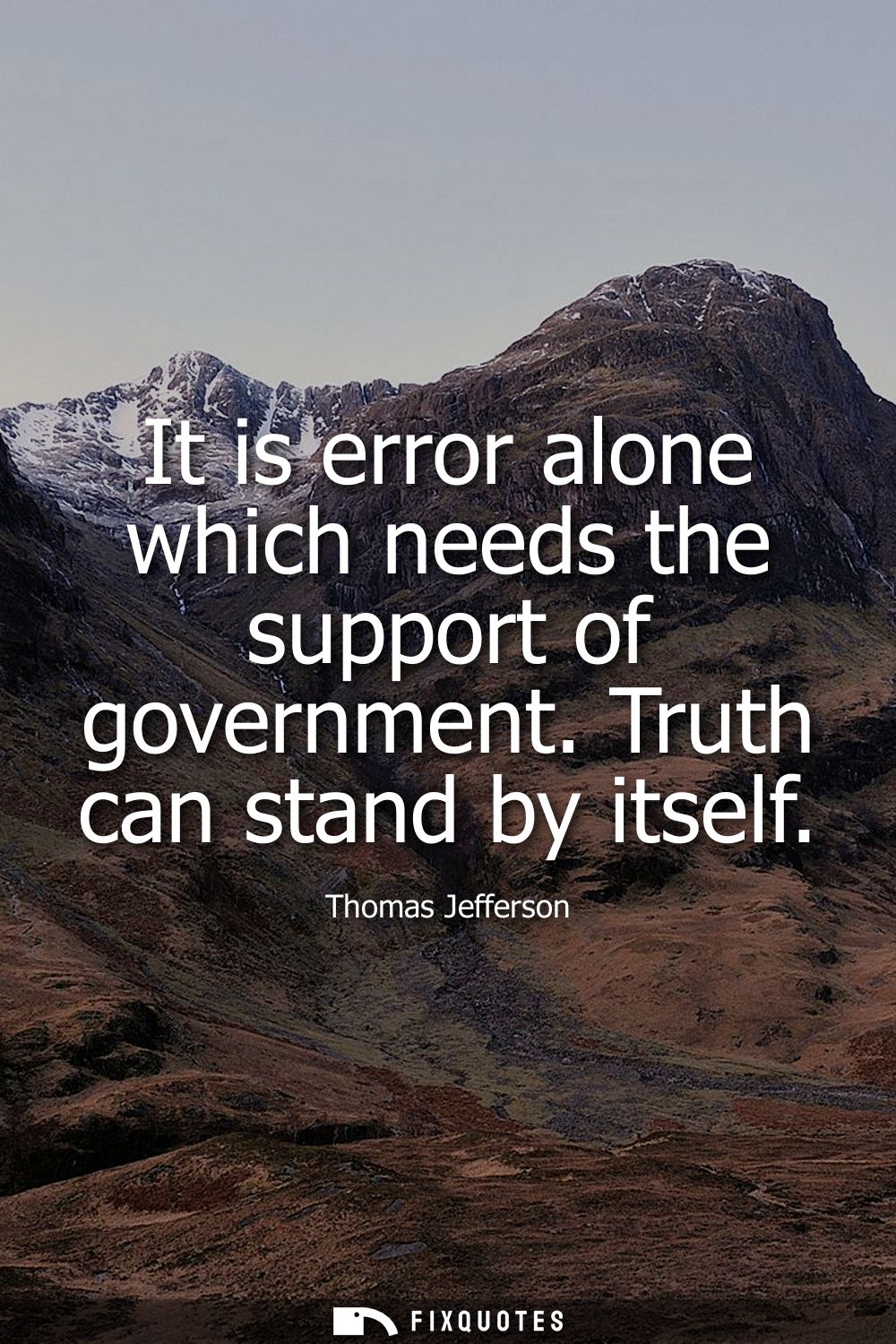
"It is error alone which needs the support of government. Truth can stand by itself"
About this Quote
Jefferson’s line lands like a dare: if an idea needs police power to survive, it’s probably not an idea worth saving. Coming from a founding-era president, that’s not airy Enlightenment optimism so much as a political weapon aimed at the old world Jefferson wanted to bury. Monarchies and established churches didn’t just govern; they curated reality, underwriting “truth” with censorship, blasphemy laws, and state patronage. His jab is that coercion is an admission of weakness. If you have to subsidize belief with penalties, you’ve already conceded it can’t persuade.
The subtext is also a defense of dissent as a stress test. Jefferson is betting on a public sphere where argument, printing presses, and pluralism do the work that kings once did. It’s a compact philosophy of the First Amendment: government should referee rights, not manage conclusions. There’s a sly inversion here, too: he frames state power as a kind of intellectual life support, keeping bad ideas breathing longer than they deserve. Truth, in his telling, is not fragile; it’s adaptive, self-propagating, capable of surviving scrutiny.
Context complicates the bravado. Jefferson knew “truth” doesn’t float above politics; it travels through institutions, education, and who gets heard. The line reads clean because it turns a messy problem (how societies decide what’s real) into a moral clarity test: when authorities insist they’re protecting the public, ask what error they’re protecting from exposure. In an age of culture-war legislation and information gatekeeping, the quote still needles: power’s loudest claim is often that it’s merely safeguarding truth.
The subtext is also a defense of dissent as a stress test. Jefferson is betting on a public sphere where argument, printing presses, and pluralism do the work that kings once did. It’s a compact philosophy of the First Amendment: government should referee rights, not manage conclusions. There’s a sly inversion here, too: he frames state power as a kind of intellectual life support, keeping bad ideas breathing longer than they deserve. Truth, in his telling, is not fragile; it’s adaptive, self-propagating, capable of surviving scrutiny.
Context complicates the bravado. Jefferson knew “truth” doesn’t float above politics; it travels through institutions, education, and who gets heard. The line reads clean because it turns a messy problem (how societies decide what’s real) into a moral clarity test: when authorities insist they’re protecting the public, ask what error they’re protecting from exposure. In an age of culture-war legislation and information gatekeeping, the quote still needles: power’s loudest claim is often that it’s merely safeguarding truth.
Quote Details
| Topic | Truth |
|---|
More Quotes by Thomas
Add to List