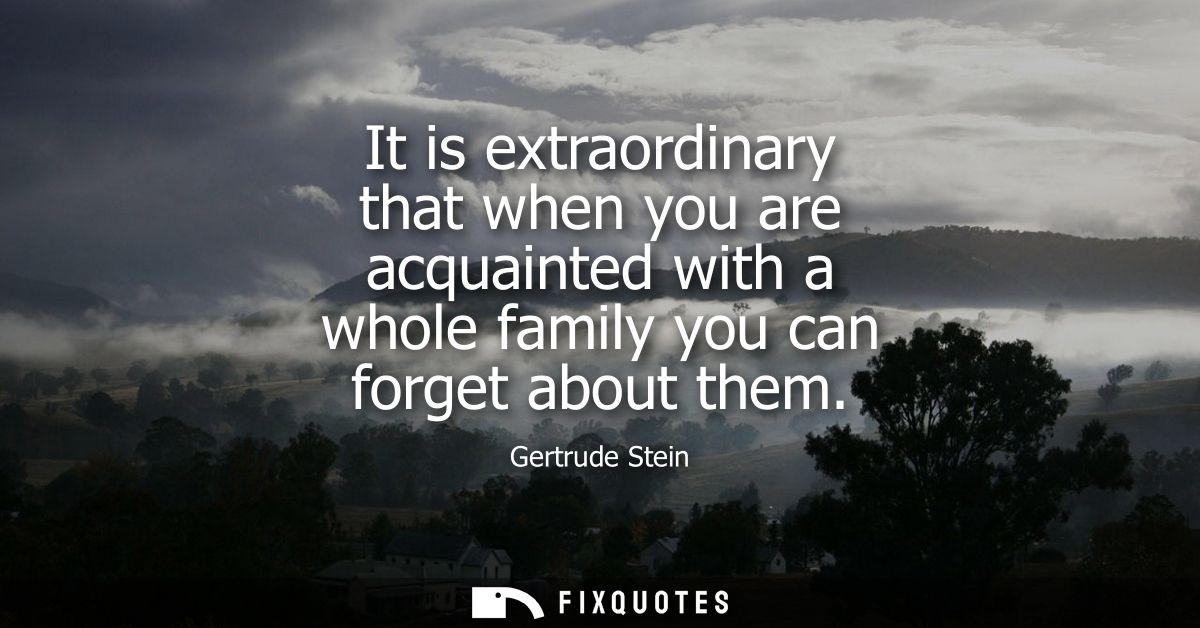
"It is extraordinary that when you are acquainted with a whole family you can forget about them"
About this Quote
Stein’s line lands like a polite insult delivered with a straight face: how can intimacy produce amnesia? The joke is in the mismatch between “acquainted” and “whole family.” We’re trained to think of acquaintance as thin social knowledge, but a family is supposed to be thick with story, obligation, repetition. Stein flips the expectation. Knowing them all, she suggests, can make them blur into a single, forgettable unit.
The intent feels less like cruelty than like a clinical observation about social saturation. A “whole family” isn’t just multiple people; it’s a system of roles and rehearsed anecdotes, a small bureaucracy of nicknames, alliances, and inherited scripts. Once you’ve seen the pattern, the individuals can disappear inside it. Stein’s dry “extraordinary” is doing double duty: it signals surprise while quietly implying, of course this happens.
The subtext also nods to Stein’s modernist project. She was fascinated by repetition, by how language and identity lose their edge when they’re over-familiar. Families run on repetition, and repetition is both comfort and erasure. Familiarity doesn’t always deepen perception; it can flatten it.
Context matters: Stein wrote from a vantage point that was both insider and outsider - an American expatriate in Paris, at the center of avant-garde circles, living openly with Alice B. Toklas. That distance from conventional domestic life sharpens her eye for the way “family” can operate as a social myth. The line punctures sentimentality with a modernist shrug: the more you know the cast, the more you can forget the play.
The intent feels less like cruelty than like a clinical observation about social saturation. A “whole family” isn’t just multiple people; it’s a system of roles and rehearsed anecdotes, a small bureaucracy of nicknames, alliances, and inherited scripts. Once you’ve seen the pattern, the individuals can disappear inside it. Stein’s dry “extraordinary” is doing double duty: it signals surprise while quietly implying, of course this happens.
The subtext also nods to Stein’s modernist project. She was fascinated by repetition, by how language and identity lose their edge when they’re over-familiar. Families run on repetition, and repetition is both comfort and erasure. Familiarity doesn’t always deepen perception; it can flatten it.
Context matters: Stein wrote from a vantage point that was both insider and outsider - an American expatriate in Paris, at the center of avant-garde circles, living openly with Alice B. Toklas. That distance from conventional domestic life sharpens her eye for the way “family” can operate as a social myth. The line punctures sentimentality with a modernist shrug: the more you know the cast, the more you can forget the play.
Quote Details
| Topic | Family |
|---|
More Quotes by Gertrude
Add to List