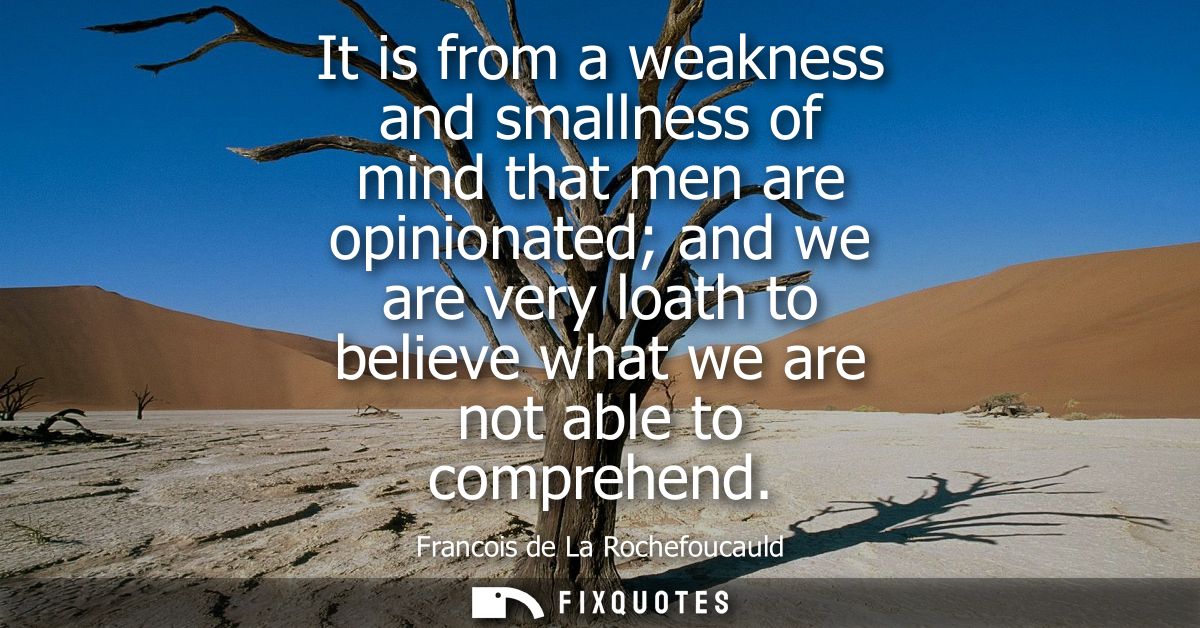
"It is from a weakness and smallness of mind that men are opinionated; and we are very loath to believe what we are not able to comprehend"
About this Quote
The second clause sharpens the blade. “We are very loath to believe what we are not able to comprehend” isn’t about stupidity; it’s about self-protection. Comprehension becomes a gatekeeping instinct: if the mind can’t domesticate an idea, it rejects it as implausible, immoral, or dangerous. That’s the subtext: our beliefs often serve the ego’s comfort more than truth’s demands. La Rochefoucauld is less interested in how people reason than in why they refuse to.
Context matters. Writing in the 17th-century French court tradition of maxims, he’s observing a social ecosystem where reputation is survival and certainty is a weapon. Being “opinionated” is a form of posture, a way to claim authority in a world built on performance. The aphorism’s efficiency mirrors its argument: it corners you quickly, leaving little room to wriggle out with self-flattering exceptions. Its sting comes from the inclusive “we.” He indicts the reader alongside everyone else, turning a critique of arrogance into a mirror for the most common human reflex: mistaking the limits of our understanding for the limits of reality.
Quote Details
| Topic | Reason & Logic |
|---|---|
| Source | Help us find the source |
| Cite |
Citation Formats
APA Style (7th ed.)
Rochefoucauld, Francois de La. (2026, January 17). It is from a weakness and smallness of mind that men are opinionated; and we are very loath to believe what we are not able to comprehend. FixQuotes. https://fixquotes.com/quotes/it-is-from-a-weakness-and-smallness-of-mind-that-35546/
Chicago Style
Rochefoucauld, Francois de La. "It is from a weakness and smallness of mind that men are opinionated; and we are very loath to believe what we are not able to comprehend." FixQuotes. January 17, 2026. https://fixquotes.com/quotes/it-is-from-a-weakness-and-smallness-of-mind-that-35546/.
MLA Style (9th ed.)
"It is from a weakness and smallness of mind that men are opinionated; and we are very loath to believe what we are not able to comprehend." FixQuotes, 17 Jan. 2026, https://fixquotes.com/quotes/it-is-from-a-weakness-and-smallness-of-mind-that-35546/. Accessed 30 Mar. 2026.