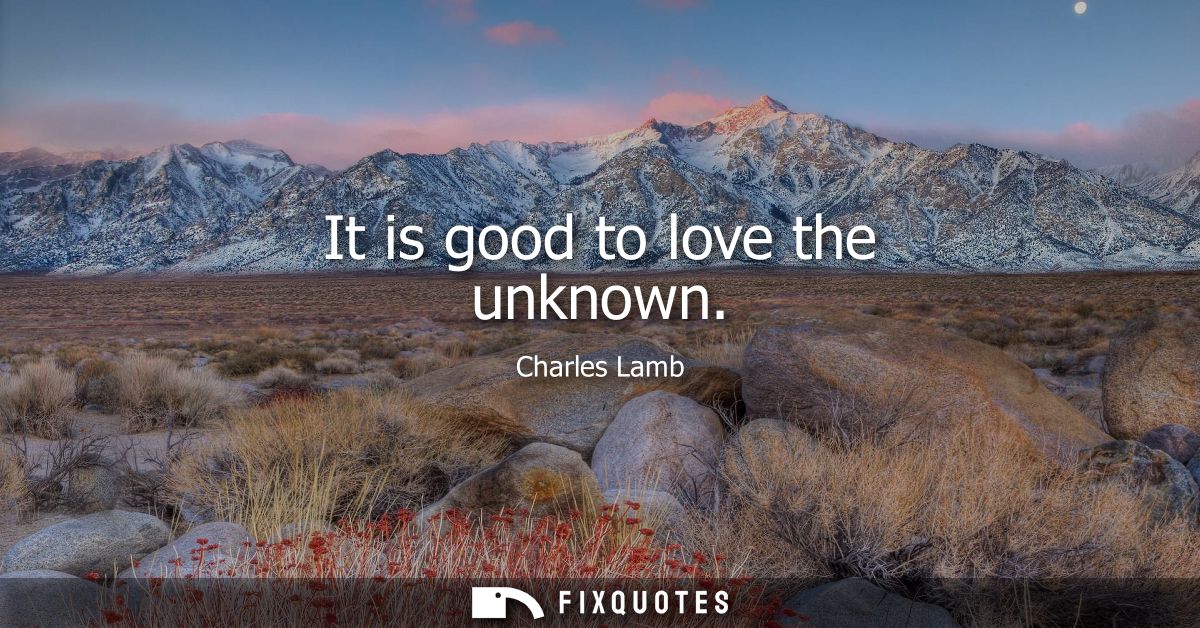
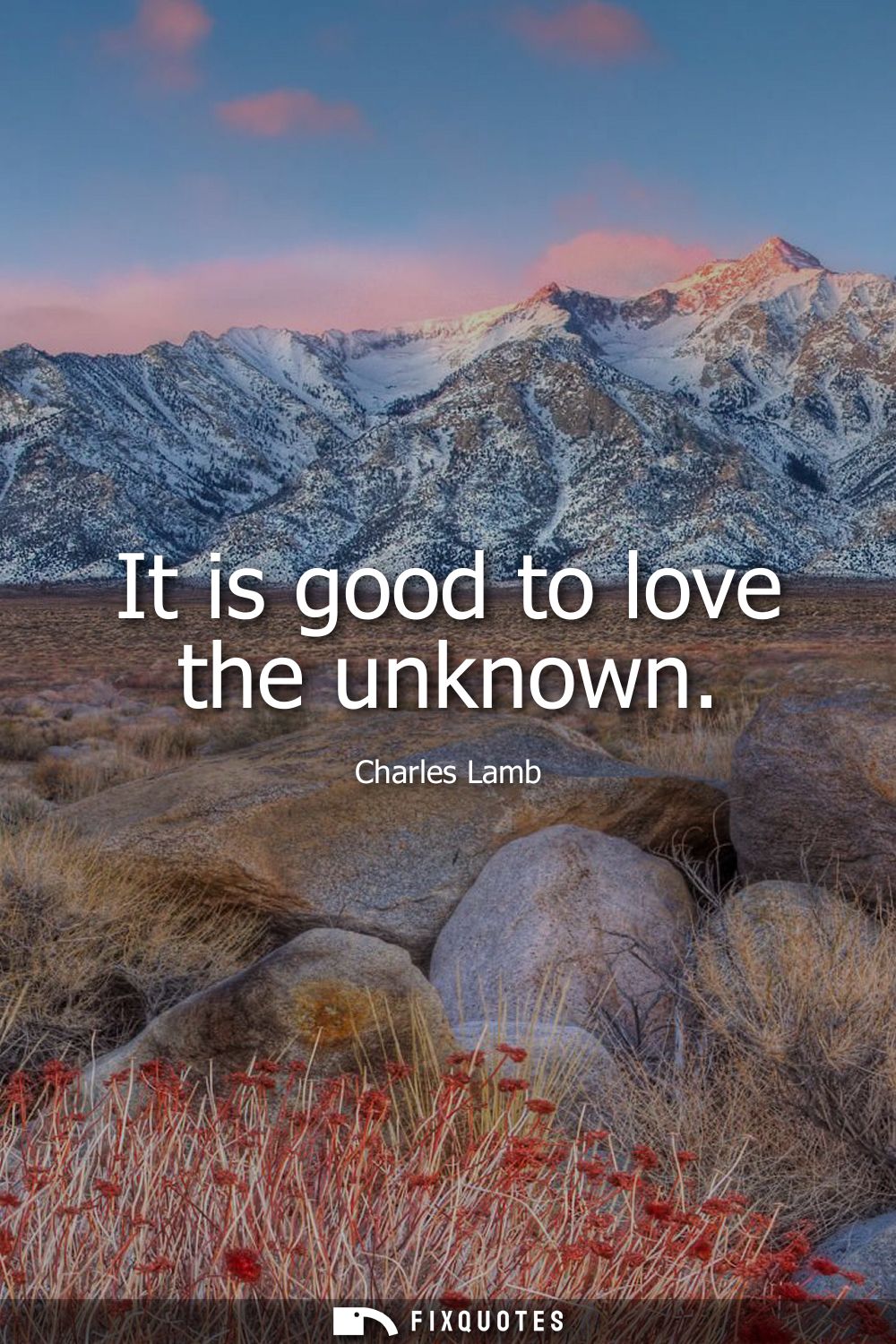
"It is good to love the unknown"
About this Quote
A tidy little aphorism, then a trapdoor: Lamb turns "the unknown" from a threat into a lover. The line works because it reverses the standard Enlightenment reflex - that darkness is simply error waiting to be lit up - and replaces it with appetite. "Good" isn’t the language of romance; it’s the language of moral permission. He’s not claiming the unknown is beautiful or safe. He’s granting you an ethic: you may desire what you cannot yet name.
That permission matters in Lamb’s cultural moment. Writing in the early 19th century, he’s adjacent to Romanticism’s revolt against cold rational accounting, but he’s also a critic and essayist with a keen sense of how minds actually move: by curiosity, by half-formed attraction, by the tug of mystery. "Love" is doing more work than "admire". To love the unknown is to accept vulnerability, to risk being altered by what you encounter. It’s a rebuke to the tidy, controlling self that demands guarantees before engagement.
The subtext is also personal. Lamb’s life was marked by psychological strain and domestic catastrophe; he knew the terror of what can’t be managed. In that light, the phrase reads less like dreamy idealism and more like a hard-won coping strategy: turning uncertainty into a stance rather than a sentence. As criticism, it’s quietly radical. It suggests art, people, and ideas shouldn’t have to be instantly legible to be worthy. The unknown becomes not a deficit of knowledge, but a space where meaning can still arrive.
That permission matters in Lamb’s cultural moment. Writing in the early 19th century, he’s adjacent to Romanticism’s revolt against cold rational accounting, but he’s also a critic and essayist with a keen sense of how minds actually move: by curiosity, by half-formed attraction, by the tug of mystery. "Love" is doing more work than "admire". To love the unknown is to accept vulnerability, to risk being altered by what you encounter. It’s a rebuke to the tidy, controlling self that demands guarantees before engagement.
The subtext is also personal. Lamb’s life was marked by psychological strain and domestic catastrophe; he knew the terror of what can’t be managed. In that light, the phrase reads less like dreamy idealism and more like a hard-won coping strategy: turning uncertainty into a stance rather than a sentence. As criticism, it’s quietly radical. It suggests art, people, and ideas shouldn’t have to be instantly legible to be worthy. The unknown becomes not a deficit of knowledge, but a space where meaning can still arrive.
Quote Details
| Topic | Wisdom |
|---|---|
| Source | Help us find the source |
| Cite |
Citation Formats
APA Style (7th ed.)
Lamb, Charles. (2026, January 17). It is good to love the unknown. FixQuotes. https://fixquotes.com/quotes/it-is-good-to-love-the-unknown-49812/
Chicago Style
Lamb, Charles. "It is good to love the unknown." FixQuotes. January 17, 2026. https://fixquotes.com/quotes/it-is-good-to-love-the-unknown-49812/.
MLA Style (9th ed.)
"It is good to love the unknown." FixQuotes, 17 Jan. 2026, https://fixquotes.com/quotes/it-is-good-to-love-the-unknown-49812/. Accessed 13 Feb. 2026.
More Quotes by Charles
Add to List