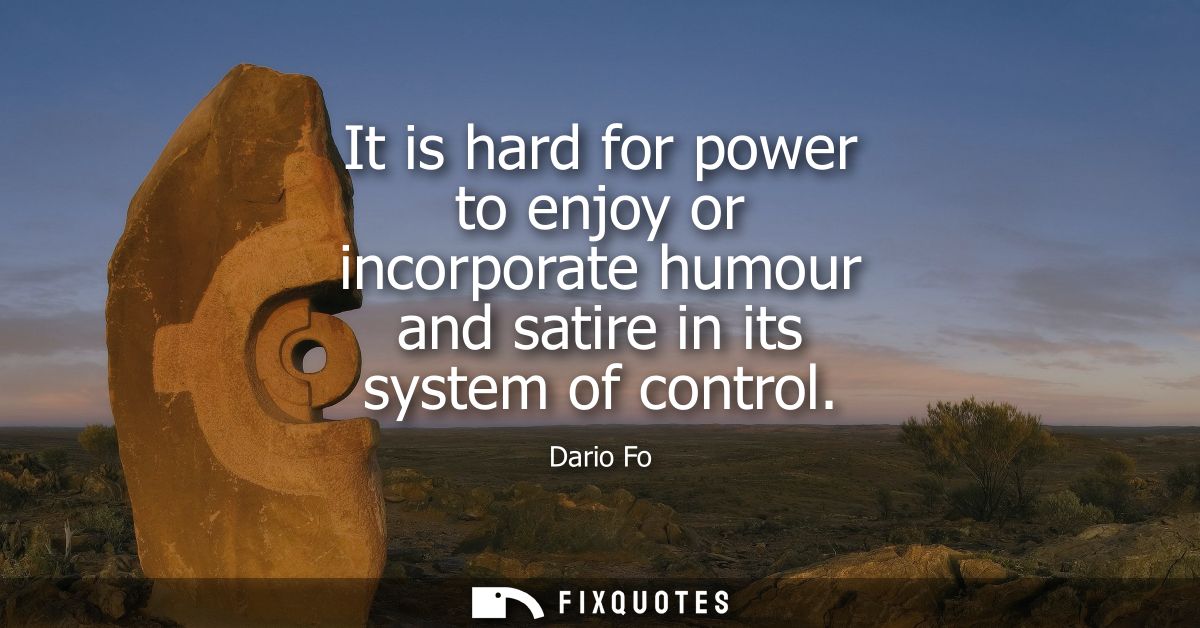
"It is hard for power to enjoy or incorporate humour and satire in its system of control"
About this Quote
Fo, a playwright forged in postwar Italy’s churn of Catholic authority, party politics, media capture, and policing, understood control as theater. Institutions stage legitimacy; citizens are the audience. Satire is the heckler who knows the script. It exposes the trapdoor, the bad props, the bargain between performer and patron. When the crowd laughs, it’s a tiny mutiny: the spell breaks, if only for a minute, because laughter redistributes status. The joke makes the king’s body ordinary again.
The intent here is also strategic. Fo is defending comedy as a political technology: an instrument that doesn’t merely argue against power but disorganizes it. Satire doesn’t need to win a debate; it needs to make certainty wobble. That’s why power struggles to “incorporate” it. The moment authority tries, humor becomes branding, a safety valve, or a sanctioned roast that implies the system is confident enough to absorb critique. Fo’s subtext: don’t be fooled by that invitation. Real satire can’t be domesticated without losing its teeth, because its real target is not a policy but the aura that makes policies untouchable.
Quote Details
| Topic | Freedom |
|---|---|
| Source | Help us find the source |
| Cite |
Citation Formats
APA Style (7th ed.)
Fo, Dario. (2026, January 15). It is hard for power to enjoy or incorporate humour and satire in its system of control. FixQuotes. https://fixquotes.com/quotes/it-is-hard-for-power-to-enjoy-or-incorporate-144950/
Chicago Style
Fo, Dario. "It is hard for power to enjoy or incorporate humour and satire in its system of control." FixQuotes. January 15, 2026. https://fixquotes.com/quotes/it-is-hard-for-power-to-enjoy-or-incorporate-144950/.
MLA Style (9th ed.)
"It is hard for power to enjoy or incorporate humour and satire in its system of control." FixQuotes, 15 Jan. 2026, https://fixquotes.com/quotes/it-is-hard-for-power-to-enjoy-or-incorporate-144950/. Accessed 4 Apr. 2026.