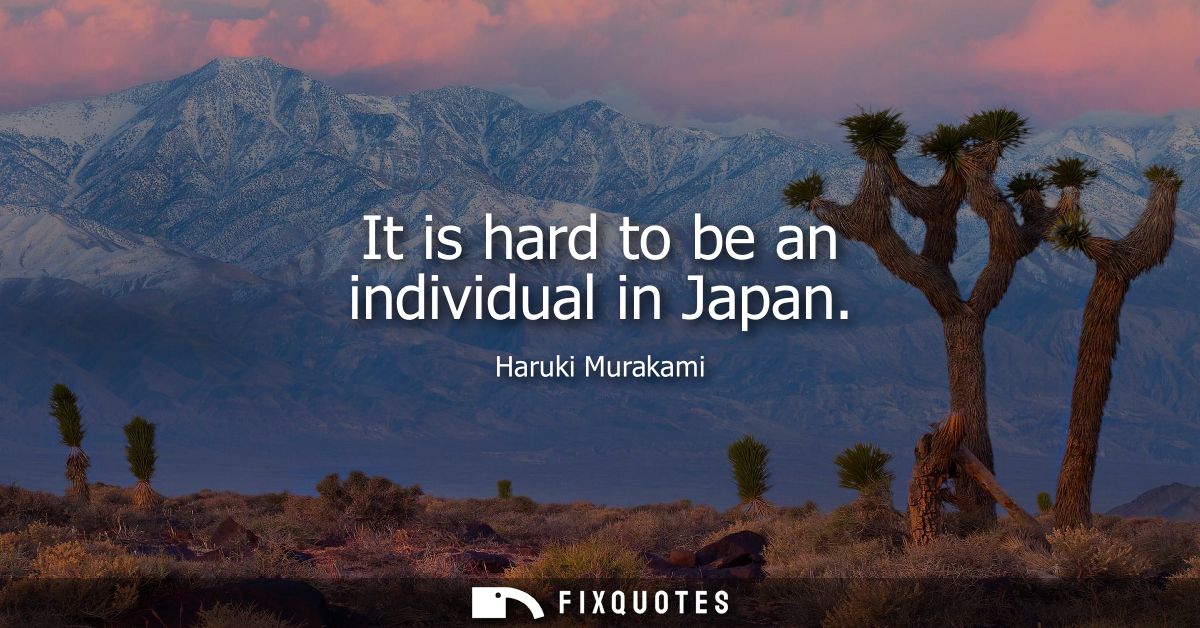
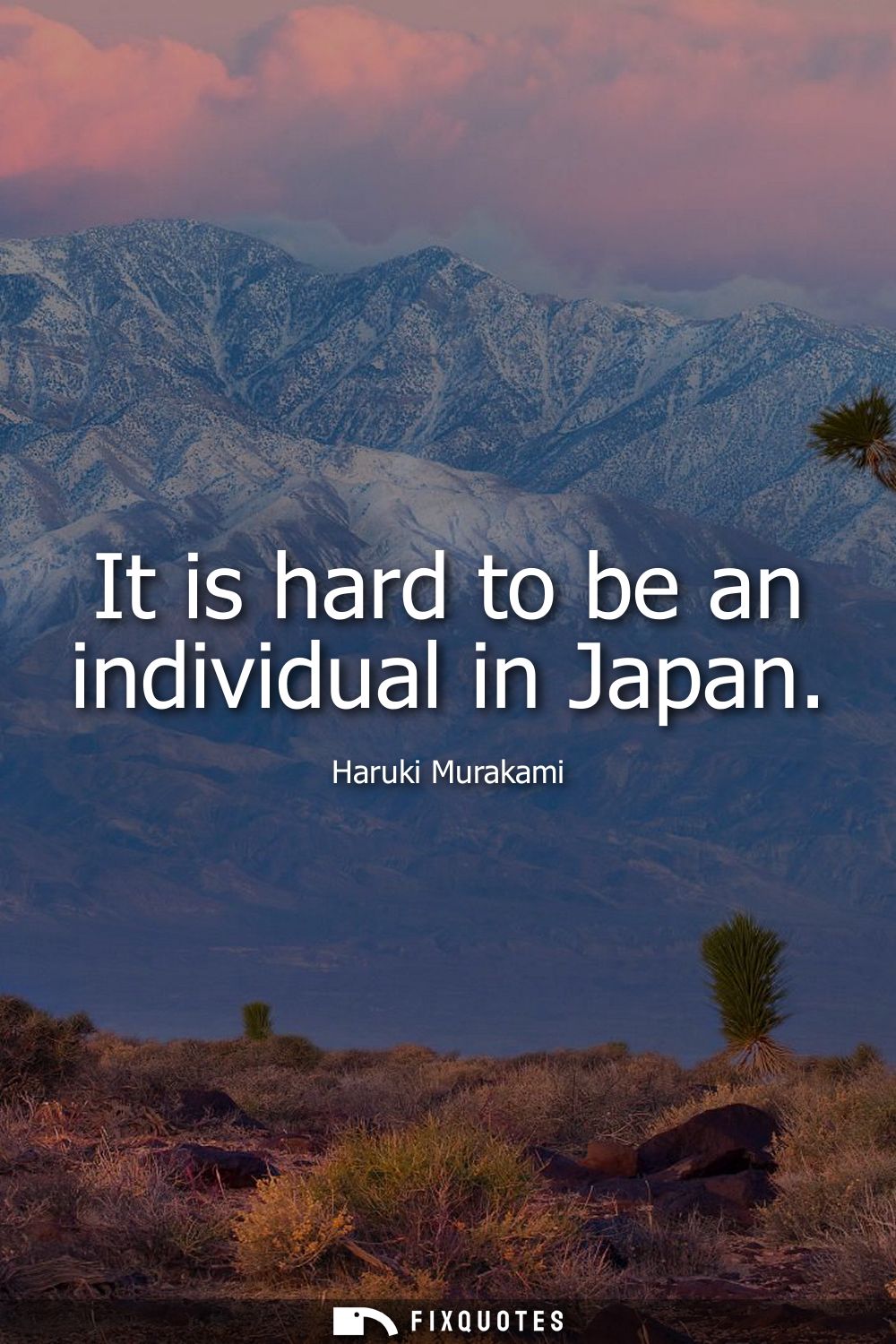
"It is hard to be an individual in Japan"
About this Quote
Murakami’s line lands with the quiet force of an understatement: “hard” is doing all the work. Coming from a novelist who made a career out of loners, drifters, and people who slip sideways out of the social script, it’s less a complaint than a diagnosis of the ambient pressure in modern Japan. The sentence is blunt, almost anti-literary, which is part of its power. It refuses the romantic framing of individualism as heroic rebellion and instead presents it as daily friction, a constant tax on the self.
The subtext is cultural and institutional. Japan’s postwar social contract prized cohesion: schools that train you to read the room, companies that reward loyalty and conformity, neighborhoods where reputation is a kind of currency. “Individual” here isn’t just “eccentric artist”; it’s anyone who won’t smoothly perform the expected roles. Murakami’s fiction often stages this as a mood rather than a manifesto: the protagonist isn’t protesting, he’s quietly opting out, and the world responds with a polite, persistent pushback.
Context matters: Murakami rose during the late-20th-century era of economic boom and its hangover, when the costs of fitting in (overwork, emotional containment, social surveillance) became harder to ignore. The line also signals his own outsider status in Japanese letters, criticized for being too Western, too pop, too detached from “serious” national themes. He’s pointing to the paradox at the center of a highly functional society: when belonging is engineered, difference becomes not just difficult but suspicious.
The subtext is cultural and institutional. Japan’s postwar social contract prized cohesion: schools that train you to read the room, companies that reward loyalty and conformity, neighborhoods where reputation is a kind of currency. “Individual” here isn’t just “eccentric artist”; it’s anyone who won’t smoothly perform the expected roles. Murakami’s fiction often stages this as a mood rather than a manifesto: the protagonist isn’t protesting, he’s quietly opting out, and the world responds with a polite, persistent pushback.
Context matters: Murakami rose during the late-20th-century era of economic boom and its hangover, when the costs of fitting in (overwork, emotional containment, social surveillance) became harder to ignore. The line also signals his own outsider status in Japanese letters, criticized for being too Western, too pop, too detached from “serious” national themes. He’s pointing to the paradox at the center of a highly functional society: when belonging is engineered, difference becomes not just difficult but suspicious.
Quote Details
| Topic | Freedom |
|---|---|
| Source | Help us find the source |
More Quotes by Haruki
Add to List