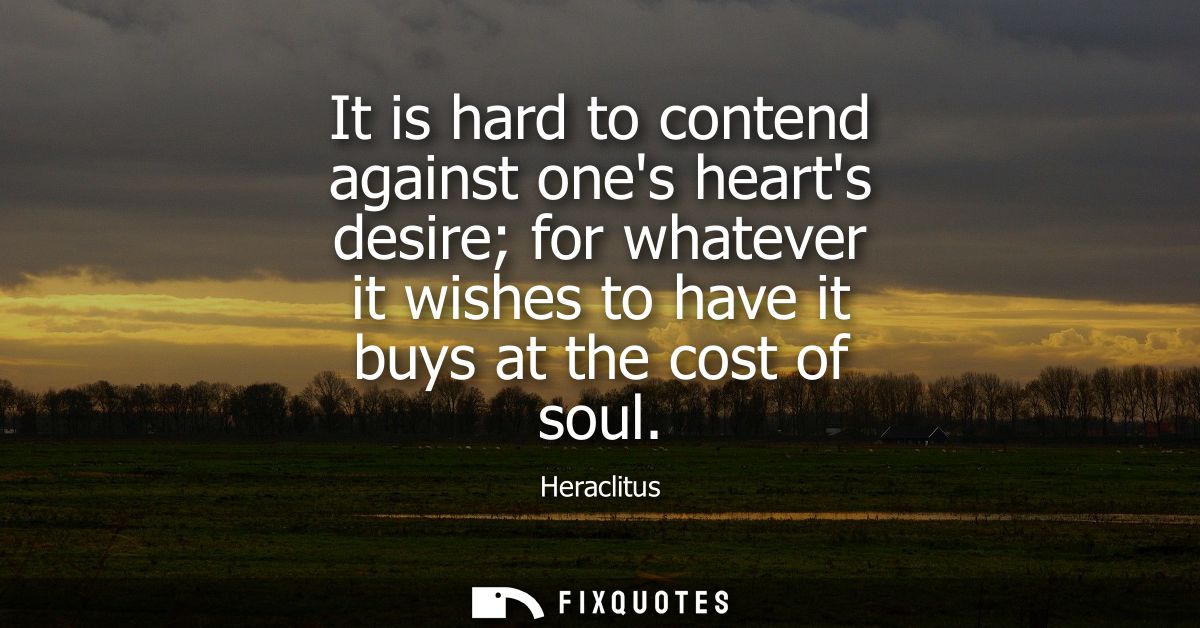
"It is hard to contend against one's heart's desire; for whatever it wishes to have it buys at the cost of soul"
About this Quote
That phrasing fits Heraclitus's wider project: reality is flux, conflict is basic, and human beings are not stable units but battlegrounds of competing pulls. "Hard to contend" suggests an internal war where reason is outmatched by appetite, not because reason is worthless, but because desire is kinetic. It moves first. It rationalizes later.
The subtext is grimly modern: the heart's desire doesn't only chase pleasure; it demands identity. You start adjusting your values to keep the wanting alive, then call those adjustments "choices". By tying fulfillment to "the cost of soul", Heraclitus implies the real danger isn't indulgence; it's self-alteration. The soul becomes smaller, traded away in increments, until the desire doesn't just have you chasing something - it has you speaking its language, defending its priorities, living inside its weather.
Quote Details
| Topic | Wisdom |
|---|---|
| Source | Help us find the source |
| Cite |
Citation Formats
APA Style (7th ed.)
Heraclitus. (2026, January 17). It is hard to contend against one's heart's desire; for whatever it wishes to have it buys at the cost of soul. FixQuotes. https://fixquotes.com/quotes/it-is-hard-to-contend-against-ones-hearts-desire-27170/
Chicago Style
Heraclitus. "It is hard to contend against one's heart's desire; for whatever it wishes to have it buys at the cost of soul." FixQuotes. January 17, 2026. https://fixquotes.com/quotes/it-is-hard-to-contend-against-ones-hearts-desire-27170/.
MLA Style (9th ed.)
"It is hard to contend against one's heart's desire; for whatever it wishes to have it buys at the cost of soul." FixQuotes, 17 Jan. 2026, https://fixquotes.com/quotes/it-is-hard-to-contend-against-ones-hearts-desire-27170/. Accessed 15 Feb. 2026.