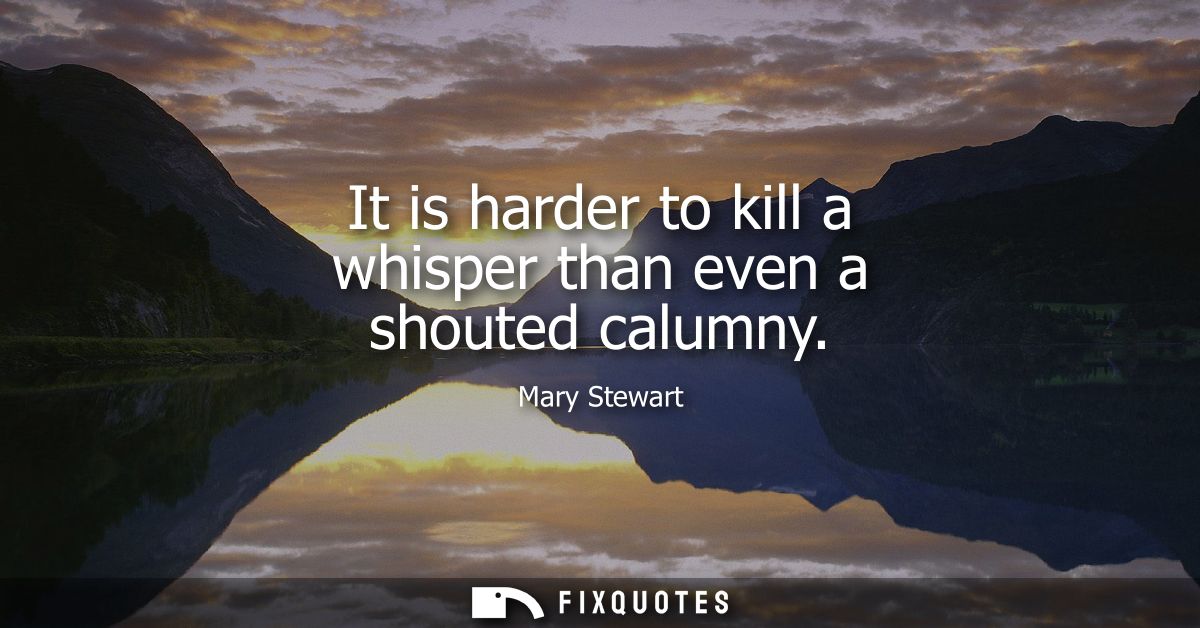
"It is harder to kill a whisper than even a shouted calumny"
About this Quote
A whisper is the perfect weapon because it recruits the listener as a co-author. Mary Stewart’s line understands the social physics of rumor: a shouted calumny can be confronted, quoted, sued, disproven, publicly shamed. It has edges. A whisper dissolves those edges on contact. It arrives already half-denied - “I’m not saying it’s true, but...” - and that plausibility shield makes it maddeningly durable.
The craft here is in the comparison. “Even a shouted calumny” sounds like the worst-case scenario, a brazen lie flung into the open. Stewart flips it. The quieter thing is harder to kill because it slips past the defenses we reserve for official statements. A whisper doesn’t argue; it insinuates. It doesn’t demand belief; it invites suspicion, which is stickier than conviction and harder to dislodge with facts. Killing it requires proving a negative while also dismantling the social thrill of being “in the know.”
Stewart, a novelist steeped in suspense and human motive, is also signaling something about narrative itself. Whispers are plot engines: they create atmosphere, imply hidden rooms, turn ordinary characters into potential culprits. In real life, they do the same, turning communities into echo chambers of half-evidence and status games. The subtext is bleakly practical: reputation isn’t destroyed by arguments you lose; it’s eroded by stories that can’t be pinned down, because no one is responsible for them.
The craft here is in the comparison. “Even a shouted calumny” sounds like the worst-case scenario, a brazen lie flung into the open. Stewart flips it. The quieter thing is harder to kill because it slips past the defenses we reserve for official statements. A whisper doesn’t argue; it insinuates. It doesn’t demand belief; it invites suspicion, which is stickier than conviction and harder to dislodge with facts. Killing it requires proving a negative while also dismantling the social thrill of being “in the know.”
Stewart, a novelist steeped in suspense and human motive, is also signaling something about narrative itself. Whispers are plot engines: they create atmosphere, imply hidden rooms, turn ordinary characters into potential culprits. In real life, they do the same, turning communities into echo chambers of half-evidence and status games. The subtext is bleakly practical: reputation isn’t destroyed by arguments you lose; it’s eroded by stories that can’t be pinned down, because no one is responsible for them.
Quote Details
| Topic | Truth |
|---|---|
| Source | Help us find the source |
| Cite |
Citation Formats
APA Style (7th ed.)
Stewart, Mary. (2026, January 15). It is harder to kill a whisper than even a shouted calumny. FixQuotes. https://fixquotes.com/quotes/it-is-harder-to-kill-a-whisper-than-even-a-170349/
Chicago Style
Stewart, Mary. "It is harder to kill a whisper than even a shouted calumny." FixQuotes. January 15, 2026. https://fixquotes.com/quotes/it-is-harder-to-kill-a-whisper-than-even-a-170349/.
MLA Style (9th ed.)
"It is harder to kill a whisper than even a shouted calumny." FixQuotes, 15 Jan. 2026, https://fixquotes.com/quotes/it-is-harder-to-kill-a-whisper-than-even-a-170349/. Accessed 20 Mar. 2026.
More Quotes by Mary
Add to List