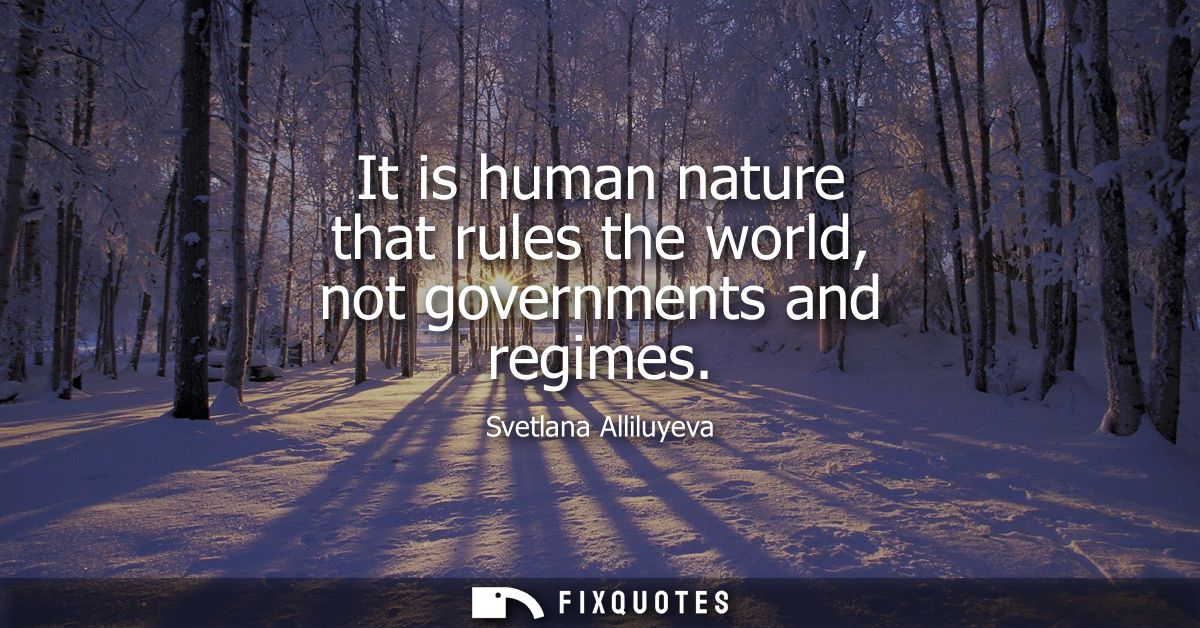
"It is human nature that rules the world, not governments and regimes"
About this Quote
The line lands like a quiet act of defiance from someone who knew, intimately, how loudly regimes insist they are history’s main character. Svetlana Alliluyeva was Stalin’s daughter, raised inside the theater of total power, then famous for walking out of it. So when she says human nature rules the world, she isn’t offering a soft, self-help truism. She’s puncturing the mythology that governments are engines of destiny rather than elaborate costumes worn by ordinary, recognizably flawed people.
The intent is twofold: demystify the state and indict it. “Governments and regimes” sound monolithic, but her phrasing reduces them to temporary arrangements, prone to the same appetites that drive private life: fear, vanity, loyalty, resentment, love, survival. The subtext is almost biographical: even totalitarianism, with its uniforms and slogans, is powered by very human impulses - including a leader’s paranoia and a populace’s desire for safety or belonging. That’s a bleak comfort. It suggests tyrannies aren’t alien invasions; they’re homegrown.
Context sharpens the edge. Alliluyeva’s celebrity wasn’t built on art or sport but on proximity to the 20th century’s most notorious political machine. Her life was proof that “regimes” can demand your identity, your speech, even your grief. By shifting agency back to “human nature,” she’s also reclaiming it: if people make the machinery, people can unmake it. The quote works because it refuses both cynicism and reverence, insisting the real battlefield is psychological, not just institutional.
The intent is twofold: demystify the state and indict it. “Governments and regimes” sound monolithic, but her phrasing reduces them to temporary arrangements, prone to the same appetites that drive private life: fear, vanity, loyalty, resentment, love, survival. The subtext is almost biographical: even totalitarianism, with its uniforms and slogans, is powered by very human impulses - including a leader’s paranoia and a populace’s desire for safety or belonging. That’s a bleak comfort. It suggests tyrannies aren’t alien invasions; they’re homegrown.
Context sharpens the edge. Alliluyeva’s celebrity wasn’t built on art or sport but on proximity to the 20th century’s most notorious political machine. Her life was proof that “regimes” can demand your identity, your speech, even your grief. By shifting agency back to “human nature,” she’s also reclaiming it: if people make the machinery, people can unmake it. The quote works because it refuses both cynicism and reverence, insisting the real battlefield is psychological, not just institutional.
Quote Details
| Topic | Truth |
|---|---|
| Source | Help us find the source |
| Cite |
Citation Formats
APA Style (7th ed.)
Alliluyeva, Svetlana. (2026, January 17). It is human nature that rules the world, not governments and regimes. FixQuotes. https://fixquotes.com/quotes/it-is-human-nature-that-rules-the-world-not-72038/
Chicago Style
Alliluyeva, Svetlana. "It is human nature that rules the world, not governments and regimes." FixQuotes. January 17, 2026. https://fixquotes.com/quotes/it-is-human-nature-that-rules-the-world-not-72038/.
MLA Style (9th ed.)
"It is human nature that rules the world, not governments and regimes." FixQuotes, 17 Jan. 2026, https://fixquotes.com/quotes/it-is-human-nature-that-rules-the-world-not-72038/. Accessed 2 Apr. 2026.
More Quotes by Svetlana
Add to List