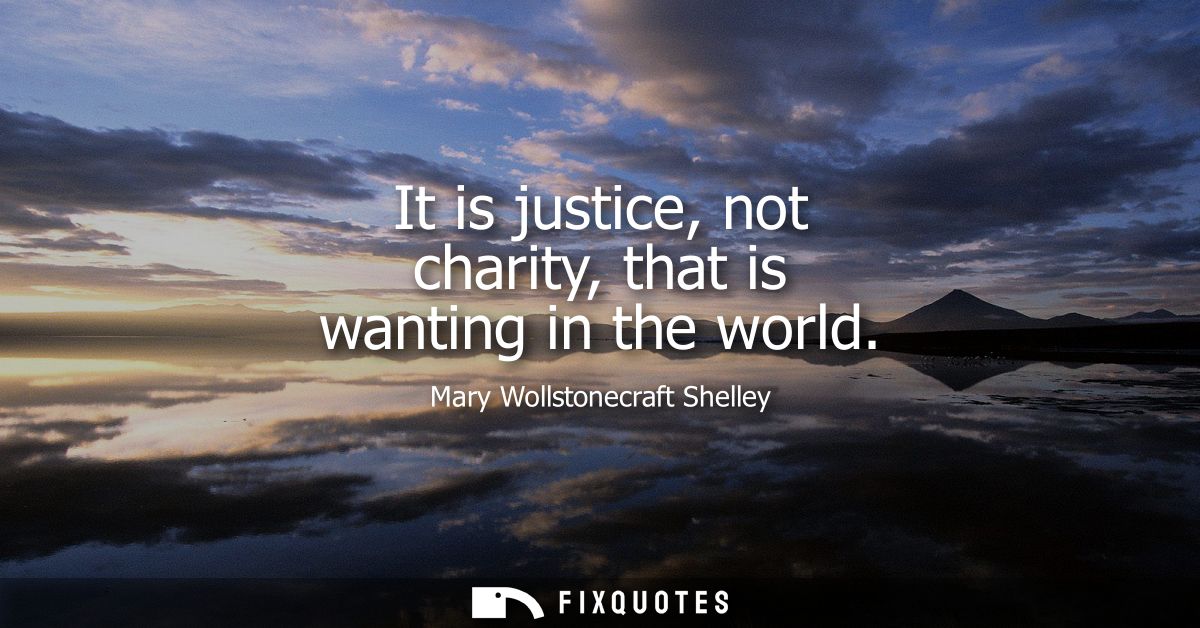
"It is justice, not charity, that is wanting in the world"
About this Quote
A world that begs for charity is a world quietly admitting it has failed at justice. Mary Shelley’s line refuses the comforting moral glow of generosity and points at the colder machinery that makes generosity necessary in the first place. “Charity” flatters the giver; it’s discretionary, uneven, and often staged as virtue. “Justice” is structural: it’s what you owe, not what you feel like offering. The bite of the sentence is its moral accounting. Wanting isn’t a shortage of kindness; it’s a deficit in the system.
Shelley writes in the long wake of Enlightenment promises and revolutionary aftershocks, when “rights” had become a vocabulary people could speak but not a reality most could live. As the daughter of Mary Wollstonecraft, she inherits a suspicion of sentimental solutions to political inequality. That lineage matters: her mother argued that appeals to emotion often mask the refusal to grant full personhood. Shelley’s phrasing keeps the focus on obligation and power, not pity.
The subtext is a critique of how societies manage suffering: charity becomes a pressure valve that lets institutions avoid reform while still appearing humane. It keeps hierarchies intact because it frames need as misfortune rather than as the predictable outcome of laws, labor arrangements, gendered dependence, and property. Shelley isn’t asking for nicer people. She’s insisting that decency without redistribution, rights, and accountability is just good PR with a halo.
Shelley writes in the long wake of Enlightenment promises and revolutionary aftershocks, when “rights” had become a vocabulary people could speak but not a reality most could live. As the daughter of Mary Wollstonecraft, she inherits a suspicion of sentimental solutions to political inequality. That lineage matters: her mother argued that appeals to emotion often mask the refusal to grant full personhood. Shelley’s phrasing keeps the focus on obligation and power, not pity.
The subtext is a critique of how societies manage suffering: charity becomes a pressure valve that lets institutions avoid reform while still appearing humane. It keeps hierarchies intact because it frames need as misfortune rather than as the predictable outcome of laws, labor arrangements, gendered dependence, and property. Shelley isn’t asking for nicer people. She’s insisting that decency without redistribution, rights, and accountability is just good PR with a halo.
Quote Details
| Topic | Justice |
|---|---|
| Source | Later attribution: Women and Justice (Sheryl J. Grana, 2009) modern compilationISBN: 9780742570023 · ID: wxJbQsEbNKgC
Evidence: ... It is justice , not charity , that is wanting in the world . ” —Mary Wollstonecraft Shelley Number and Location of Women's Prisons In most states , there is one women's prison . One . Even with the enormous in- crease in the building of ... Other candidates (1) A Vindication of the Rights of Woman (Mary Wollstonecraft Shelley, 1792)50.0% Asylums and Magdalens are not the proper remedies for these abuses. It is justice, not charity, that is wanting in th... |
| Cite |
Citation Formats
APA Style (7th ed.)
Shelley, Mary Wollstonecraft. (2026, February 23). It is justice, not charity, that is wanting in the world. FixQuotes. https://fixquotes.com/quotes/it-is-justice-not-charity-that-is-wanting-in-the-97134/
Chicago Style
Shelley, Mary Wollstonecraft. "It is justice, not charity, that is wanting in the world." FixQuotes. February 23, 2026. https://fixquotes.com/quotes/it-is-justice-not-charity-that-is-wanting-in-the-97134/.
MLA Style (9th ed.)
"It is justice, not charity, that is wanting in the world." FixQuotes, 23 Feb. 2026, https://fixquotes.com/quotes/it-is-justice-not-charity-that-is-wanting-in-the-97134/. Accessed 4 Apr. 2026.
More Quotes by Mary
Add to List