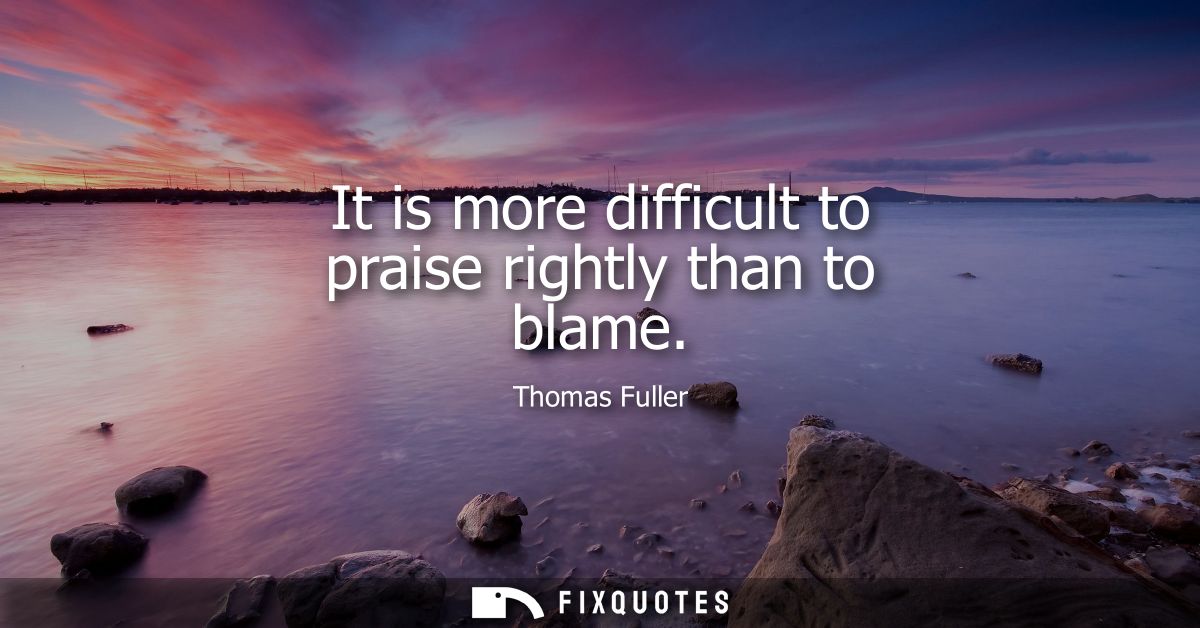
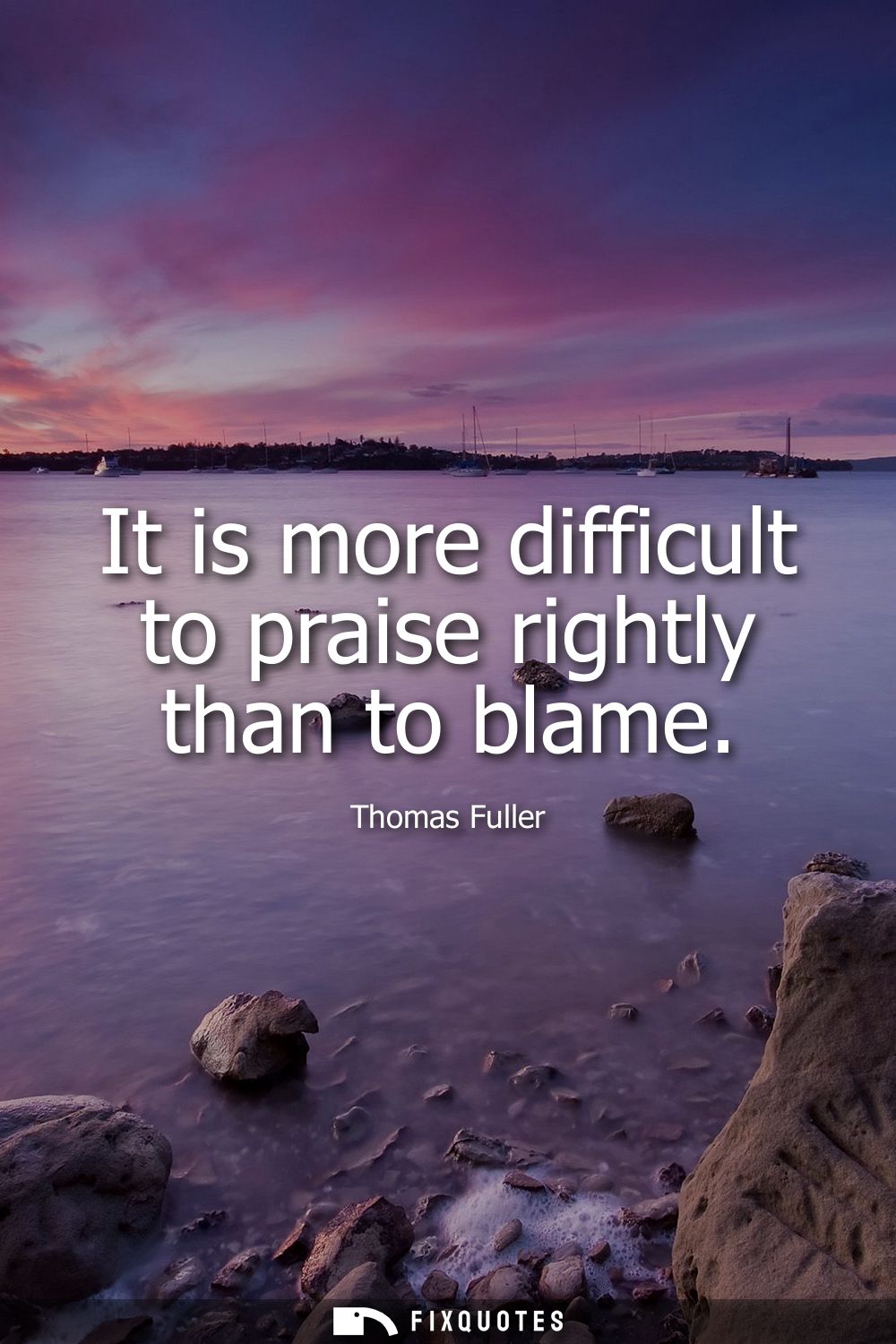
"It is more difficult to praise rightly than to blame"
About this Quote
Blame is cheap theater; praise is craftsmanship. Thomas Fuller, a seventeenth-century English cleric writing in an age of sermons, sectarian friction, and civil war, isn’t offering a Hallmark sentiment. He’s making a moral-technical point about speech under pressure: condemnation comes preloaded with certainty, while commendation demands discrimination.
To blame, you can generalize. You can accuse broadly, ride the current of group outrage, and still sound righteous. Blame flatters the speaker as judge; it costs little to the ego because it positions you above the mess. “Praise rightly,” by contrast, forces you to look closely. What exactly was good? How much credit belongs to luck, privilege, or circumstance? Is the admired act actually virtuous, or merely successful? Right praise is specific, proportionate, and timely; it refuses both flattery and grudging understatement. That takes attention, humility, and a willingness to be pinned down.
Fuller’s clerical context matters. In Christian moral life, praise isn’t just politeness; it’s a form of guidance, an attempt to name the good so it can be repeated. Praise done badly becomes vanity fuel or manipulation, a counterfeit currency that corrodes community. In a culture where public reputation could be as lethal as a verdict, “right praise” is also a restraint: don’t canonize people for what you wish were true.
The subtext is sternly practical: blame is easy because it’s imprecise and self-serving. Praise is hard because it makes you accountable to reality.
To blame, you can generalize. You can accuse broadly, ride the current of group outrage, and still sound righteous. Blame flatters the speaker as judge; it costs little to the ego because it positions you above the mess. “Praise rightly,” by contrast, forces you to look closely. What exactly was good? How much credit belongs to luck, privilege, or circumstance? Is the admired act actually virtuous, or merely successful? Right praise is specific, proportionate, and timely; it refuses both flattery and grudging understatement. That takes attention, humility, and a willingness to be pinned down.
Fuller’s clerical context matters. In Christian moral life, praise isn’t just politeness; it’s a form of guidance, an attempt to name the good so it can be repeated. Praise done badly becomes vanity fuel or manipulation, a counterfeit currency that corrodes community. In a culture where public reputation could be as lethal as a verdict, “right praise” is also a restraint: don’t canonize people for what you wish were true.
The subtext is sternly practical: blame is easy because it’s imprecise and self-serving. Praise is hard because it makes you accountable to reality.
Quote Details
| Topic | Wisdom |
|---|---|
| Source | Help us find the source |
| Cite |
Citation Formats
APA Style (7th ed.)
Fuller, Thomas. (2026, January 15). It is more difficult to praise rightly than to blame. FixQuotes. https://fixquotes.com/quotes/it-is-more-difficult-to-praise-rightly-than-to-10326/
Chicago Style
Fuller, Thomas. "It is more difficult to praise rightly than to blame." FixQuotes. January 15, 2026. https://fixquotes.com/quotes/it-is-more-difficult-to-praise-rightly-than-to-10326/.
MLA Style (9th ed.)
"It is more difficult to praise rightly than to blame." FixQuotes, 15 Jan. 2026, https://fixquotes.com/quotes/it-is-more-difficult-to-praise-rightly-than-to-10326/. Accessed 31 Mar. 2026.
More Quotes by Thomas
Add to List