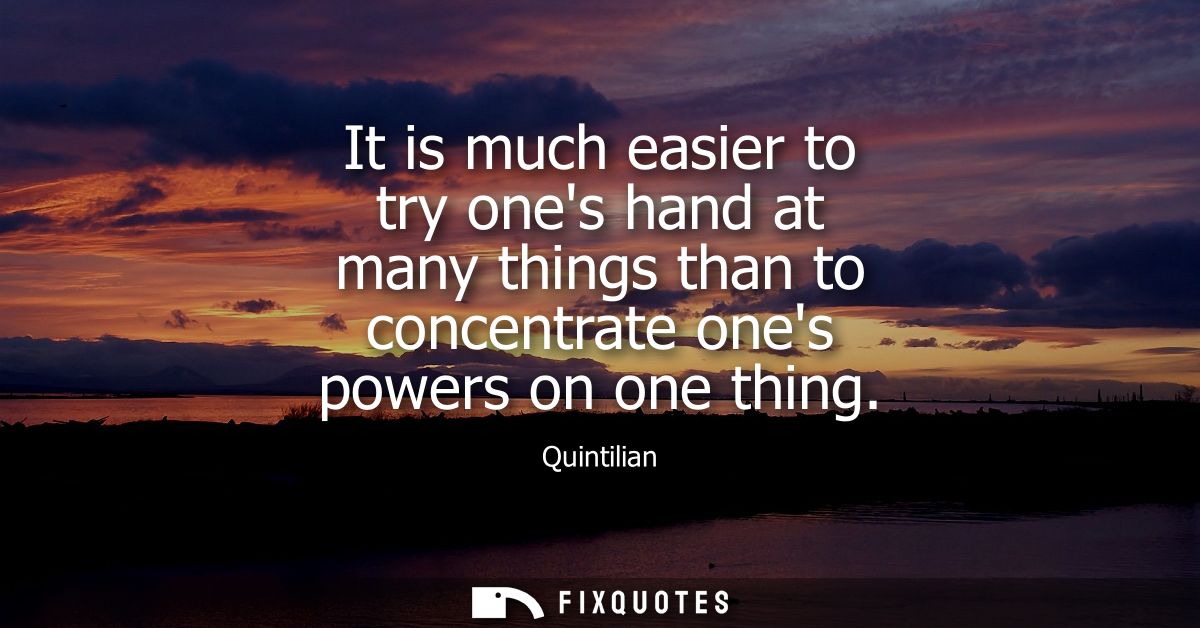
"It is much easier to try one's hand at many things than to concentrate one's powers on one thing"
About this Quote
The line works because it reverses a common assumption about difficulty. We tend to treat multitasking as proof of energy and focus as narrowing, even timid. Quintilian flips it: spreading yourself thin is the easier path precisely because it never demands full accountability. Trying “one’s hand” suggests a casual, almost recreational touch - the hand dips in, then withdraws. “Concentrate one’s powers” is a different body entirely: not a hand, but the whole self gathered into purpose.
Context matters. Quintilian wasn’t a motivational poster; he was Rome’s premier educator, hired to produce capable citizens and persuasive advocates. In the Institutio Oratoria, he argues that eloquence is not a party trick but a disciplined moral and intellectual formation. The subtext is pedagogical and political: Rome needs people who can think clearly and speak responsibly, not performers chasing novelty.
Read now, it lands as an anti-distraction manifesto without the tech panic. Quintilian isn’t condemning curiosity; he’s naming the comfort of perpetual beginnings - and insisting that mastery is the braver, harder choice.
Quote Details
| Topic | Wisdom |
|---|---|
| Source | Help us find the source |
| Cite |
Citation Formats
APA Style (7th ed.)
Quintilian. (2026, January 16). It is much easier to try one's hand at many things than to concentrate one's powers on one thing. FixQuotes. https://fixquotes.com/quotes/it-is-much-easier-to-try-ones-hand-at-many-things-128660/
Chicago Style
Quintilian. "It is much easier to try one's hand at many things than to concentrate one's powers on one thing." FixQuotes. January 16, 2026. https://fixquotes.com/quotes/it-is-much-easier-to-try-ones-hand-at-many-things-128660/.
MLA Style (9th ed.)
"It is much easier to try one's hand at many things than to concentrate one's powers on one thing." FixQuotes, 16 Jan. 2026, https://fixquotes.com/quotes/it-is-much-easier-to-try-ones-hand-at-many-things-128660/. Accessed 1 Apr. 2026.