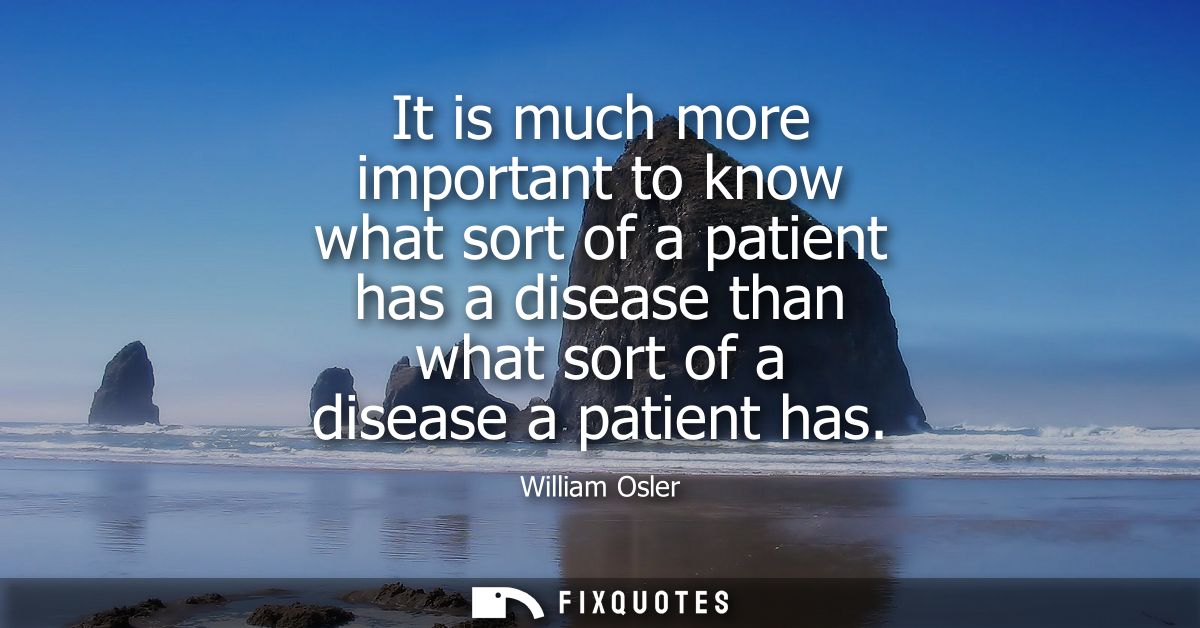
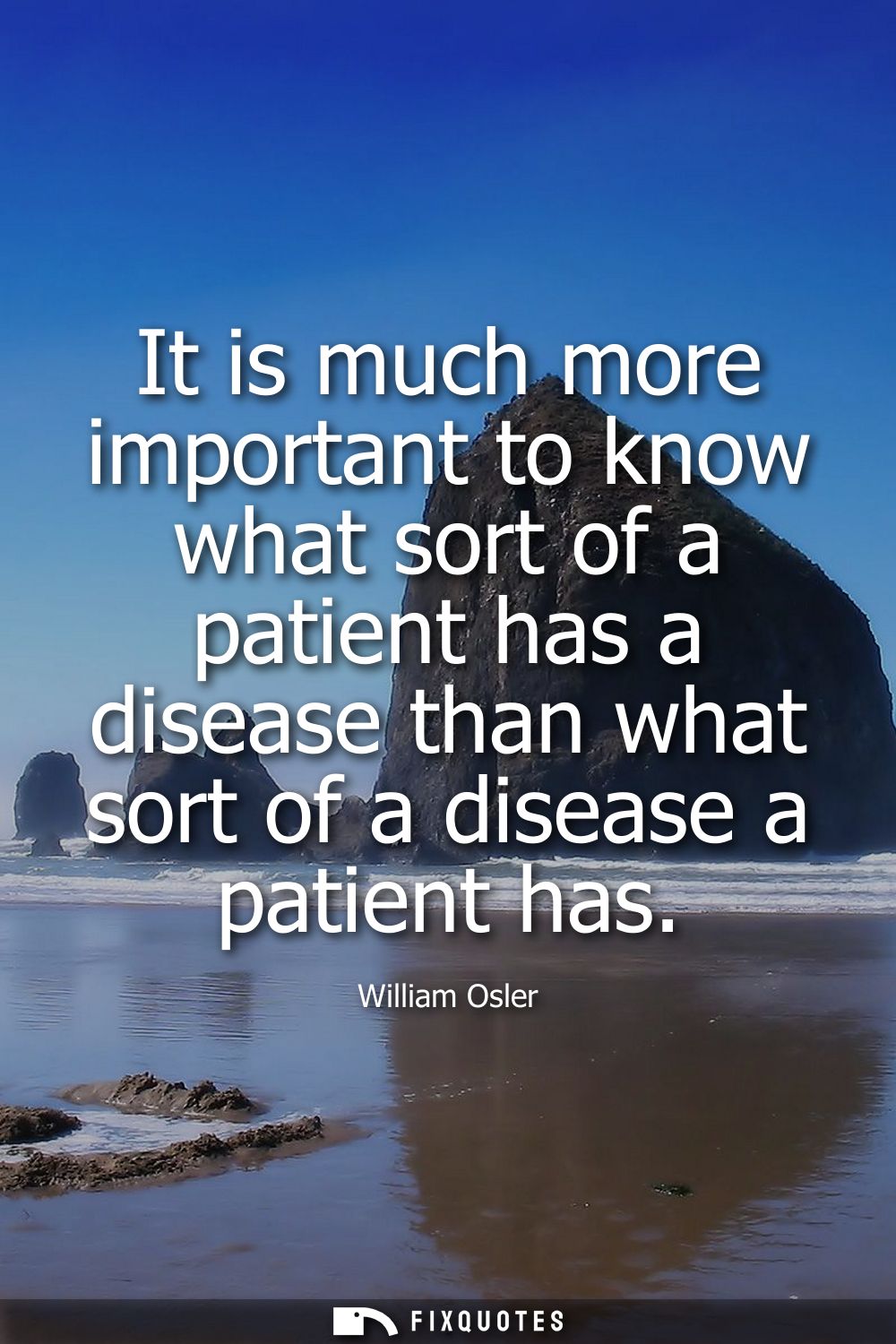
"It is much more important to know what sort of a patient has a disease than what sort of a disease a patient has"
About this Quote
The rhetoric works because it flips the expected hierarchy. Disease sounds like the “real” thing; patient sounds like context. Osler reverses that, implying that context is causal. Two people can carry the same diagnosis and live entirely different prognoses because adherence, stigma, mental health, work conditions, and trust in the clinician are part of the clinical picture, not afterthoughts. The quote quietly sketches an ethic: treatment is interpretation, and interpretation requires seeing the patient as more than a vessel for symptoms.
Historically, this is also Osler staking out a middle path at a moment when laboratory medicine and specialization were accelerating. He’s defending bedside observation and the doctor-patient relationship against a future where the chart, the test, and the label threaten to replace the encounter. Read now, it feels eerily contemporary: an early argument against algorithmic medicine that forgets the human inputs it can’t easily quantify.
Quote Details
| Topic | Engineer |
|---|---|
| Source | Help us find the source |
| Cite |
Citation Formats
APA Style (7th ed.)
Osler, William. (2026, January 16). It is much more important to know what sort of a patient has a disease than what sort of a disease a patient has. FixQuotes. https://fixquotes.com/quotes/it-is-much-more-important-to-know-what-sort-of-a-97902/
Chicago Style
Osler, William. "It is much more important to know what sort of a patient has a disease than what sort of a disease a patient has." FixQuotes. January 16, 2026. https://fixquotes.com/quotes/it-is-much-more-important-to-know-what-sort-of-a-97902/.
MLA Style (9th ed.)
"It is much more important to know what sort of a patient has a disease than what sort of a disease a patient has." FixQuotes, 16 Jan. 2026, https://fixquotes.com/quotes/it-is-much-more-important-to-know-what-sort-of-a-97902/. Accessed 13 Feb. 2026.