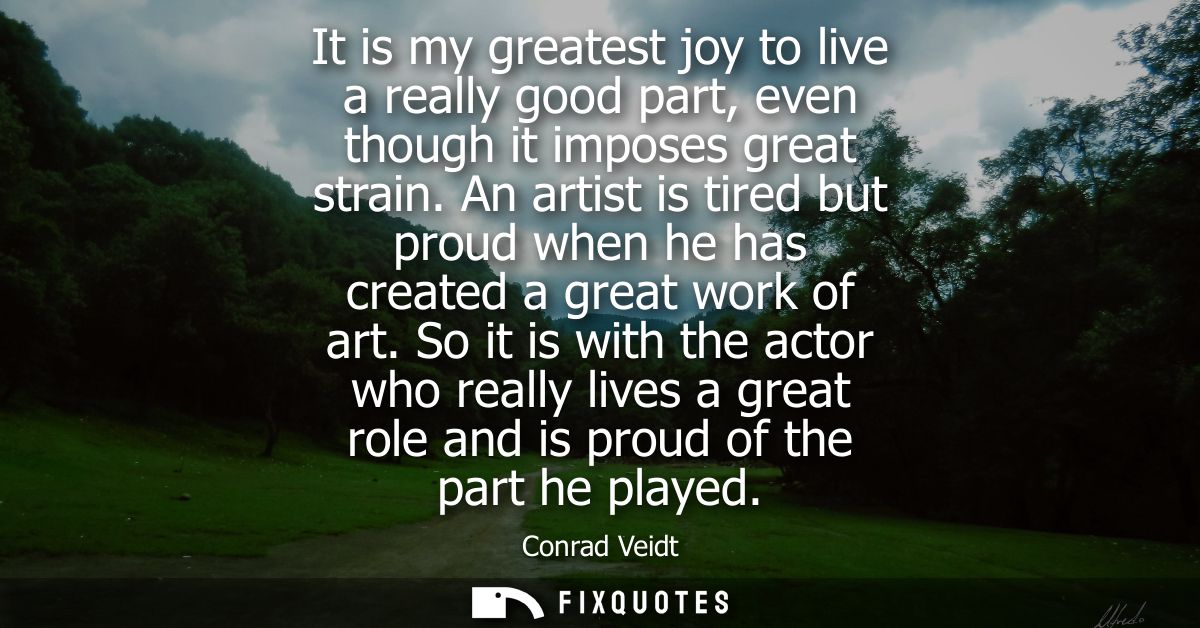
"It is my greatest joy to live a really good part, even though it imposes great strain. An artist is tired but proud when he has created a great work of art. So it is with the actor who really lives a great role and is proud of the part he played"
About this Quote
The subtext is a quiet rebuttal to the perennial suspicion that actors are merely charming liars. Veidt insists on stakes. By saying the actor “really lives” the role, he stakes a claim for seriousness: acting is not mimicry but an embodied creation with consequences to the self. It’s also a defensive line against the industrial side of cinema, where speed, marketability, and typecasting can flatten a performer into a commodity. His emphasis on “part he played” keeps the humility of the job, but “great role” elevates it to vocation.
Context sharpens the edge. Veidt, a major star of German silent film who later left Nazi Germany and worked in Britain and Hollywood, knew what it meant to be read through a mask: villain roles, foreignness, political suspicion. In that light, pride isn’t vanity; it’s survival. The quote becomes a manifesto for actors as workers of feeling, paid in fatigue, compensated in the rare moment when a role feels not consumed but completed.
Quote Details
| Topic | Art |
|---|---|
| Source | Help us find the source |
| Cite |
Citation Formats
APA Style (7th ed.)
Veidt, Conrad. (2026, January 17). It is my greatest joy to live a really good part, even though it imposes great strain. An artist is tired but proud when he has created a great work of art. So it is with the actor who really lives a great role and is proud of the part he played. FixQuotes. https://fixquotes.com/quotes/it-is-my-greatest-joy-to-live-a-really-good-part-39626/
Chicago Style
Veidt, Conrad. "It is my greatest joy to live a really good part, even though it imposes great strain. An artist is tired but proud when he has created a great work of art. So it is with the actor who really lives a great role and is proud of the part he played." FixQuotes. January 17, 2026. https://fixquotes.com/quotes/it-is-my-greatest-joy-to-live-a-really-good-part-39626/.
MLA Style (9th ed.)
"It is my greatest joy to live a really good part, even though it imposes great strain. An artist is tired but proud when he has created a great work of art. So it is with the actor who really lives a great role and is proud of the part he played." FixQuotes, 17 Jan. 2026, https://fixquotes.com/quotes/it-is-my-greatest-joy-to-live-a-really-good-part-39626/. Accessed 13 Feb. 2026.