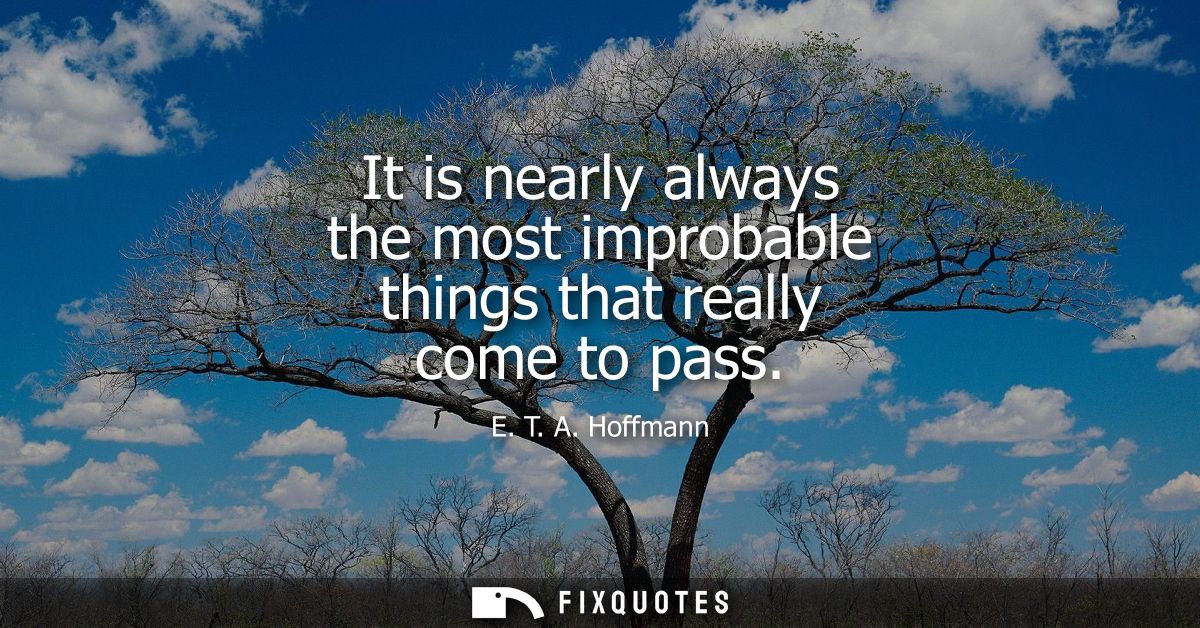
"It is nearly always the most improbable things that really come to pass"
About this Quote
As a Romantic-era writer and critic steeped in the uncanny, Hoffmann knew how “improbable” works as both aesthetic and diagnosis. In his fiction, the unbelievable is rarely mere spectacle; it’s the moment when rational explanations fail and the self’s hidden machinery takes over - obsession, desire, paranoia, the unconscious. So the quote isn’t just about freak accidents or long odds. It’s about how the improbable becomes inevitable when you account for what polite logic edits out.
There’s also a sly jab at the Enlightenment confidence that the world can be fully mapped. Hoffmann lived through revolutions, Napoleonic upheaval, and the churn of early modern bureaucracy - an era when history itself felt like a series of implausible turns delivered at scale. The line doubles as a critique of “reasonable” forecasts: the more confident the system, the more spectacular the blind spot.
What makes it work is its tonal balancing act. It sounds like common sense while smuggling in a worldview: expect the strange, because the strange is often the truest register of how people and societies actually behave.
Quote Details
| Topic | Free Will & Fate |
|---|---|
| Source | Help us find the source |
| Cite |
Citation Formats
APA Style (7th ed.)
Hoffmann, E. T. A. (2026, January 16). It is nearly always the most improbable things that really come to pass. FixQuotes. https://fixquotes.com/quotes/it-is-nearly-always-the-most-improbable-things-111570/
Chicago Style
Hoffmann, E. T. A. "It is nearly always the most improbable things that really come to pass." FixQuotes. January 16, 2026. https://fixquotes.com/quotes/it-is-nearly-always-the-most-improbable-things-111570/.
MLA Style (9th ed.)
"It is nearly always the most improbable things that really come to pass." FixQuotes, 16 Jan. 2026, https://fixquotes.com/quotes/it-is-nearly-always-the-most-improbable-things-111570/. Accessed 12 Feb. 2026.