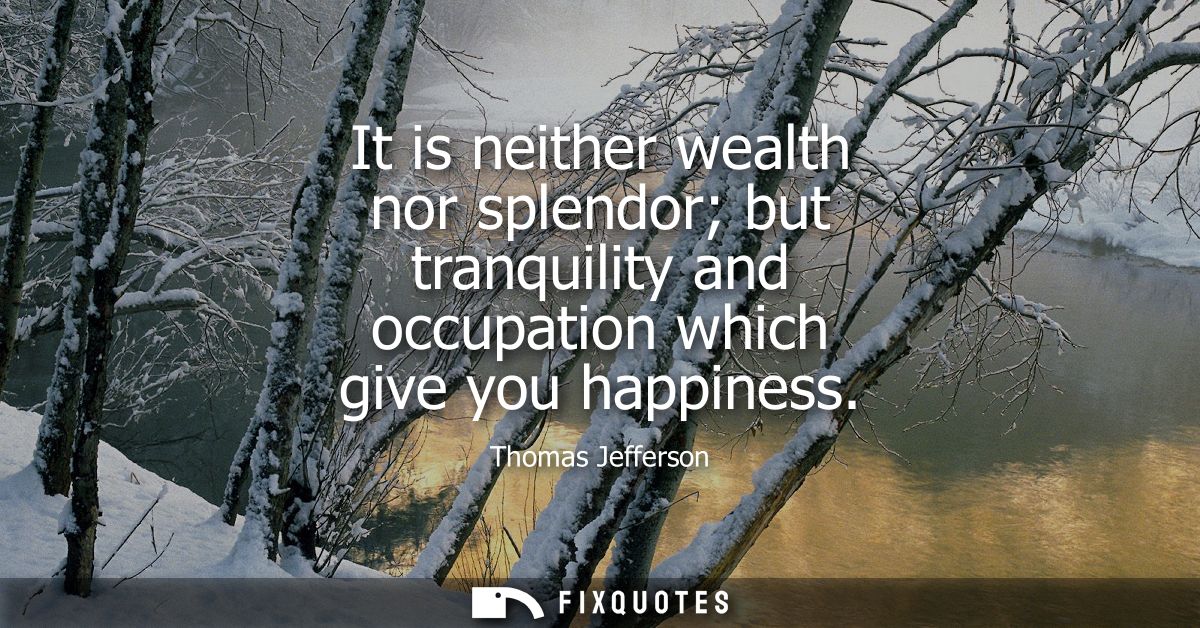
"It is neither wealth nor splendor; but tranquility and occupation which give you happiness"
About this Quote
The subtext is political as much as personal. A republic, in Jefferson’s view, survives when citizens are calm enough to deliberate and busy enough to resist corruption or despair. Tranquility isn’t mere serenity; it’s social stability, the absence of chaos that makes self-government possible. Occupation isn’t just a job; it’s the virtue of productive engagement, the kind that ties people to community and purpose rather than spectacle.
There’s also a revealing tension: Jefferson’s ideal happiness is accessible in theory but complicated in practice. He romanticized the independent, working citizen even as his own comfort relied on enslaved labor. That dissonance doesn’t negate the line; it sharpens it. The quote functions as aspiration and alibi at once, offering a democratic ethic of contentment while quietly smoothing over how unevenly “tranquility” was distributed in his America.
Quote Details
| Topic | Happiness |
|---|---|
| Source | Help us find the source |
| Cite |
Citation Formats
APA Style (7th ed.)
Jefferson, Thomas. (2026, January 18). It is neither wealth nor splendor; but tranquility and occupation which give you happiness. FixQuotes. https://fixquotes.com/quotes/it-is-neither-wealth-nor-splendor-but-tranquility-22034/
Chicago Style
Jefferson, Thomas. "It is neither wealth nor splendor; but tranquility and occupation which give you happiness." FixQuotes. January 18, 2026. https://fixquotes.com/quotes/it-is-neither-wealth-nor-splendor-but-tranquility-22034/.
MLA Style (9th ed.)
"It is neither wealth nor splendor; but tranquility and occupation which give you happiness." FixQuotes, 18 Jan. 2026, https://fixquotes.com/quotes/it-is-neither-wealth-nor-splendor-but-tranquility-22034/. Accessed 5 Mar. 2026.