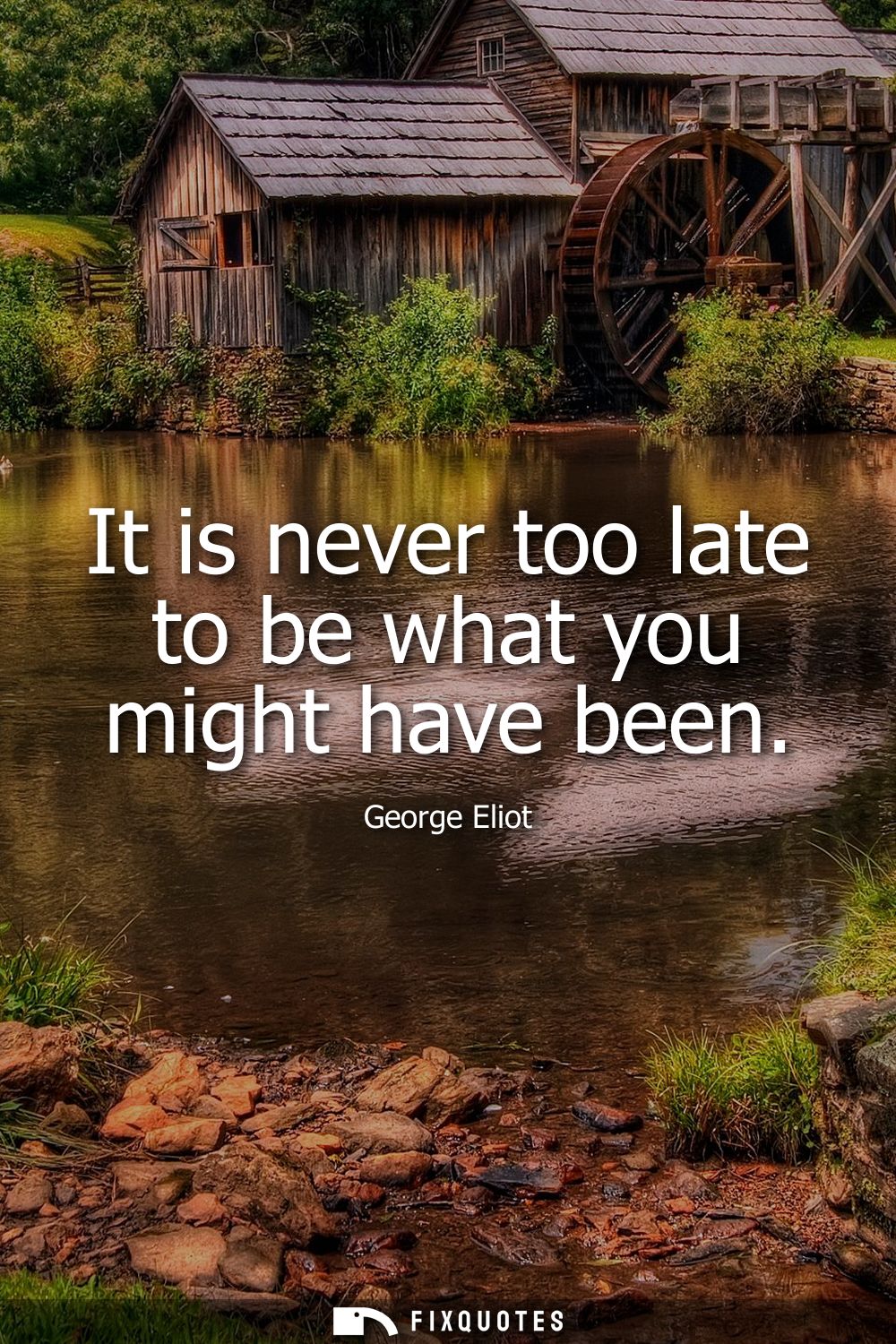
"It is never too late to be what you might have been"
About this Quote
A line like this lands because it refuses the cheap drama of regret. Eliot doesn’t romanticize missed chances; she quietly demolishes the idea that a life is only valid if it follows the early, linear script. “Never too late” is a rebuke to the Victorian obsession with fixed roles - especially for women - where “might have been” often meant “was not allowed to be.”
The phrase is also doing something sneakier than motivational posters admit. “Might have been” isn’t “should have been.” Eliot leaves room for ambiguity: our unrealized selves are part fantasy, part social suppression, part genuine vocation. That softness matters. It acknowledges that selfhood isn’t a single buried treasure you dig up, but a set of possibilities you negotiate with time, responsibility, and courage.
Context sharpens the intent. George Eliot was Mary Ann Evans, writing under a male pen name to be taken seriously, living in a socially scandalous partnership, building a public intellectual life she wasn’t “supposed” to have. Her authority comes from lived contradiction: she knew reinvention isn’t a weekend hobby; it’s a wager against ridicule, loneliness, and the internalized voice that says your moment has passed.
The sentence works because it’s both consoling and accusatory. It comforts the reader with permission, then pressures them with a quiet dare: if it’s not too late, what exactly are you waiting for?
The phrase is also doing something sneakier than motivational posters admit. “Might have been” isn’t “should have been.” Eliot leaves room for ambiguity: our unrealized selves are part fantasy, part social suppression, part genuine vocation. That softness matters. It acknowledges that selfhood isn’t a single buried treasure you dig up, but a set of possibilities you negotiate with time, responsibility, and courage.
Context sharpens the intent. George Eliot was Mary Ann Evans, writing under a male pen name to be taken seriously, living in a socially scandalous partnership, building a public intellectual life she wasn’t “supposed” to have. Her authority comes from lived contradiction: she knew reinvention isn’t a weekend hobby; it’s a wager against ridicule, loneliness, and the internalized voice that says your moment has passed.
The sentence works because it’s both consoling and accusatory. It comforts the reader with permission, then pressures them with a quiet dare: if it’s not too late, what exactly are you waiting for?
Quote Details
| Topic | Reinvention |
|---|---|
| Source | Later attribution: George Eliot (George Eliot) modern compilation
Evidence:
rations from a womans glance it is never too late to be what you might have been |
| Cite |
Citation Formats
APA Style (7th ed.)
Eliot, George. (2026, February 15). It is never too late to be what you might have been. FixQuotes. https://fixquotes.com/quotes/it-is-never-too-late-to-be-what-you-might-have-35730/
Chicago Style
Eliot, George. "It is never too late to be what you might have been." FixQuotes. February 15, 2026. https://fixquotes.com/quotes/it-is-never-too-late-to-be-what-you-might-have-35730/.
MLA Style (9th ed.)
"It is never too late to be what you might have been." FixQuotes, 15 Feb. 2026, https://fixquotes.com/quotes/it-is-never-too-late-to-be-what-you-might-have-35730/. Accessed 17 Mar. 2026.
More Quotes by George
Add to List