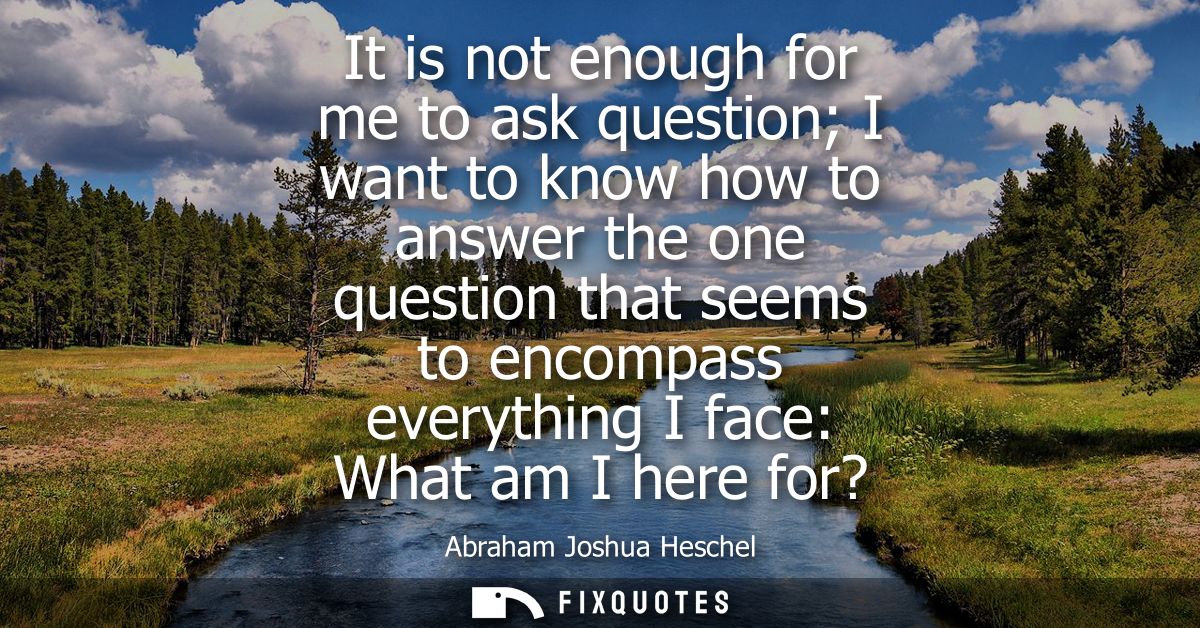
"It is not enough for me to ask question; I want to know how to answer the one question that seems to encompass everything I face: What am I here for?"
About this Quote
Restlessness is the engine of this line: not curiosity for its own sake, but a hunger for moral orientation. Heschel draws a sharp line between asking and answering, treating question-making as insufficiently demanding. Plenty of modern life rewards the performance of inquiry - the clever take, the endless skepticism, the podcast episode that ends where it began. Heschel wants something riskier: a response that reorganizes how you live.
The phrasing deliberately tightens the aperture. He moves from "questions" in the plural to "the one question", a rhetorical funnel that strips away distraction. "Encompass everything I face" is not poetic excess; it is an argument about what counts as real knowledge. For Heschel, the point of learning isn't accumulation but accountability. If your education never collides with purpose, it becomes a sophisticated form of avoidance.
Context matters: Heschel was a Jewish theologian shaped by the trauma of 20th-century Europe, the murder of his family in the Holocaust, and later by the ethical urgencies of America, where he marched with Martin Luther King Jr. and critiqued a society anesthetized by comfort. His work insists that awe and responsibility are linked; the spiritual life is not private mood but public demand.
The subtext is a rebuke to passive existence. "What am I here for?" isn't a lifestyle-brand quest for self-optimization. It's a spiritual and civic interrogation: if your days are finite and history is brutal, purpose can't be a vague feeling. It has to become an answer you can practice.
The phrasing deliberately tightens the aperture. He moves from "questions" in the plural to "the one question", a rhetorical funnel that strips away distraction. "Encompass everything I face" is not poetic excess; it is an argument about what counts as real knowledge. For Heschel, the point of learning isn't accumulation but accountability. If your education never collides with purpose, it becomes a sophisticated form of avoidance.
Context matters: Heschel was a Jewish theologian shaped by the trauma of 20th-century Europe, the murder of his family in the Holocaust, and later by the ethical urgencies of America, where he marched with Martin Luther King Jr. and critiqued a society anesthetized by comfort. His work insists that awe and responsibility are linked; the spiritual life is not private mood but public demand.
The subtext is a rebuke to passive existence. "What am I here for?" isn't a lifestyle-brand quest for self-optimization. It's a spiritual and civic interrogation: if your days are finite and history is brutal, purpose can't be a vague feeling. It has to become an answer you can practice.
Quote Details
| Topic | Meaning of Life |
|---|---|
| Source | Help us find the source |
More Quotes by Abraham
Add to List